The difference between a 3 ton and 3.5 ton diesel forklift looks small on paper. In daily use, that extra 500 kg can be valuable—or completely unnecessary. The right choice depends on your actual loads, attachments, aisle space and how close you regularly work to the rated capacity.

At first glance, choosing between a 3 ton diesel forklift and a 3.5 ton diesel forklift seems almost too easy.
If your loads weigh less than 3,000 kg, buy the 3-ton machine. If they are heavier, buy the 3.5-ton model.
In practice, that is not how forklift selection works.
The rated number assumes a specific load center and configuration. Real loads may be longer than a standard pallet. A sideshifter or fork positioner can move the load farther forward. Some businesses also discover that a truck that is technically large enough becomes uncomfortable to operate because it spends every day close to its maximum capacity.
That is where the CPCD30 and CPCD35 become an interesting comparison.
In the current RUNTX specification, both machines use the same 36.8 kW XINCHAI 4D32G31 engine, the same 500 mm rated load center and the same standard 3,000 mm lifting height. The difference is not simply that one has “more engine.”
The CPCD35 uses a longer and slightly heavier chassis to provide another 500 kg of rated lifting capacity. Whether that additional reserve is worth paying for depends on the work you actually do.
The 500 kg Difference Is Bigger Than It Sounds
Moving from 3,000 kg to 3,500 kg adds 16.7% more rated capacity.
For a warehouse that usually handles 1.5- to 2-ton pallets, that extra capacity may provide very little practical benefit. Both trucks would already have comfortable reserve for the normal workload.
For a building-material supplier, machinery shop or rental company regularly handling loads around 2.8 to 3.2 tons, the situation is different.
A CPCD30 operating close to 3,000 kg leaves little margin for a longer load or an attachment that changes the effective load center. The CPCD35 gives the buyer more room before reaching the upper limit of the machine.
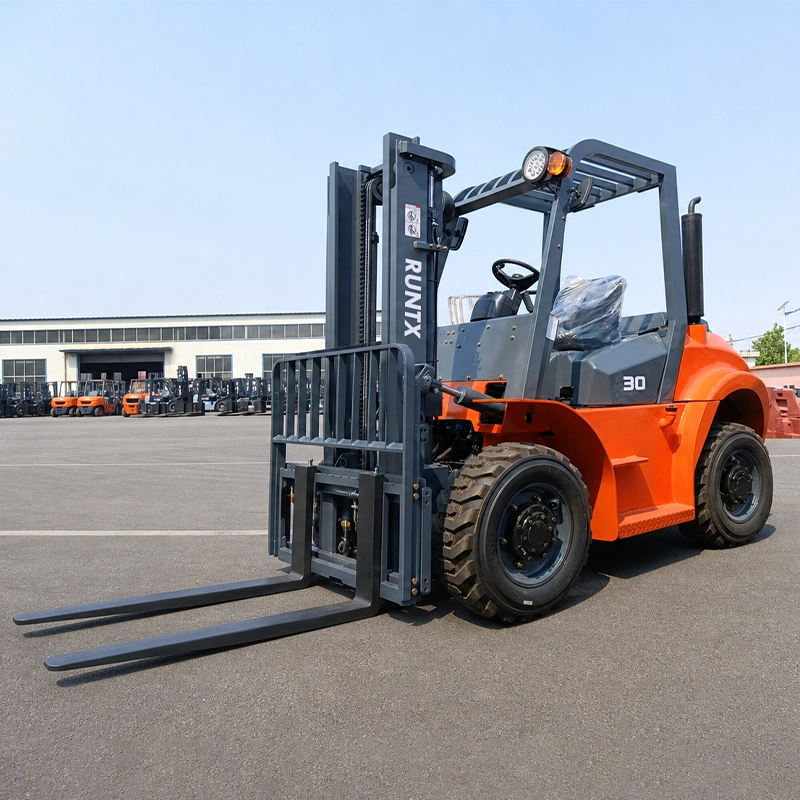
The current RUNTX CPCD30 3 Ton Diesel Forklift is rated at 3,000 kg, while the RUNTX CPCD35 3.5 Ton Diesel Forklift is rated at 3,500 kg. Both are specified at a 500 mm load center.
That last number matters just as much as the capacity figure.
A 3-Ton Load Is Not Always a “3-Ton Forklift Job”
This is one of the easiest mistakes to make when comparing forklifts.
OSHA explains that forklift capacity only applies at the load center shown on the data plate. As the center of gravity moves farther away from the fork face, available lifting capacity decreases.
In one OSHA example, a forklift capable of carrying 4,000 lb at a 24-inch load center can carry only about 2,666 lb at a 36-inch load center. That is roughly a 33% reduction caused by load geometry rather than a change in the forklift itself.
Source: U.S. Occupational Safety and Health Administration (OSHA), Powered Industrial Trucks – Load Composition.
This matters for buyers handling machinery crates, long building materials, steel products or unusual pallets.
If your “2.9-ton load” is long enough to move its center of gravity beyond 500 mm, selecting a CPCD30 simply because 2.9 is less than 3.0 may not be a good decision.
For standard compact pallets, the CPCD30 may be perfectly adequate. For awkward or extended loads, the extra reserve of the CPCD35 starts to make more sense.
CPCD30 vs CPCD35: What Actually Changes?
| Specification | CPCD30 | CPCD35 | What It Means in Practice |
|---|---|---|---|
| Rated Capacity | 3,000 kg | 3,500 kg | CPCD35 offers 16.7% more rated capacity |
| Load Center | 500 mm | 500 mm | Same rated load-center basis |
| Standard Lift Height | 3,000 mm | 3,000 mm | No standard-height advantage either way |
| Turning Radius | 2,400 mm | 2,550 mm | CPCD30 is about 150 mm tighter in turns |
| Length Without Forks | 2,750 mm | 2,995 mm | CPCD35 is 245 mm longer |
| Overall Width | 1,225 mm | 1,225 mm | Same width in the current series |
| Engine | XINCHAI 4D32G31 | XINCHAI 4D32G31 | Same standard engine platform |
| Rated Engine Power | 36.8 kW | 36.8 kW | The 3.5T model does not rely on a larger standard engine |
| Operating Weight | 4,350 kg | 4,560 kg | CPCD35 carries about 210 kg more machine mass |
The comparison shows why this decision is more subtle than it first appears.
The CPCD35 gives you another 500 kg of rated capacity, but it does not become dramatically wider or use a larger standard engine. The trade-off is mainly a longer chassis, a slightly wider turning circle and a little more machine weight.
For an open yard, those differences may be barely noticeable. Inside a tighter loading area, another 150 mm of turning radius and 245 mm of chassis length can matter every single shift.
If Your Loads Are Usually Below 2.5 Tons, the CPCD30 Often Makes More Sense
A bigger forklift is not automatically a better forklift.
If most of your daily work involves 1.5- to 2.5-ton pallets, the CPCD30 already provides useful reserve while remaining the more compact of the two machines.
This is particularly relevant for small warehouses, logistics yards and businesses that frequently move between trucks, narrow staging areas and production spaces.
The CPCD30’s 2,400 mm minimum turning radius is about 6.25% tighter than the CPCD35’s 2,550 mm radius. Its chassis is also about 8.9% shorter without forks.
Those differences are not dramatic on a specification sheet, but maneuverability is experienced hundreds of times during a shift.
If you never use the extra 500 kg, carrying a larger truck through every turn provides no operational advantage.

The CPCD35 Starts Winning When 3 Tons Becomes Normal
The buying logic changes when regular loads move into the upper end of the CPCD30’s range.
If a contractor frequently handles 2.8-ton concrete products, a machinery company moves 3-ton components, or a rental fleet regularly receives customers asking for “around three tons,” capacity reserve becomes more valuable.
Working at the edge of a truck’s rated capacity leaves less flexibility when the load is unusually shaped or when the customer later requests an attachment.
This is where a CPCD35 can be the more comfortable long-term purchase. The truck is not dramatically larger, yet the rated capacity increases by 500 kg.
For distributors, that extra reserve can also broaden the number of applications the machine can cover without immediately moving customers into the 4-ton class.
Attachments Can Change the Answer
A buyer may initially plan to use standard forks and later decide that a sideshifter would make truck loading much easier.
That sounds like a small upgrade, but it changes the forklift’s capacity calculation.
OSHA shows a real nameplate example where a forklift rated at 5,000 lb with standard forks is rated at 4,500 lb with a sideshifter installed. In that specific configuration, available rated capacity drops by 10%.
Source: U.S. Occupational Safety and Health Administration (OSHA), Powered Industrial Trucks – Nameplate and Attachment Guidance.
That does not mean every sideshifter reduces capacity by exactly 10%. OSHA also notes that attachments affect the truck’s center of gravity, visibility and lifting capacity.
For buyers expecting to use fork positioners, clamps, long forks or other attachments, it is better to specify those requirements before choosing between CPCD30 and CPCD35.
A 3-ton machine that is comfortable with standard forks may no longer provide the same reserve once the final attachment package is installed.
Not Sure Whether 3 Ton or 3.5 Ton Is the Better Buy?
Send RUNTX your heaviest regular load, load dimensions, lift height, attachment requirement and working space. We can compare the CPCD30 and CPCD35 around the job you actually need to do rather than simply recommending the larger truck.
Do Not Ignore the Yard Around the Forklift
A 3.5-ton truck may offer more capacity, but the machine still has to turn, brake and travel through the site safely.
The UK Health and Safety Executive reports that vehicle overturns account for nearly one-fifth of workplace transport deaths. It identifies uneven ground, overloading, excessive speed and unsuitable equipment among common contributors.
Source: UK Health and Safety Executive (HSE), Workplace Transport – Overturning.
HSE also states that lift trucks are involved in around one-quarter of all workplace transport accidents.
Source: UK Health and Safety Executive (HSE), Managing Lift Trucks.
For a buyer, the practical lesson is simple: measure the site as carefully as you measure the load.
If your operation is an open construction-material yard, the CPCD35’s slightly larger footprint may be irrelevant. If the machine works between trucks and tight warehouse doors, CPCD30 maneuverability may be worth more than unused capacity.

What About Fuel and Running Cost?
Because the current CPCD30 and CPCD35 share the same standard XINCHAI 4D32G31 engine and the same 36.8 kW rated engine power, it would be misleading to claim that the CPCD35 automatically uses dramatically more fuel.
Actual consumption depends on duty cycle, load, travel distance, terrain, transmission choice, operator behavior and idle time.
The CPCD35 is heavier—4,560 kg compared with 4,350 kg—but the 210 kg difference is only about 4.8% of machine operating weight.
For small businesses, the bigger financial question is usually utilization.
If the CPCD35 allows you to handle heavier jobs that the CPCD30 cannot safely cover, the extra capacity can pay for itself. If both trucks spend every day carrying two-ton pallets, the smaller machine is usually the more disciplined purchase.
Downtime Matters More Than a Small Difference in Purchase Price
For an owner with one forklift, the machine’s reliability matters more than it does to a large warehouse with ten backups.
Historical U.S. Bureau of Labor Statistics data recorded 9,050 forklift-related nonfatal workplace cases involving days away from work in 2017. The median absence was 13 days, compared with eight days across all cases.
Source: U.S. Bureau of Labor Statistics, Occupational Injuries, Illnesses, and Fatalities Involving Forklifts.
That is injury data, not a maintenance statistic, and it should not be used to claim that one model is safer than the other.
What it does show is how expensive disruption around forklift operations can become.
Whichever model you choose, ask about service documentation, filters, common wear parts and after-sales support rather than making the entire decision around a small difference in factory price.
For Dealers, the Better Answer May Be to Stock Both
A distributor has a slightly different problem from an end user.
The CPCD30 is one of the most common general-purpose capacity classes and can cover standard logistics, manufacturing and yard work. The CPCD35 provides a useful upgrade for customers whose loads are approaching three tons or who want more capacity reserve.
Because both models in the current RUNTX range use the same standard engine platform and the same overall width, carrying both capacities can make more sense than jumping immediately from 3 tons to 4 tons.
The RUNTX 3–5 Ton Diesel Forklift Series allows distributors and fleet buyers to compare CPCD30, CPCD35, CPCD40 and CPCD50 within one product family.
RUNTX supports 1 Unit MOQ for suitable direct orders, while dealers and rental companies can request small-batch pricing or mixed-model orders. OEM/ODM options include custom colors, branding, mast configuration, tires and attachments.
Export documentation and shipping coordination can also be included, which is particularly useful for smaller buyers without a dedicated international logistics team.
Frequently Asked Questions
Is a 3.5 ton forklift much bigger than a 3 ton forklift?
Not necessarily. In the current RUNTX specification, CPCD30 and CPCD35 are both 1,225 mm wide. The CPCD35 is 245 mm longer without forks and has a 150 mm larger minimum turning radius.
Should I buy a 3.5 ton forklift if my maximum load is 3 tons?
It may be sensible if the 3-ton load is handled frequently, has a long load center or requires an attachment. For compact loads handled only occasionally, the CPCD30 may still be suitable. The final decision should be based on the actual load geometry and approved capacity.
Do CPCD30 and CPCD35 use different engines?
In the current RUNTX series specification, both use the standard XINCHAI 4D32G31 diesel engine rated at 36.8 kW. Export-market engine and emission options can also be customized.
Which is better for a small warehouse?
If normal loads remain comfortably below 3 tons and maneuvering space is important, CPCD30 often offers the better balance. CPCD35 becomes more attractive when heavier loads are a regular part of the workflow.
Can I order only one forklift from RUNTX?
Yes. RUNTX supports suitable single-unit factory-direct orders as well as small-batch, distributor and OEM/ODM projects.
So Which One Should You Buy?
If most of your loads sit comfortably below 2.5 tons and your work area rewards a tighter turning circle, the CPCD30 is difficult to argue against. You get the same standard engine platform, the same 3-meter standard lift and a more compact chassis.
If loads regularly approach three tons, are unusually long, or require attachments that reduce residual capacity, the CPCD35 is often the more sensible long-term choice.
The key is not buying the biggest forklift you can afford.
It is buying enough capacity that the machine can handle your normal work comfortably without carrying unnecessary size and cost through every shift.
Still Choosing Between CPCD30 and CPCD35?
Send RUNTX your load weight, dimensions, lift height, attachment requirements and destination. We can compare both models and prepare factory-direct pricing based on the same working conditions.