Port Equipment Guide
What is a reach stacker and when does a port, container depot or intermodal yard actually need one? This guide explains how reach stackers work, container-handling capacity, operating costs, safety and how to choose the right machine.
For a large container terminal, purchasing specialized handling equipment is part of daily fleet planning. For a smaller inland depot, regional port, logistics operator or equipment rental company, however, buying a reach stacker can be a much bigger decision.
The machine may represent a major capital investment, yet it can also solve a problem that ordinary forklifts cannot: moving loaded shipping containers quickly, stacking them several levels high and reaching across the first row of containers without installing fixed gantry infrastructure.
That flexibility explains why reach stackers are widely used in ports, railway terminals, container yards and industrial logistics hubs.
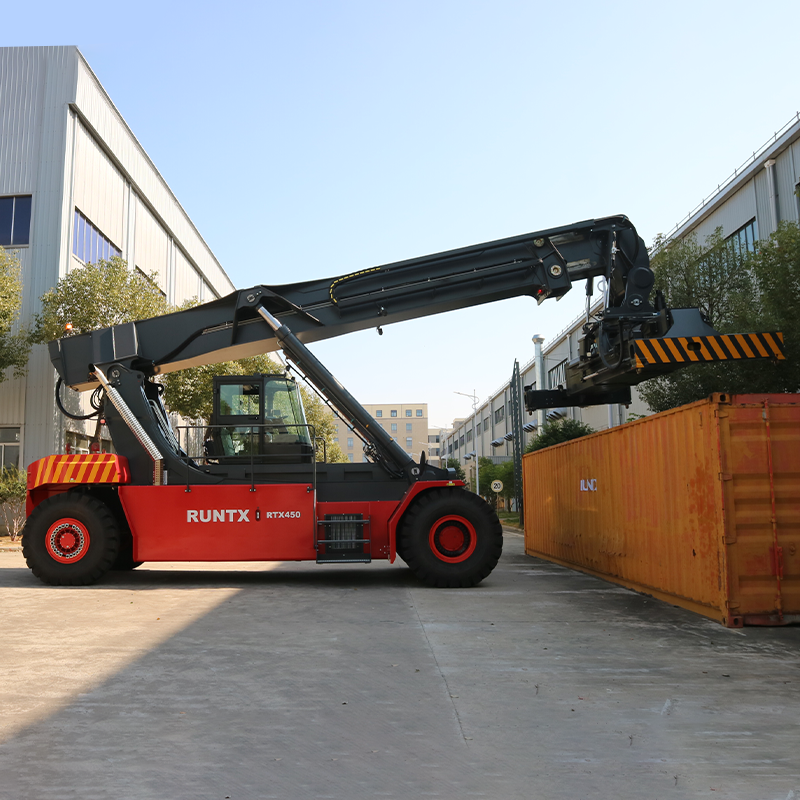
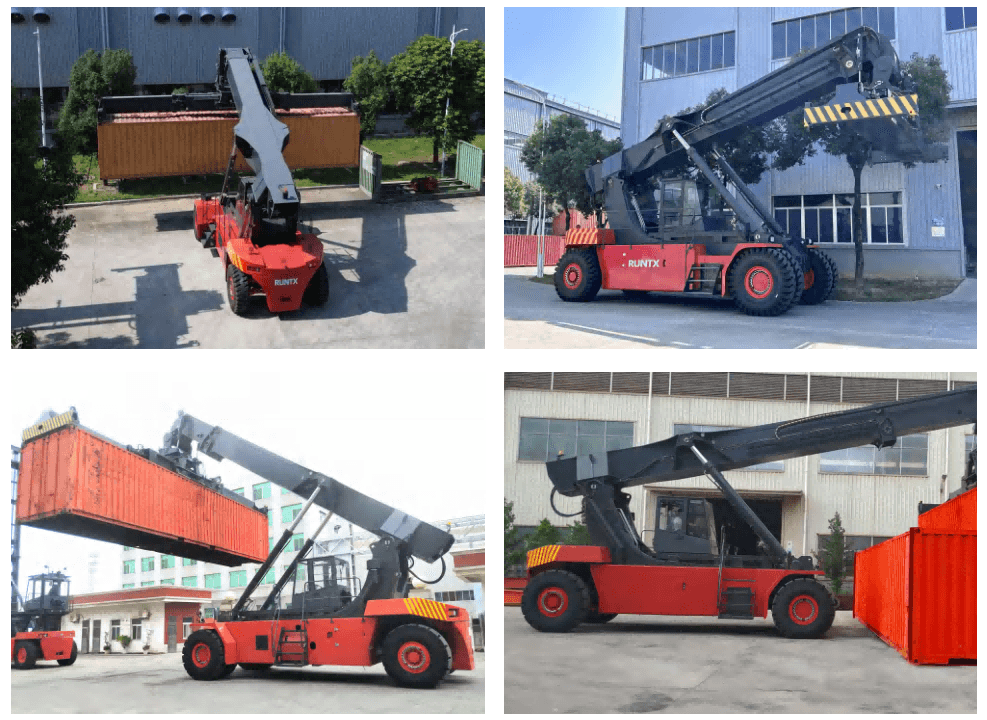
A reach stacker is a mobile heavy-duty container handling vehicle that uses a telescopic boom and container spreader to lift, transport and stack ISO containers while also reaching over the first container row to access additional rows.
1. Why Reach Stackers Matter in Modern Container Logistics
Container traffic is enormous and still growing. According to UN Trade and Development, ports worldwide handled approximately 920 million TEU in 2024, an increase of 6.9% from the previous year. Developing Asian economies alone handled around 60% of global container port traffic.
Source: UN Trade and Development (UNCTAD), UNCTADstat Container Port Throughput Data, updated April 2026.
For smaller terminals, that growth does not necessarily justify buying rail-mounted cranes or building highly automated yards. They often need equipment that can be deployed quickly, change routes easily and perform several container movements without permanent infrastructure.
This is where the reach stacker becomes attractive.
Unlike a gantry crane, it travels freely around the yard. Unlike a conventional forklift, its telescopic boom can extend forward, allowing the machine to place or retrieve containers beyond the first row.
2. How Does a Reach Stacker Work?
The operating principle is straightforward, although the engineering behind it is not.
A heavy chassis and counterweight provide stability. A telescopic boom pivots upward and extends forward. At the end of the boom, a container spreader connects to the ISO container’s corner castings through twist locks.
Telescopic boom
The boom provides both vertical lifting and horizontal reach. This is the key difference between a reach stacker and a vertical-mast container handler.
Container spreader
The spreader locks onto the container at designated lifting points. This allows a properly configured machine to pick up and position containers without relying on ordinary forklift forks.
Counterweight and long wheelbase
When the boom extends forward, leverage increases dramatically. Reach stackers therefore use a heavy counterweight, strong chassis and carefully engineered wheelbase to manage the resulting load moment.
Hydraulic system
High-capacity hydraulics control boom lifting, extension and spreader functions. For the operator, good proportional control translates into something practical: smoother container placement and less unnecessary impact on equipment and cargo.
3. Reach Stacker vs Container Handler vs Forklift
| Equipment | Main Function | Reach Capability | Best Application |
|---|---|---|---|
| Reach Stacker | Loaded container handling and stacking | Telescopic boom can reach across rows | Ports, inland terminals, intermodal yards |
| Empty Container Handler | High-volume empty-container stacking | Primarily vertical mast movement | Empty container depots |
| Heavy-Duty Forklift | General heavy cargo handling | Mainly vertical mast lift | Steel, machinery, timber and industrial cargo |
| RTG / RMG Crane | High-volume container yard operations | Wide block coverage | Large, high-throughput terminals |
The important point for a smaller operator is flexibility. A reach stacker can normally be introduced into an existing paved yard without the major fixed infrastructure associated with a rail-mounted gantry system.
4. How Productive Is a Reach Stacker?
Actual productivity depends heavily on yard layout, travel distance, stack arrangement, truck arrival patterns and operator experience. There is no honest universal “containers per hour” figure.
However, one published intermodal-terminal study used approximate reach-stacker productivity benchmarks of 25 moves per hour for railcar loading or unloading, 15 moves per hour for stacking and 10 moves per hour for road-truck handling. The study used an average handling-cycle assumption of around three minutes per move.
Source: Stoilova & Martinov, IOP Conference Series: Materials Science and Engineering, 2019. Figures are study benchmarks and should not be treated as guaranteed machine performance.
This distinction matters. A salesperson may focus on maximum machine speed, but a terminal operator should focus on the complete container cycle.
If trucks are not available, lanes are blocked or the target container is buried behind several others, the reach stacker will spend time waiting or reshuffling instead of producing revenue-generating moves.
5. More Reach Stackers Do Not Automatically Mean More Throughput
This is particularly important for small ports that are deciding whether to buy another machine.
A simulation study of a multipurpose seaport found that, with one yard reach stacker, increasing supporting trailers from two to three raised container productivity from 10.6 to 14.5 lifts per hour—an improvement of roughly 37%.
By comparison, when two trailers were available, adding another yard reach stacker increased productivity only from 10.6 to 10.98 lifts per hour, an improvement of about 3.6% in that modeled scenario.
Source: Journal of Marine Science and Engineering, simulation-based operational evaluation of a multipurpose seaport, 2021.
Before purchasing a second machine, check whether your real bottleneck is the reach stacker, supporting trucks, gate process, yard layout or container retrieval plan. Fixing the bottleneck may produce a better return than simply adding equipment.
6. Fuel Cost and Duty Cycle Matter More Than Purchase Price Alone
Reach stackers are heavy machines, so fuel becomes a meaningful part of total cost of ownership when the unit works long shifts.
A European ports energy-efficiency review reported that a hybrid reach stacker tested under normal container-handling conditions at the Port of Helsingborg demonstrated approximately 30% to 50% lower fuel consumption compared with conventional units in that specific field application.
Source: Sustainability, “Energy Efficiency in European Ports: State-of-Practice and Insights on the Way Forward,” 2019. This is an external hybrid-equipment case study, not a performance claim for the RUNTX RTX450.
The lesson for a diesel-machine buyer is not that every reach stacker can achieve those savings. It is that fuel strategy, idle time, hydraulic efficiency and operating cycle have a large impact on lifetime operating cost.
Ask suppliers for engine specifications, maintenance intervals, hydraulic-system details and expected service requirements before comparing quotations.
7. A Real Example: RUNTX RTX450 45 Ton Reach Stacker
The RUNTX RTX450 45 Ton Container Reach Stacker is designed for loaded-container handling in ports, railway intermodal yards and heavy logistics hubs.
Its published configuration includes a maximum lifting capacity of 45,000 kg, a maximum lifting height of 15,760 mm, a 250 kW diesel engine platform and a machine operating weight of approximately 71,400 kg.
The machine uses a telescopic boom, container spreader, load-sensing hydraulic control and integrated electronic monitoring. Dynamic anti-tip protection and boom/spreader anti-collision functions are intended to support safer heavy-container handling.
Buyers who want to compare different port-equipment options can also browse the wider RUNTX Container Reach Stacker range.
Planning Your First Reach Stacker Purchase?
Send RUNTX your container weights, 20 ft / 40 ft mix, required stacking height, target rows, annual throughput and yard dimensions. Our team can help you determine whether a reach stacker configuration fits your actual workflow.
8. Safety: Container Weight and Stability Cannot Be Estimated
A reach stacker works with very high loads and long forward reach, so accurate container information is essential.
International maritime rules require the verified gross mass of packed containers before vessel loading because incorrectly declared container weight can contribute to unsafe stowage, collapsed stacks and other serious handling risks.
Source: International Maritime Organization (IMO), SOLAS Verified Gross Mass requirements.
OSHA rules for containerized cargo also state that a container should not be hoisted when its actual gross weight exceeds either its marked limit or the capacity of the lifting appliance.
For an operator, the practical rules are simple:
- Know the actual container weight before lifting.
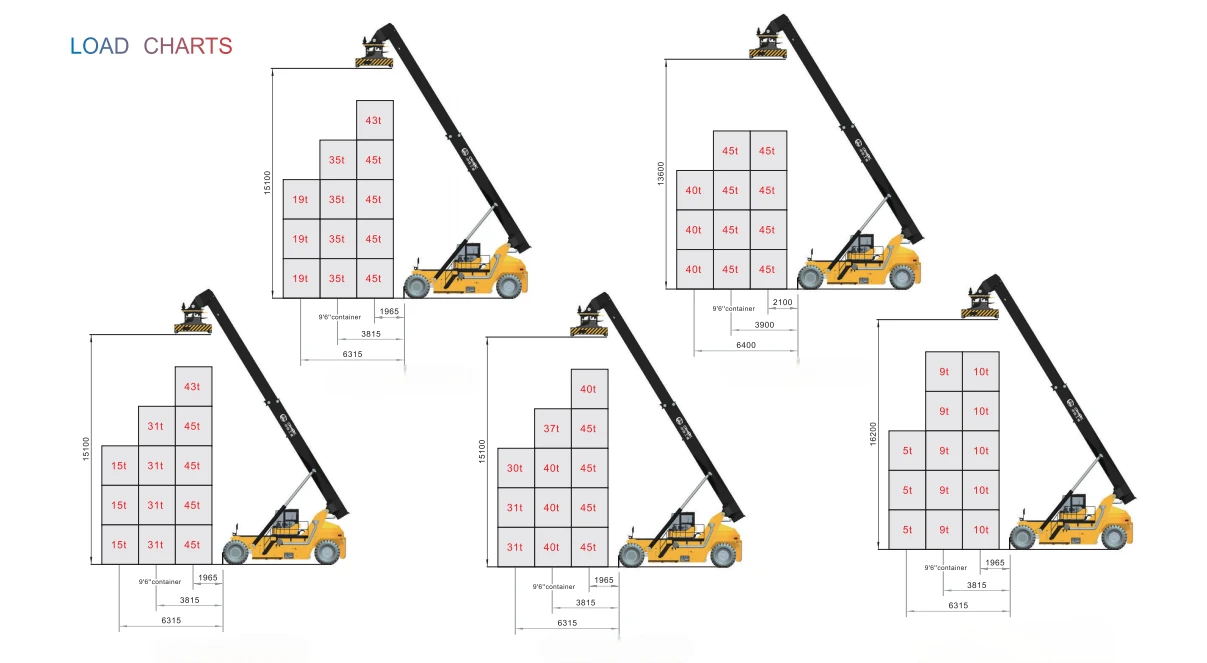
- Follow the manufacturer’s load chart for boom extension and stacking position.
- Keep the operating surface properly maintained and capable of supporting the machine.
- Do not treat maximum first-row capacity as the capacity for every reach position.
- Maintain clear pedestrian exclusion zones around container-handling traffic.
ISO 3691-2:2023 specifically covers safety requirements for self-propelled variable-reach trucks and variable-reach container handlers, including reach stackers.
9. Who Should Buy a Reach Stacker?
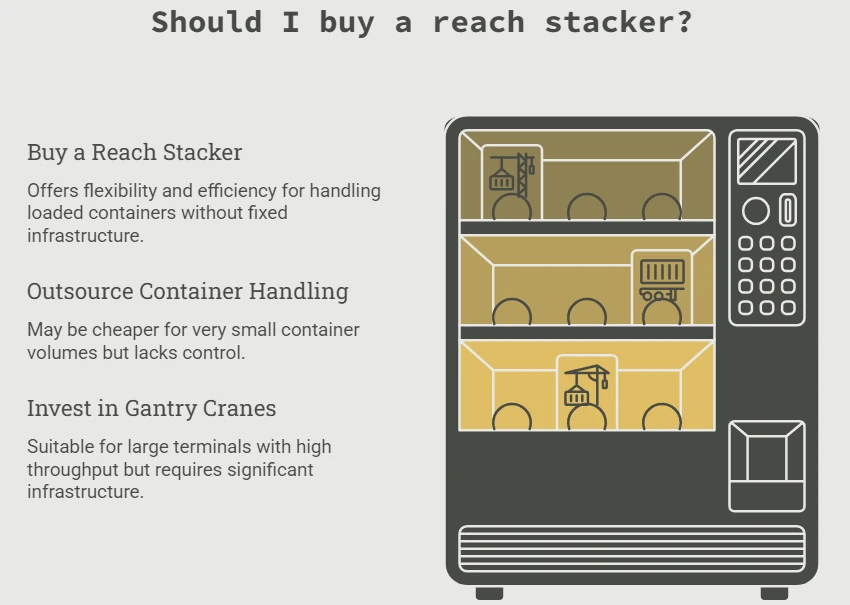
A reach stacker is usually a strong fit when your operation handles loaded ISO containers regularly but does not require—or cannot justify—the infrastructure of a fixed container crane system.
Typical buyers include:
- Small and medium-sized ports
- Inland container depots
- Rail-road intermodal terminals
- Container leasing and storage yards
- Industrial manufacturers with private container yards
- Equipment rental companies serving port and logistics customers
For very small container volumes, outsourcing may still be cheaper. For consistent daily handling, however, owning the machine can provide greater scheduling control and reduce dependence on externally hired equipment.
10. Factory-Direct Purchasing for Smaller Buyers
Reach stacker procurement does not have to be limited to large multinational terminal operators.
As a source manufacturer, RUNTX supports 1 Unit MOQ for suitable orders, allowing smaller terminals, contractors and independent logistics businesses to request factory-direct pricing without committing to an unrealistic fleet order.
OEM/ODM support can cover machine branding, paint, configuration and selected equipment requirements. Distributors and rental companies purchasing multiple units can request small-batch wholesale pricing.
RUNTX can also assist international customers with export documentation and shipping coordination, reducing one of the biggest concerns for first-time equipment importers: getting a very large machine from the factory to the destination port efficiently.
Frequently Asked Questions
What is the main purpose of a reach stacker?
A reach stacker is primarily used to lift, transport and stack ISO shipping containers in ports, container depots and intermodal terminals.
What is the difference between a reach stacker and a forklift?
A standard forklift normally uses a vertical mast and forks. A container reach stacker uses a telescopic boom and spreader, allowing it to reach forward and handle containers beyond the first stacking row.
Can a reach stacker handle loaded containers?
Yes, when the machine and load chart are rated for the required container weight and reach position. Always verify actual weight and allowable capacity for the intended boom extension.
How many containers can a reach stacker move per hour?
There is no universal figure. Published research shows that productivity can vary substantially between rail loading, stacking and truck handling because yard layout, travel distance, traffic and reshuffling strongly affect cycle time.
Can I buy only one RUNTX reach stacker?
Yes. RUNTX supports single-unit purchasing for suitable projects, while distributors, terminal operators and rental fleets can request volume or small-batch pricing.
Final Verdict: Buy Yard Flexibility, Not Just Lifting Capacity
A reach stacker is valuable because it combines heavy container capacity with something fixed cranes cannot offer as easily: mobility and flexible reach.
For smaller ports and inland terminals, that can make it an effective middle ground between ordinary mobile handling equipment and expensive fixed container infrastructure.
But the best machine is not simply the one with the highest lifting number. Evaluate container weight, stacking pattern, second-row requirements, annual moves, yard surface, supporting vehicles, fuel cost and serviceability together.
That is how a reach stacker becomes a productive asset rather than an oversized piece of equipment waiting for work.
Need a Reach Stacker for Your Port or Container Yard?
Buying your first machine? Request single-unit factory-direct pricing. Building a terminal fleet or distribution business? Ask for small-batch wholesale terms. Send us your container weight, stacking height, yard layout and destination to receive a configuration proposal.