Container handler or reach stacker? Learn how these two port machines differ in container type, stacking pattern, flexibility, yard layout and cost so you can choose the right equipment for your terminal.
For a small port, inland container depot or regional logistics yard, choosing container-handling equipment can be surprisingly difficult.
At first glance, an empty container handler and a reach stacker appear to solve the same problem: both lift containers, both work in terminals and both can stack cargo vertically. That makes it tempting to compare only price, lifting height or engine power.
In practice, they are built around very different operating priorities.
An empty container handler is optimized for moving lightweight empty ISO containers quickly and stacking them efficiently in a relatively organized yard. A reach stacker uses a telescopic boom and spreader to handle much heavier laden containers while also reaching beyond the first row.
For a smaller operator, choosing the wrong one can create years of unnecessary cost. A reach stacker may provide flexibility you never use, while an empty handler may become a bottleneck if your business regularly handles loaded containers.
Choose an empty container handler when your main job is fast, high-density empty-box stacking. Choose a reach stacker when you need to handle laden containers, work across multiple rows or serve several different parts of the terminal with one mobile machine.
1. Why This Equipment Choice Matters More Than Ever
Global container traffic continues to grow. UN Trade and Development reports that ports handled approximately 920 million TEU in 2024, an increase of 6.9% year over year. Over the last decade, world container port throughput has grown at slightly more than 3% per year on average.
Source: UN Trade and Development (UNCTAD), Container Port Throughput Data, 2024.
That growth is not limited to mega-terminals. Smaller ports, inland depots and regional logistics hubs are also being pushed to handle more boxes with limited yard space and limited capital.
For these operators, equipment utilization matters enormously. Buying a machine that spends half the day waiting for the right type of container is poor fleet economics, even if the specification looks impressive.
The better question is not “Which machine is stronger?” It is “Which machine matches the container mix and yard workflow we actually have?”
2. What an Empty Container Handler Is Designed to Do
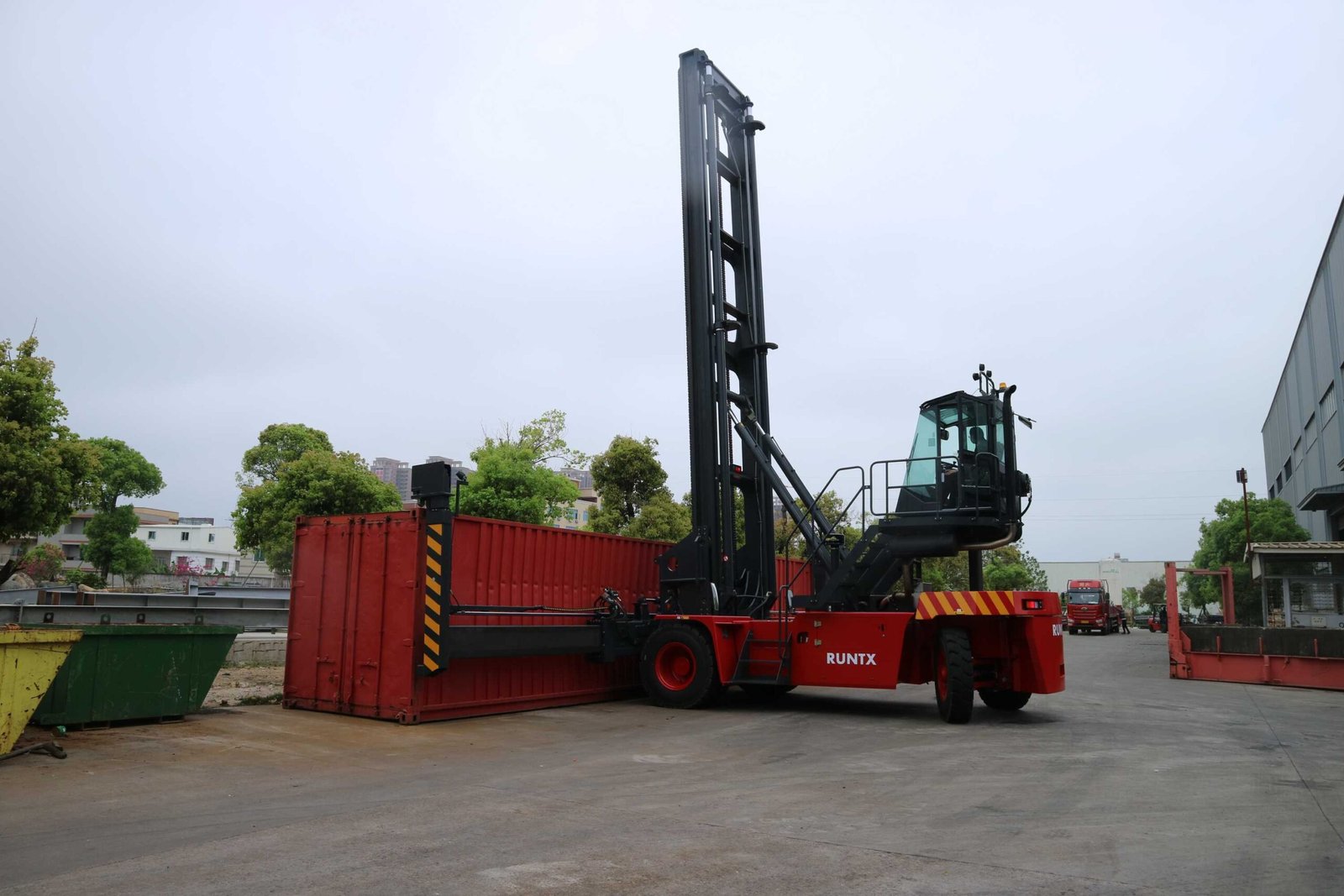
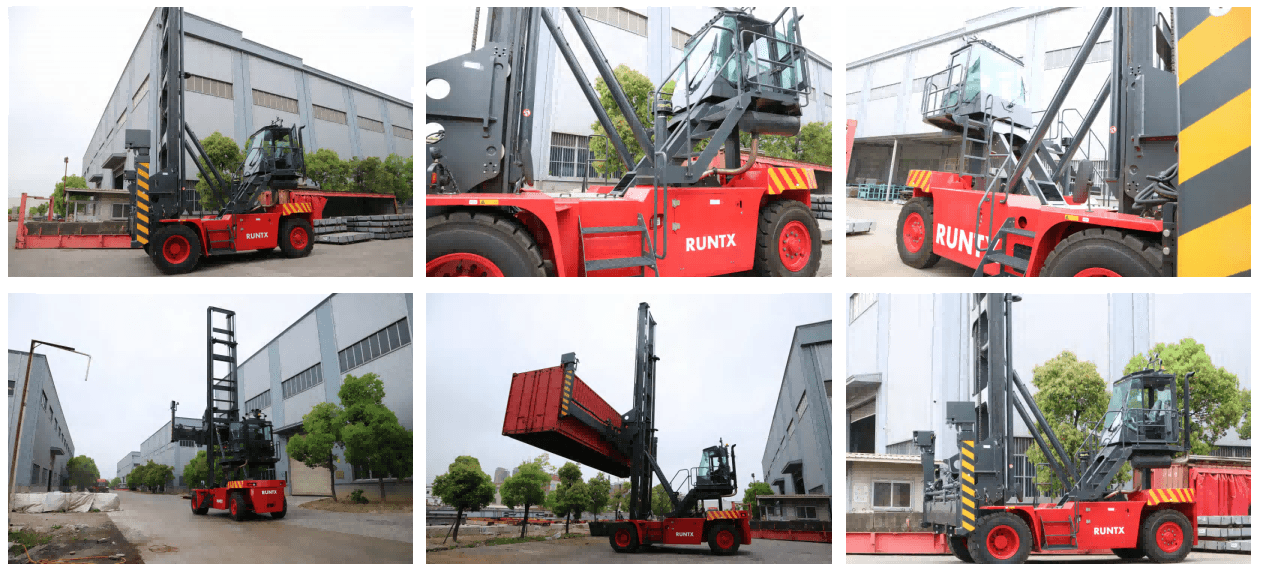
A conventional empty container handler uses a vertical mast rather than a telescopic boom. Its spreader grips the container from the top, and the machine lifts vertically in a way that resembles a highly specialized heavy forklift.
The important word is empty.
An empty 20-foot or 40-foot shipping container is far lighter than a fully laden one. Because the payload requirement is lower, the machine can be optimized around quick vertical stacking, relatively compact movements and repeated cycles within a depot.
This makes an empty handler particularly useful where containers arrive after unloading, are inspected or repaired, and then need to be stored until the shipping line requests them again.
For a business whose revenue depends on turning empty boxes around quickly, the value is straightforward: the machine is doing one job repeatedly without carrying the mass and complexity required for a fully laden container.
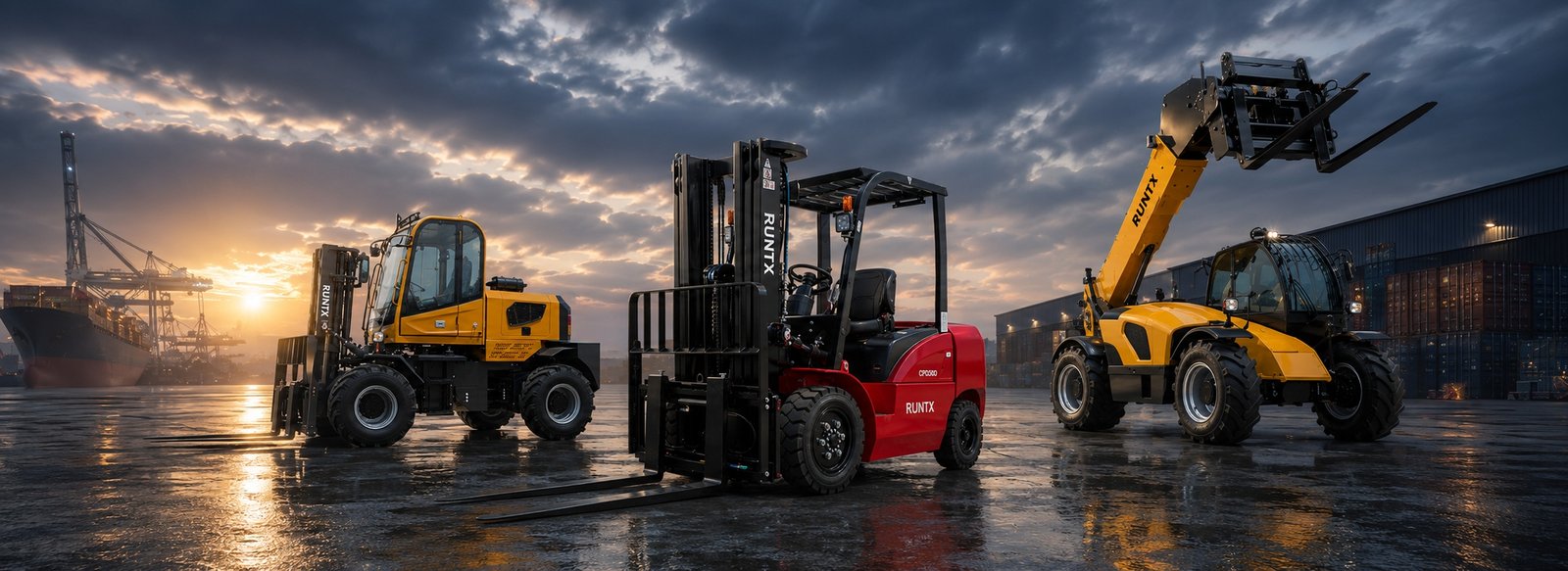
The RUNTX port-machine range includes dedicated container handling equipment for terminal and depot operations, including reach stackers and specialized container handlers for different load profiles.
3. What Makes a Reach Stacker Different
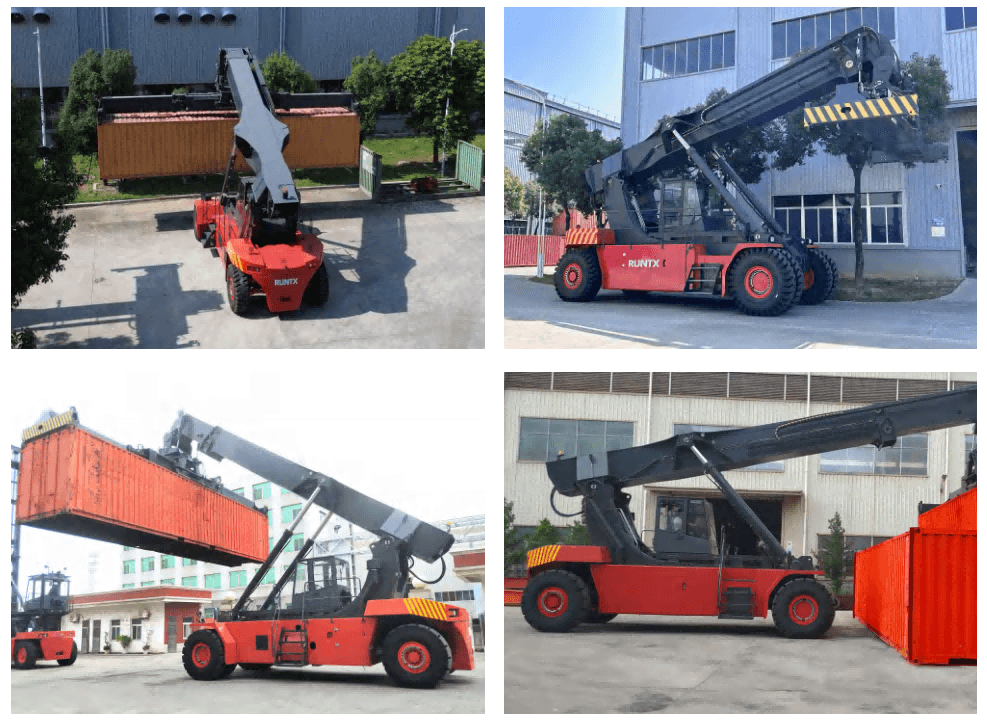
A reach stacker is built around a telescopic boom. Instead of simply lifting vertically, the boom can extend forward, allowing the spreader to reach over the first row of containers and access the second or even third row depending on the machine’s load chart.
That is the source of its flexibility—and also the reason it becomes a much heavier and more expensive machine.
The RUNTX RTX450 45 Ton Container Reach Stacker, for example, is designed around a maximum lifting capacity of 45,000 kg, a maximum lifting height of 15,760 mm and a machine operating weight of approximately 71,400 kg. The telescopic boom and container spreader allow it to work with loaded containers in ports and intermodal yards.
This capability matters where the same machine may need to unload a truck, transfer a container across the yard, serve a rail line and then stack the box beyond the first row.
That kind of multi-purpose work is where a reach stacker earns its higher investment.
4. Container Handler vs Reach Stacker: Practical Comparison
| Buying Factor | Empty Container Handler | Reach Stacker |
|---|---|---|
| Primary Cargo | Empty ISO containers | Loaded and empty containers |
| Lifting Structure | Vertical mast | Telescopic boom |
| Row Reach | Primarily first-row vertical stacking | Can reach beyond the first row |
| Best Yard Type | High-volume empty container depot | Mixed container terminal or intermodal yard |
| Flexibility | High within dedicated empty-container work | High across trucks, rail, yard and multi-row stacking |
| Capital Requirement | Typically lower for equivalent empty-container duty | Higher because of heavy chassis, boom and laden-container capacity |
The important point is that these are not simply two machines competing for the same job.
An empty handler is a specialist. A reach stacker is closer to a multi-purpose terminal tool.
5. Reach Stacker Flexibility Can Improve Utilization—But Only If the Yard Uses It
A reach stacker is attractive because it can serve several parts of the terminal rather than being restricted to one vertical stacking lane.
Research into rail-road intermodal terminals uses an approximate reach-stacker cycle time of 3–3.5 minutes per move. The same study cites typical productivity around 25 moves per hour for railcar loading or unloading, 15 moves per hour for stacking and 10 moves per hour for road-truck handling.
Source: Stoilova & Martinov, IOP Conference Series: Materials Science and Engineering, 2019. Values are planning benchmarks rather than guaranteed machine performance.
That range tells us something important: reach-stacker productivity depends heavily on what the machine is doing.
If it spends most of its shift travelling long distances between trucks and stacks, output will be lower than when it stays inside a compact stacking zone. The machine may be flexible, but flexibility only creates value when the yard layout and workflow actually use it.
A small terminal with only one reach stacker should pay particular attention to this because every minute spent travelling is a minute the machine is not lifting.

6. The Bigger ROI Question: Is the Machine Really the Bottleneck?
Port equipment buyers often assume that low productivity means they need another handler. Operational research shows why that assumption can be expensive.
A simulation study of a multipurpose seaport found that with one yard reach stacker, increasing supporting trailers from two to three raised container productivity from 10.6 to 14.5 lifts per hour—an increase of approximately 36.8%.
By contrast, when two trailers were available, adding a second yard reach stacker increased productivity from only 10.6 to 10.98 lifts per hour, around 3.6% in that modeled scenario.
Source: Journal of Marine Science and Engineering, “Simulation-Based Operational Evaluation of a Single-Berth Multipurpose Seaport with Wharf Space Restriction,” 2021.
For a small port, that is a valuable purchasing lesson. If the real constraint is trailer availability, truck arrival scheduling or yard layout, buying another expensive container machine may produce very little improvement.
Before adding equipment, map the complete container cycle from gate to stack and back again.
7. Empty Containers Need Density; Laden Containers Need Reach and Stability
Empty-container yards usually care most about storage density and fast repetitive cycles. Because the boxes are relatively light, a dedicated handler can stack them vertically without carrying the enormous chassis mass required for a 40-plus-ton laden load.
This becomes particularly attractive when the depot has a predictable operating pattern: containers enter empty, move into inspection or storage, and leave empty again.
A reach stacker becomes more valuable when the workflow is less predictable. Loaded containers may arrive from trucks, need temporary yard storage, move to rail or be retrieved from behind another stack.
This is why the machine’s telescopic boom matters. It gives the operator more choices about where the container can be placed without reorganizing the entire first row every time.
But that flexibility needs space. A reach stacker is physically large, and the RTX450 currently lists an outside turning radius of approximately 8.6–9.9 meters depending on the measurement condition. Yard lanes, turning zones and pavement strength therefore need to be considered before purchasing.
Still Deciding Between an Empty Handler and a Reach Stacker?
Send RUNTX your percentage of empty vs loaded containers, daily moves, stacking height, row depth and yard dimensions. Our engineering team can help identify which equipment category fits your real workflow before you invest in unused capacity.
8. Safety Standards Apply to the Machine You Actually Buy
Container-handling equipment works with large suspended loads, long sight lines and substantial machine mass. That makes safety engineering part of the purchasing decision, not an optional accessory package.
The current ISO 3691-2:2023 standard covers safety requirements and verification for self-propelled variable-reach trucks and variable-reach container handlers, including reach stackers equipped with forks or integral container-handling devices such as spreaders.
Source: International Organization for Standardization, ISO 3691-2:2023.
For a reach stacker, buyers should pay attention to the load chart at different boom extensions, stability systems, braking, visibility and spreader controls. For an empty handler, mast condition, spreader locking, visibility at high stacking levels and yard-surface quality are equally important.
Do not buy either machine based only on maximum lifting height.
9. Which Machine Makes More Sense for a Smaller Port?
If most of your work is empty-container storage and retrieval, an empty container handler usually makes more financial sense. You are paying for the capacity and structure you actually use, rather than carrying a reach stacker’s 45-ton laden-container capability through every cycle.
If your business handles both loaded and empty containers, serves road trucks and rail wagons, or frequently needs second-row access, the reach stacker becomes easier to justify.
A terminal with limited equipment can also benefit from the reach stacker’s ability to perform several different roles. One machine may cover truck handling, yard stacking and intermodal transfer rather than requiring separate equipment for each location.
That does not automatically make it cheaper. It makes it more flexible.
The final ROI depends on utilization. If the machine’s extra capability is used every shift, the higher purchase price can be justified. If the terminal handles empty boxes 90% of the time, a specialized empty handler may be the more disciplined investment.
10. Factory-Direct Procurement for Smaller Terminal Operators
Port machinery does not have to be purchased only through large fleet tenders.
RUNTX supports 1 Unit MOQ for suitable port-equipment projects, giving regional ports, inland depots and independent logistics operators access to factory-direct purchasing without committing to multiple machines.
OEM/ODM discussions can cover branding, paint, spreader configuration and project-specific technical requirements. Distributors and larger fleet operators can also request small-batch pricing when multiple units or different equipment types are required.
Export logistics is especially important with machines of this size. RUNTX can assist with commercial documentation, shipping coordination and transport planning so buyers can understand the landed project before the equipment leaves the factory.
Buyers comparing options can also view the wider RUNTX Container Reach Stacker range and discuss container-handler configurations directly with our engineering team.
Frequently Asked Questions
Is a container handler the same as a reach stacker?
No. In this guide, “container handler” refers primarily to a mast-based empty container handler. A reach stacker uses a telescopic boom and is designed for greater forward reach and heavy laden-container handling.
Can an empty container handler lift loaded containers?
A dedicated empty handler should not be treated as a laden-container machine. Always follow the manufacturer’s rated load chart and use equipment specifically designed for the actual container weight.
Why are reach stackers popular in smaller terminals?
They can perform several tasks with one mobile machine, including truck handling, yard stacking and intermodal work. That flexibility can be valuable when a terminal cannot justify multiple specialized machines.
Is an empty handler cheaper to operate?
It can be when the operation is dominated by empty containers because the machine is not engineered around 40-plus-ton laden-container loads. Actual operating cost still depends on engine, duty cycle, maintenance and utilization.
Can I buy only one RUNTX port machine?
Yes. RUNTX supports single-unit purchasing for suitable projects as well as OEM/ODM and small-batch procurement for distributors and terminal fleets.
Final Takeaway: Buy for Your Container Mix, Not the Biggest Specification
The choice between a container handler and a reach stacker should start with the containers your yard actually handles.
If the job is mostly high-frequency empty-box storage, a dedicated empty container handler offers a focused solution. If loaded containers, multi-row access and mixed terminal work are part of daily operations, a reach stacker provides much greater flexibility.
For smaller ports, this distinction has a direct effect on payback. The right machine spends more time doing useful work and less time carrying capacity the business never uses.
Choose the Right Container Equipment Before You Buy
Tell us your daily container moves, empty-to-laden ratio, stacking height and yard layout. RUNTX can prepare a factory-direct equipment proposal around your actual terminal operation—not just the largest machine in the catalog.