Long timber packs, uneven yards and frequent truck loading create a very different handling problem from ordinary warehouse pallets. Here is where a 12-ton diesel forklift can start earning its place in a busy lumber operation.
A lumber yard usually does not outgrow its forklift overnight.
At first, a 5-ton or 7-ton truck may handle most daily bundles without much trouble. Then the business starts receiving longer timber packs, denser hardwood, engineered wood products or larger customer orders. Trucks arrive faster. Loads stay on the forks longer. Operators begin spending more time splitting bundles, repositioning machines or waiting for heavier equipment.
That is normally when the question changes from “Can our current forklift lift this?” to “Is this still the right forklift for the way our yard now works?”
For high-volume lumber operations, a 12 ton diesel forklift can become a useful middle ground. It provides significantly more lifting reserve than the common 5–8 ton class without immediately moving into the size and cost of a 16-, 20- or 25-ton industrial truck.
But capacity alone is not the reason. In a lumber yard, load length, center of gravity, traction, visibility and ground conditions matter just as much as the number painted on the counterweight.
Lumber Is a Bigger Material-Handling Business Than It Looks
The scale of the wood-products industry helps explain why specialized handling equipment matters.
FAO reports that global production reached approximately 445 million cubic metres of sawnwood in 2024. Wood-based panel production reached another 393 million cubic metres, increasing by about 5% year over year.
Source: Food and Agriculture Organization of the United Nations (FAO), Global Forest Products Statistics, 2024.
The United States alone accounted for around 17% of global sawnwood production, while China accounted for about 14%, Canada and Russia about 8% each.
Behind those numbers are sawmills, timber terminals, building-material distributors and lumber yards that have to move increasingly standardized packs of wood quickly between production, storage and outbound trucks.
That workflow is very different from handling a neat 1,000 kg warehouse pallet. Timber is often long, bulky and stored outside. Even when the actual bundle weight is comfortably below 12 tons, its geometry can place much greater demands on the forklift.
The Real Problem Is Often Length, Not Weight
This is the part of forklift selection that lumber buyers sometimes underestimate.
A forklift capacity rating only applies at the load center stated on the truck’s data plate. Move the center of gravity forward and the available lifting capacity decreases.
OSHA illustrates this with a simple load-moment calculation. A truck rated at 3,000 lb at a 24-inch load center has a rated load moment of 72,000 inch-pounds. If that same load center moves to 30 inches, the equivalent allowable load becomes only 2,400 lb.
That is a 20% reduction even though nothing changed about the forklift itself.
Source: U.S. Occupational Safety and Health Administration (OSHA), Powered Industrial Trucks – Load Composition and Stability Guidance.
Timber bundles make this issue especially relevant because long packs naturally push the center of gravity farther away from the mast.
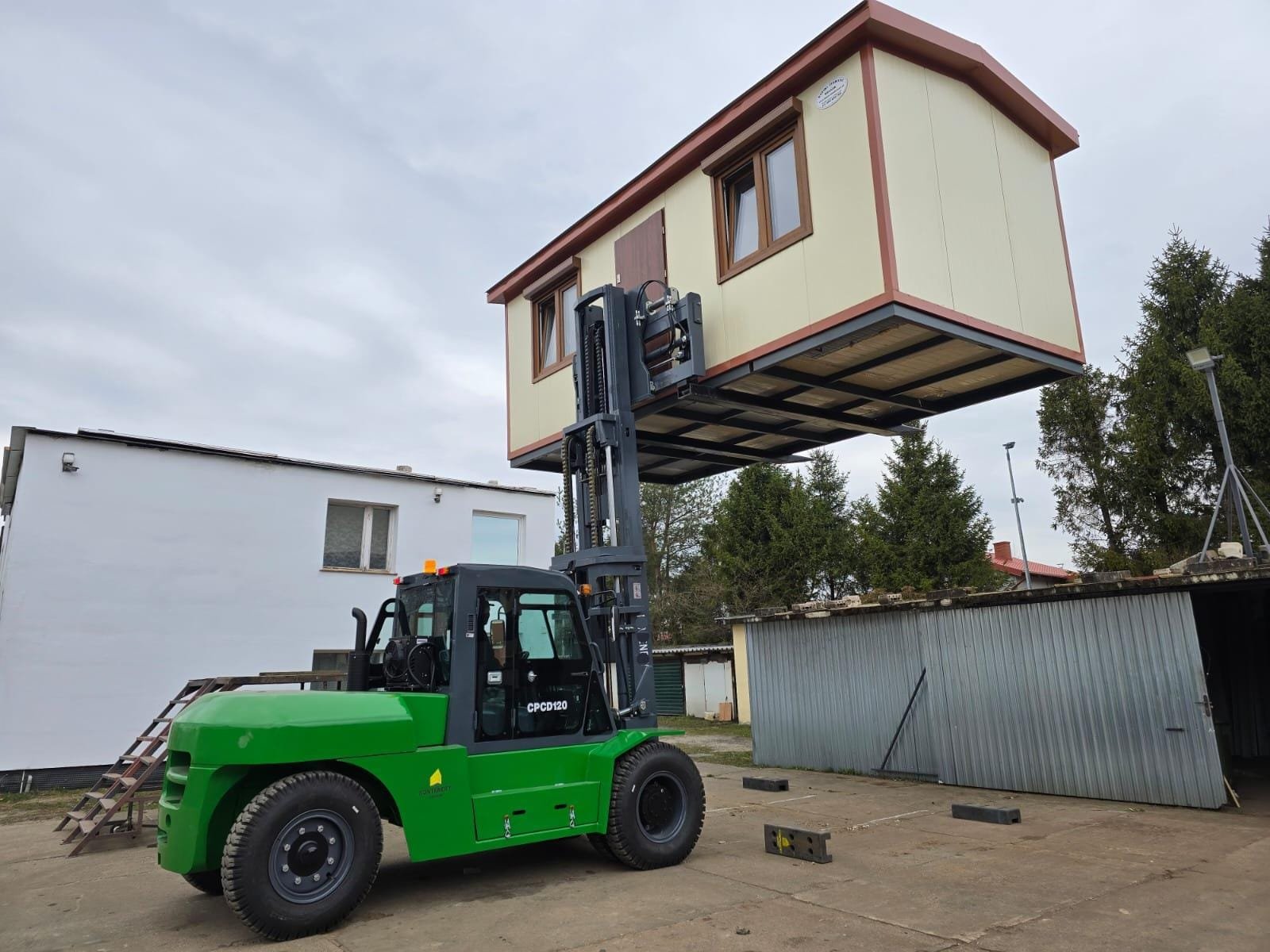
The RUNTX CPCD120 12 Ton Diesel Forklift is rated at 12,000 kg with a 600 mm load center and a 3,000 mm standard lifting height. That gives lumber operators considerably more reserve than a smaller truck, but the same basic rule still applies: a long 8-ton timber pack is not automatically equivalent to a compact 8-ton load.
Before ordering, the buyer should provide the bundle weight, total length, width and expected fork spacing. In lumber handling, those numbers are often more useful than simply saying “we need a 12-ton forklift.”
Why 12 Tons Can Be a Useful Sweet Spot
Going larger always sounds safer on paper, but in a working yard every extra capacity class comes with a larger chassis, larger turning envelope and higher capital cost.
| Forklift Class | Typical Lumber-Yard Role | Main Advantage | Where It Can Fall Short |
|---|---|---|---|
| 5–7 Ton | General timber packs, building materials and routine truck loading | Lower cost and easier maneuvering | Limited reserve for large or long dense bundles |
| 8–10 Ton | Heavier timber, engineered wood and larger outbound packs | Good balance for medium-duty yards | Can lose useful reserve with long loads and attachments |
| 12 Ton CPCD120 | Large timber packs, dense hardwood, sawmill and high-volume yard work | More capacity reserve without immediately moving into very large forklift classes | Requires suitable yard space, ground and traffic planning |
| 16 Ton+ | Very large timber packs and specialized heavy industrial handling | Greater reserve for exceptional loads | Higher purchase cost and larger operating footprint |
The CPCD120’s published operating weight is approximately 13,900 kg, with an overall width of around 2,200 mm and a chassis length of approximately 4,540 mm without forks.
That substantial counterweight and chassis mass are part of what allows a 12-ton forklift to manage heavy loads, but they also explain why the machine needs space.
For an open sawmill or outdoor timber yard, that is usually less of a problem than it would be inside a narrow warehouse.
A Lumber Yard Is Hard on Equipment
Wood dust, uneven pavement, outdoor storage and repeated truck loading create a working environment where a forklift rarely stays on a perfect warehouse floor.
OSHA’s sawmill guidance specifically identifies lumber-handling vehicles as equipment routinely used in sawmills, planing mills, storage areas, shipping operations and yards.
The same guidance requires suitable warning signals, headlights and tail lights when working in dark or poorly lit areas, and brakes capable of holding and controlling the vehicle with its rated load on grades where it operates.
Source: U.S. Occupational Safety and Health Administration (OSHA), Sawmills – Lumber Storage and Lumber Handling Vehicles.
Those requirements are useful even outside the United States because they reflect the realities of lumber-yard work.
A machine may start at dawn, move between outdoor stacks, load trailers and operate around workers, trucks and storage racks during the same shift. Visibility and braking matter just as much as lifting power.
This is where diesel power remains attractive for many lumber businesses. Refueling is quick, the machine can work long outdoor shifts, and there is no requirement to interrupt the day for traction-battery charging.

Attachments Can Help—But They Change the Capacity Equation
Long lumber often benefits from wider fork spacing, longer forks or specialist attachments. Dealers and fleet operators may also request fork positioners or sideshifters to make positioning large packs easier.
Those upgrades can improve day-to-day usability, but they should be specified before the machine is built.
OSHA’s nameplate example shows why. A truck rated at 5,000 lb with standard forks is shown at 4,500 lb with a sideshifter installed. In that particular truck-and-attachment combination, usable rated capacity falls by 10%.
Source: U.S. Occupational Safety and Health Administration (OSHA), Powered Industrial Trucks – Nameplate and Attachment Guidance.
That does not mean every sideshifter causes a 10% reduction. It means the final attachment, its weight and its forward offset need to be included in the truck’s load-capacity assessment.
For timber buyers, that is especially important because the load itself may already have a longer-than-standard center of gravity.
Handling Long or Heavy Timber Packs?
Send RUNTX the maximum bundle weight, length, required fork length, lift height and yard conditions. Our team can review whether CPCD120 capacity is suitable and recommend a configuration before production.
The Yard Layout Can Matter More Than Another Ton of Capacity
There is little value in buying a powerful forklift if the site forces the operator into awkward turns around every timber stack.
Heavy counterbalance trucks need clear traffic routes. Mud, damaged concrete, loose gravel and steep transitions can all affect stability, particularly when the machine is carrying a long load.
The UK Health and Safety Executive reports that vehicle overturns account for nearly one-fifth of all workplace transport deaths. It identifies soft or uneven ground, excessive slopes, overloading, uneven loads and excessive cornering speed among common factors.
Source: UK Health and Safety Executive (HSE), Workplace Transport – Overturning.
This is directly relevant to timber yards because outdoor storage areas are often less controlled than warehouse floors.
Before ordering a CPCD120, measure more than the load. Measure the narrowest route between stacks, loading-bay turning area and ground conditions the truck will encounter throughout the year.
If the site is genuinely rough rather than simply outdoor, that may also change the type of forklift you need.
Long Loads Also Create a Visibility Problem
A 2023 NIOSH investigation at an Oregon lumber mill provides a sobering example.
A worker was fatally struck by the load carried by a forklift when the machine entered a lumber shed. The investigation described a work area located between a forklift travel pathway and lumber storage, with the operator unable to see the worker standing in the travel path.
Source: U.S. National Institute for Occupational Safety and Health (NIOSH), FACE Report 2023OR01.
The lesson is not specific to one forklift brand or one machine size. Lumber itself can block sightlines.
Wide packs, long forks and tall stacks make traffic management important. Dedicated pedestrian routes, mirrors, lighting, horns and clearly defined travel lanes often do more for a safe yard than simply purchasing a larger truck.
For buyers evaluating heavy equipment, safety therefore starts with the machine but does not end there.

When Does the CPCD120 Actually Pay for Itself?
A 12-ton forklift should not spend most of its life moving 2-ton timber bundles.
The investment starts to make sense when heavier packs occur often enough that the existing fleet creates a bottleneck.
A sawmill may currently divide one outbound timber package into two lifts. A building-material distributor may need to call in outside equipment for larger customer orders. A rental operator may regularly turn away jobs because its fleet ends at seven or eight tons.
In those situations, the CPCD120 is not earning money merely because it can lift more. It earns money when that capacity removes repeated handling steps or allows the business to accept work it previously could not perform efficiently.
RUNTX has also previously hosted an Australian customer for hands-on evaluation of the same capacity class. Buyers interested in seeing how heavy equipment is inspected before purchase can view the Australian CPCD120 Factory Testing Case.
For smaller lumber companies, direct factory purchasing does not require a large fleet commitment either. RUNTX supports 1 Unit MOQ for suitable orders, while distributors and rental companies can discuss small-batch pricing.
OEM/ODM options can include colors, branding, fork configuration, tires, attachments and market-specific equipment requirements. Export documentation and international shipping coordination can also be handled as part of the project.
Frequently Asked Questions
Is a 12 ton diesel forklift suitable for a lumber yard?
Yes, particularly for high-volume yards regularly handling large or dense timber bundles. The actual suitability depends on load dimensions, load center, fork configuration and ground conditions rather than weight alone.
Can a CPCD120 lift a 12-ton timber pack?
The CPCD120 is rated for 12,000 kg at its specified 600 mm load center. A long timber pack may have a larger effective load center, reducing available capacity. The actual bundle dimensions should therefore be checked before confirming the lift.
What fork length is best for lumber?
There is no single correct length. Forks should support the load appropriately without creating unnecessary forward load center. Provide the timber bundle dimensions to the manufacturer before selecting fork length.
Should lumber yards use solid or pneumatic tires?
The choice depends on surface conditions. Pneumatic tires can provide better ride characteristics on uneven outdoor surfaces, while solid tires remove puncture risk. The actual yard should be evaluated before specifying the truck.
Can I order one CPCD120 directly from RUNTX?
Yes. RUNTX supports suitable single-unit factory orders as well as small-batch and OEM/ODM purchasing for distributors, rental fleets and industrial customers.
The Right Heavy Forklift Is About Flow, Not Just Tonnage
A modern lumber yard needs more than a machine capable of lifting a large number on a specification sheet.
The forklift has to pick long loads safely, move across an outdoor yard, turn between storage areas, load trucks efficiently and keep doing that work throughout the shift.
For businesses that have genuinely outgrown the 5–8 ton class, the CPCD120 can become a practical workhorse because it provides useful capacity reserve without immediately moving into a much larger industrial truck.
For businesses that rarely handle heavy packs, it may be unnecessary.
The best decision starts with the timber itself: weight, length, center of gravity and handling frequency. Get those four things right, and choosing the correct forklift becomes much easier.
Need a CPCD120 for Your Lumber Yard?
Send us your timber bundle weight, dimensions, fork requirements and yard conditions. RUNTX can prepare a factory-direct CPCD120 configuration for a single machine, rental fleet or distributor project.