Forklift Import & Shipping Guide
Importing a forklift from China is not difficult once the quotation, shipping term and documents are clear. The expensive mistakes usually happen when buyers compare EXW, FOB and CIF prices as if they include the same things.
A buyer may find a 3-ton diesel forklift in China at an attractive factory price and assume the difficult part is over.
Then the quotation arrives with three letters next to the price: EXW, FOB or CIF.
After that come container sizes, ocean freight, insurance, customs documents, destination port charges and possibly additional requirements for batteries, attachments or local certification.
For an experienced importer, these are normal parts of the transaction. For a small contractor, warehouse owner or first-time equipment buyer, they can make two apparently similar forklift quotations surprisingly difficult to compare.
The most important rule is simple: never compare forklift prices until you know exactly what the quoted Incoterm includes.
EXW, FOB or CIF: What Is the Practical Difference?
Incoterms® define how transportation responsibilities, costs and risks are divided between seller and buyer.
RUNTX commonly works with EXW, FOB and CIF depending on how much logistics support the customer needs.
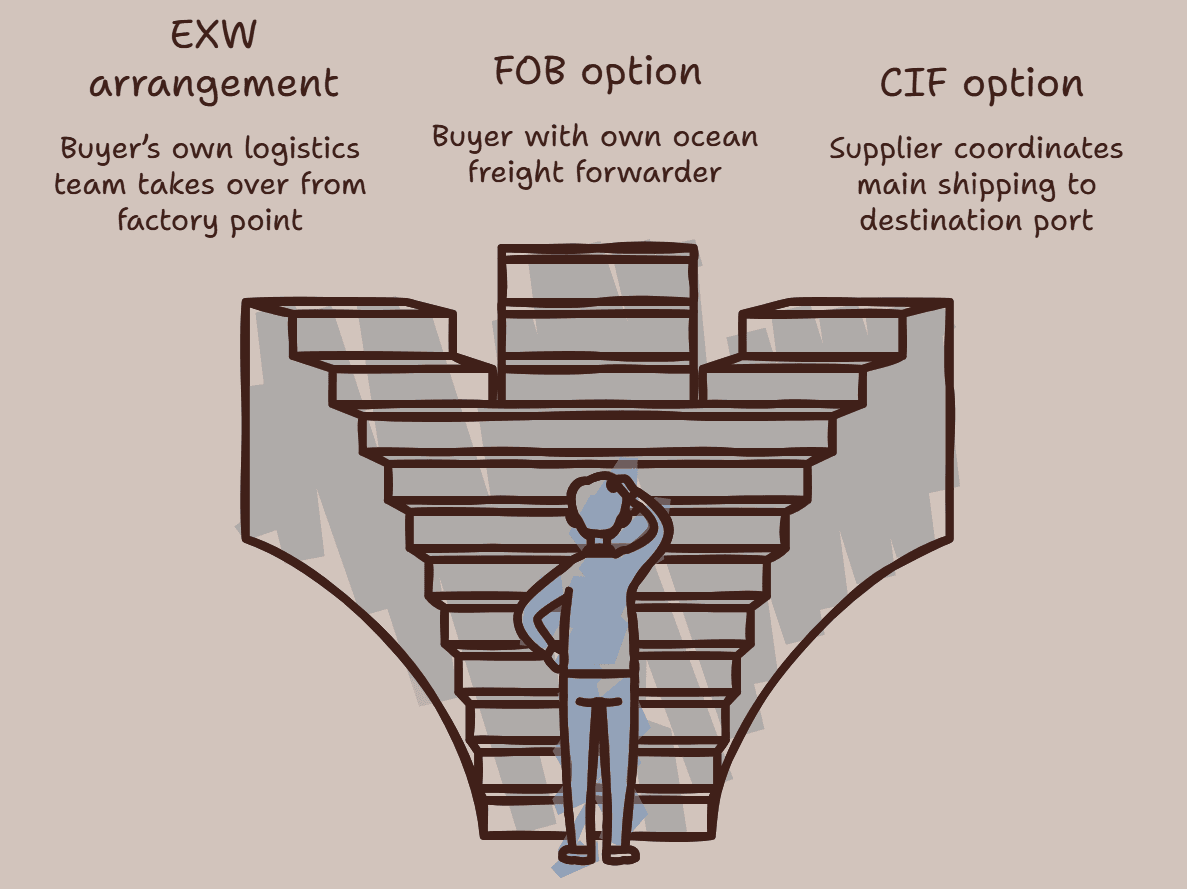
If a customer already has a freight forwarder or purchasing agent in China, an EXW-type arrangement may be convenient because the buyer’s own logistics team can take over from the agreed factory point.
For buyers without that network, FOB and CIF are more common choices.
| Item | EXW | FOB | CIF |
|---|---|---|---|
| Factory Equipment Price | Included | Included | Included |
| Export Clearance | Normally buyer responsibility under the rule | Seller | Seller |
| Main Ocean Freight | Buyer | Buyer | Seller arranges and pays to named destination port |
| Marine Insurance | Buyer | Buyer | Seller provides required minimum cover unless otherwise agreed |
| Import Clearance / Duty | Buyer | Buyer | Buyer |
| Best Fit | Buyer with established China logistics | Buyer with own ocean freight forwarder | Buyer wanting the supplier to coordinate main shipping |
Source: International Chamber of Commerce, Incoterms® 2020. Exact responsibilities depend on the agreed term, named place/port and sales contract.
The Biggest CIF Misunderstanding: Cost and Risk Are Not the Same Thing
A buyer may see “CIF Santos” or “CIF Puerto Quetzal” and think the seller remains responsible for the machine until it arrives at that port.
That is not how CIF works.
Under Incoterms® 2020, the seller arranges and pays the freight and required insurance to the named destination port, but the risk transfers when the goods are loaded on board the vessel at the port of shipment.
Source: International Chamber of Commerce, Incoterms® 2020 – CIF Cost, Insurance and Freight.
That difference between “who pays” and “who carries the risk” is one of the most important concepts for a first-time importer to understand.
CIF also does not automatically mean the forklift will be delivered to your warehouse.
Import duties, taxes, customs clearance, destination terminal charges, storage, demurrage and inland delivery can still fall to the buyer depending on the contract and local arrangements.
How RUNTX Normally Quotes International Forklift Orders
RUNTX does not force every buyer into the same shipping term.
If the customer already has a freight forwarder or agent in China, we can work around that arrangement.
If the buyer does not have an established logistics partner, RUNTX can normally prepare FOB or CIF options and help coordinate the export side of the shipment.
For buyers with limited customs-clearance experience, our team can also help communicate with freight and documentation partners and provide the information needed for local clearance, although the final import responsibilities still depend on the agreed trade term and destination-country regulations.
A complete commercial quotation should therefore show more than the machine price.
For example, a recent RUNTX Proforma Invoice for a multi-unit CPCD50 order clearly identified the quotation as FOB Qingdao Port, China, together with machine specifications, quantity, payment terms, production lead time, warranty conditions and statements concerning destination-country customs costs and delays.
That kind of detail matters because it prevents a buyer from assuming that an FOB machine price already includes destination-country expenses.
FOB Usually Makes Sense When You Already Have a Forwarder
For experienced importers, FOB can provide more control.
The seller handles the agreed export-side responsibilities and gets the cargo on board at the named Chinese port. The buyer’s nominated forwarder then manages the main international transport.
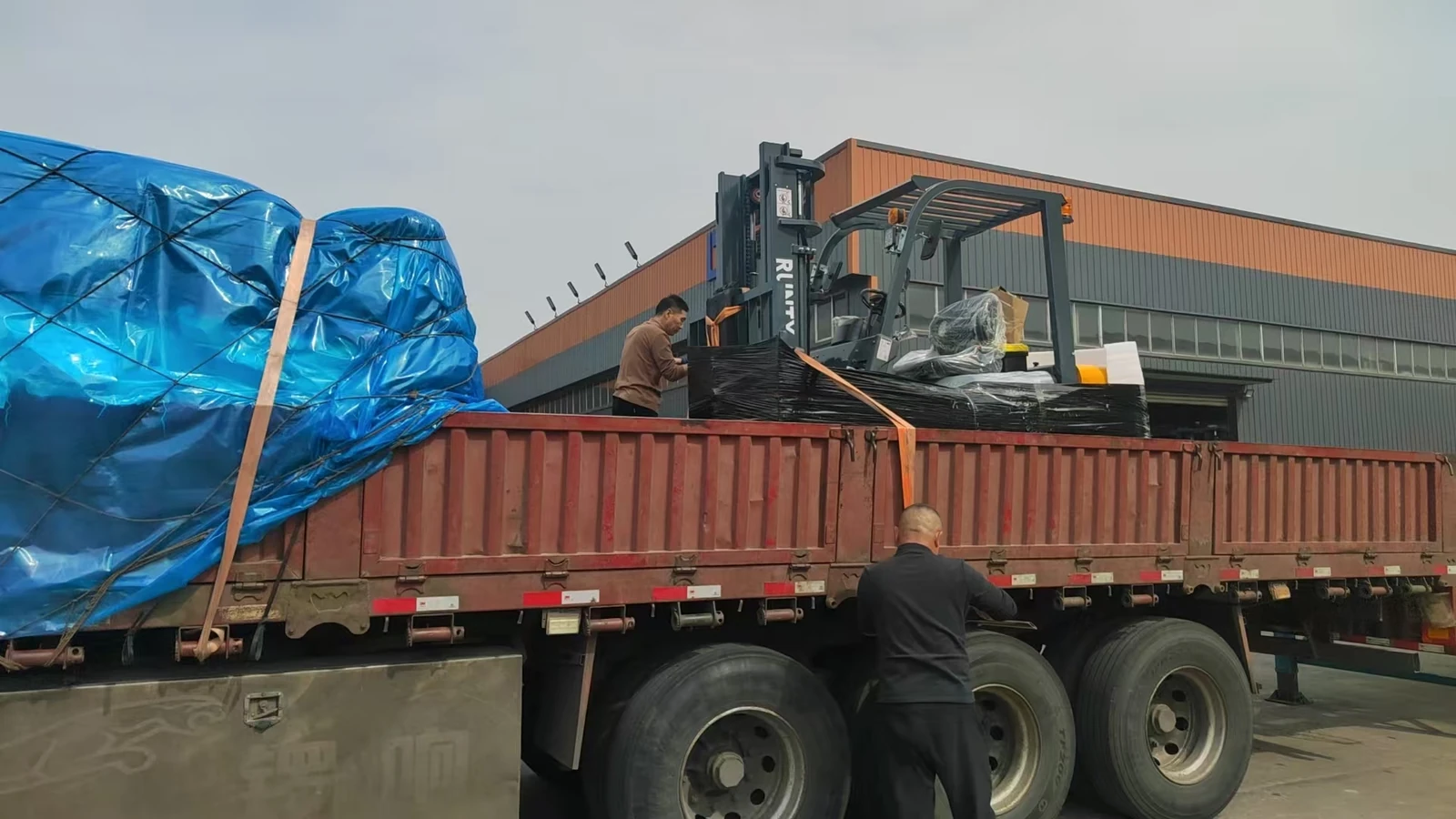
RUNTX shipments may move through major Chinese container ports such as Qingdao, Shanghai or Ningbo, depending on production location, sailing schedule, destination and logistics plan.
A distributor importing machinery every month may already have negotiated carrier contracts or preferred freight agents. In that situation, paying the factory to arrange the ocean freight may add little value.
A first-time importer may see the situation differently.
CIF Can Be Easier for a First-Time Forklift Importer
If the customer has never booked ocean freight from China, CIF can remove one significant piece of coordination.
RUNTX can obtain the freight quotation, arrange the ocean booking and required insurance, and quote the machine to the agreed destination port.
The buyer still needs to understand what happens at destination.
Local customs clearance, duties, taxes, terminal charges and transport from the port to the final warehouse are not automatically included merely because the quotation says CIF.
That is why we recommend asking one simple question before paying a deposit:
“What costs will I still need to pay after the vessel arrives?”
A good supplier should be able to explain the boundary clearly.
How Many Forklifts Fit in a 20GP or 40HQ?
Container utilization can have a major effect on the landed cost per forklift.
RUNTX uses model-specific loading plans rather than assuming every forklift occupies the same space.
For example, current internal loading references show that a standard CPC15 can typically be planned at around 4 units in a 20-foot container or 8 units in a 40HQ.
A CPC30 is larger, with a reference plan of approximately 3 units in a 20-foot container or 6 units in a 40HQ.
For heavier CPCD50 machines, container quantity reduces further. Depending on the exact CPCD50 version, the loading plan may be around 1–2 units in a smaller container and approximately 3–4 units in a 40HQ.
Once the forklift moves into heavier classes, a 20-foot container may no longer be practical at all.
Important:
These are planning references, not guaranteed loading quantities. Cabins, pneumatic versus solid tires, three-stage masts, longer forks, spare parts and additional attachments can change the loading plan. RUNTX reconfirms container quantity against the final machine configuration before shipment.
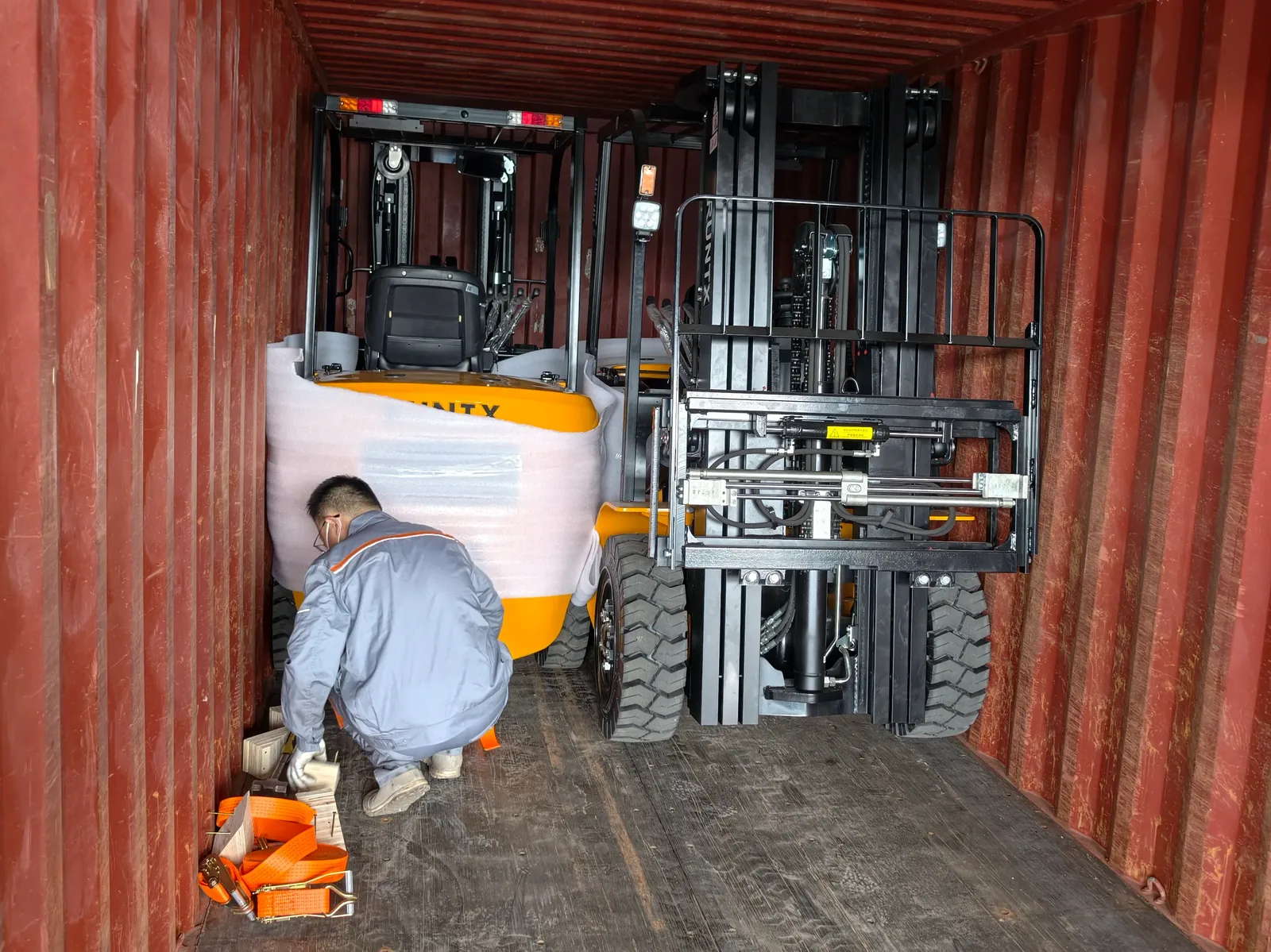
This is exactly why “FOB price per forklift” is not enough to calculate the real landed cost.
Two machines with similar factory prices may have different shipping economics if one configuration uses container space much less efficiently.
Why Current Ocean Freight Should Be Treated as a Moving Cost
Sea freight is not a fixed percentage of the forklift price.
Rates change by route, season, carrier capacity, congestion and geopolitical conditions.
As of October 29, 2026, Drewry’s World Container Index was approximately US$4,429 per 40-foot container, down 3% that week. Its October monthly average was around US$4,457 per 40-foot container.
Source: Drewry World Container Index, October 2026. This is a global freight-market benchmark, not a quotation for shipping a RUNTX forklift.
Freightos data from late October also showed very different rates by lane—for example approximately US$3,551/FEU from Asia to Northern Europe versus around US$4,252/FEU to the Mediterranean.
Source: Freightos Baltic Index market update, October 2026. Rates vary by route, carrier and booking conditions.
This is why RUNTX freight quotations are prepared around the actual destination and current sailing market rather than publishing one permanent “shipping price” on a product page.
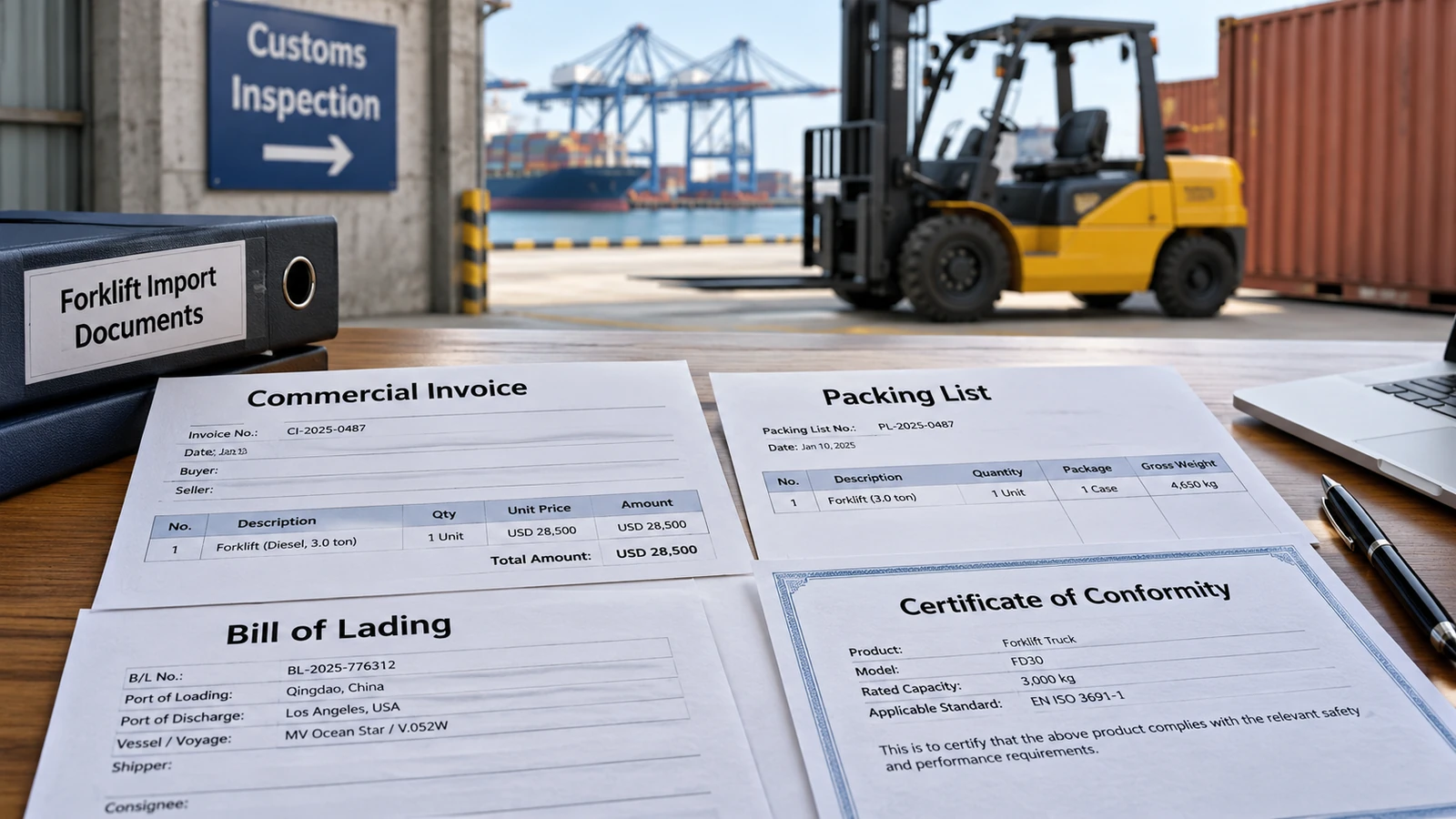
Which Documents Do You Normally Need to Import a Forklift?
The exact document package depends on the destination country, product configuration and local regulations.
For a conventional diesel forklift shipment, the core commercial documents commonly include the Commercial Invoice, Packing List and Bill of Lading.
Depending on the market and customer request, the shipment may also require or benefit from a Certificate of Origin, CE documentation, inspection or conformity certificates, insurance documents and other country-specific paperwork.
RUNTX provides the documents required for the agreed export procedure and works with customers when destination-country certification or clearance documents need to be prepared.
What buyers should avoid is assuming every country asks for exactly the same paperwork.
Lithium Electric Forklifts Need Extra Shipping Attention
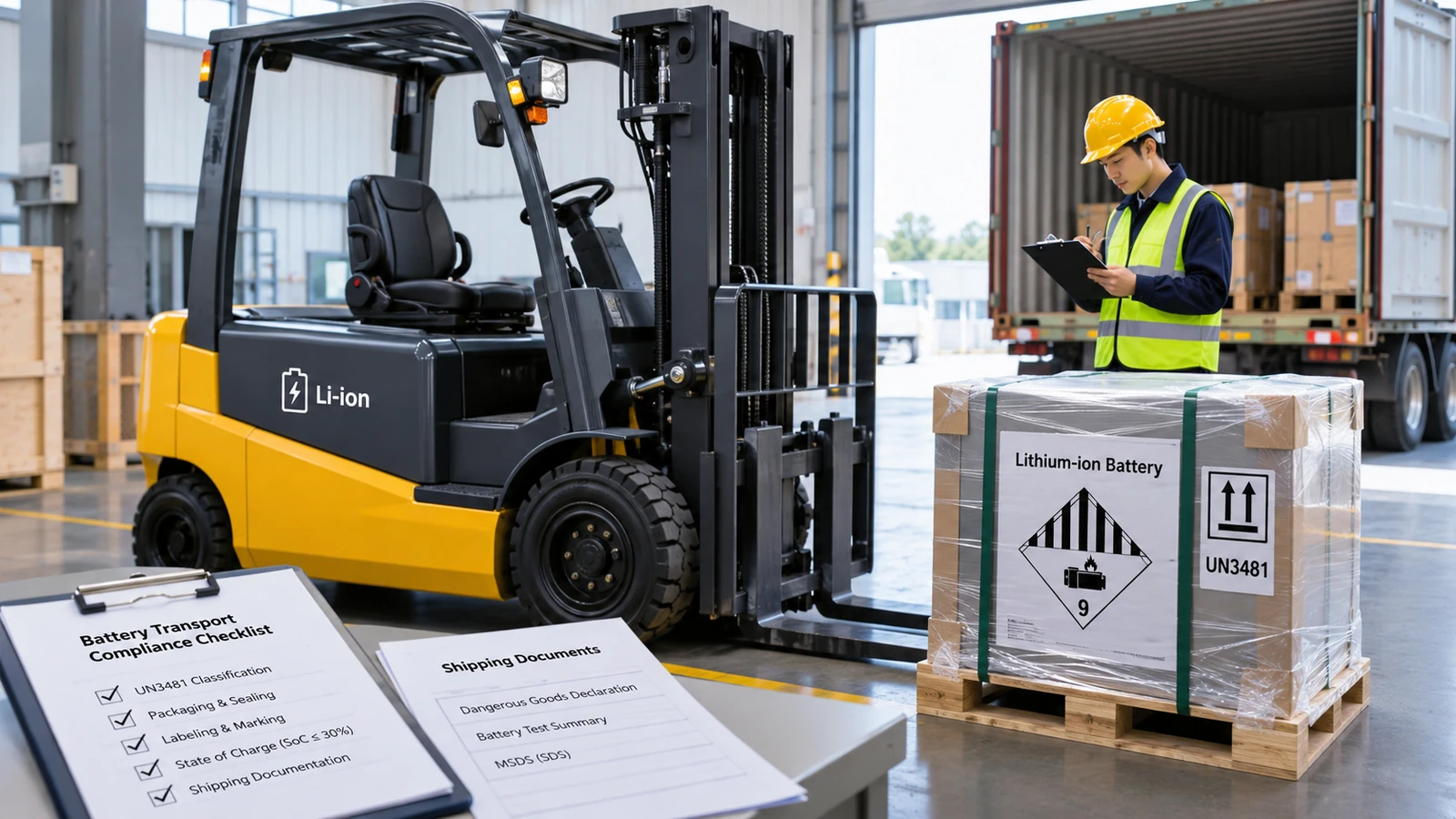
An electric forklift with a lithium battery introduces another layer of transport compliance.
Lithium batteries fall within dangerous-goods transport rules, and documentation can include battery test information such as UN 38.3 documentation, MSDS information and carrier-specific dangerous-goods paperwork depending on the battery, installation and shipment method.
From January 1, 2026, the IMO’s IMDG Code 2024 Edition incorporating Amendment 42-24 became mandatory for maritime transport of dangerous goods.
Source: International Maritime Organization, IMDG Code 2024 Edition, Amendment 42-24.
The UN Manual of Tests and Criteria also requires a lithium cell or battery test summary under subsection 38.3 to contain information such as battery type, mass, watt-hour rating, model identification, laboratory details and test results.
Source: United Nations Manual of Tests and Criteria, subsection 38.3.
For RUNTX lithium-powered equipment, our team works with the battery supplier and freight side to prepare or coordinate the required shipping documentation according to the actual project.
Do Not Forget VGM Before the Container Goes on the Vessel
Once forklifts, spare parts and securing materials are packed into a container, the final container weight also matters.
Under SOLAS rules, the shipper is responsible for providing the Verified Gross Mass (VGM) of a packed container before it can be used in the vessel’s stowage plan.
A packed container without the required verified gross mass can be denied loading.
Source: International Maritime Organization, SOLAS Verified Gross Mass requirements.
This becomes especially relevant with heavy forklifts because several machines, long forks, spare parts and additional attachments can bring a container close to practical weight limits before available physical space is fully used.
Buying Your First Forklift from China?
Tell RUNTX your model, quantity, destination port and whether you already have a freight forwarder in China. We can prepare an EXW, FOB or CIF proposal and explain which shipping costs and documents remain on the buyer’s side.
How to Compare Two Forklift Import Quotations Properly

Imagine Supplier A quotes a CPCD30 at US$500 less than Supplier B.
That does not tell you which offer is cheaper.
One quotation may be EXW while the other is FOB. One may include a three-stage mast, spare filters and solid tires while the other does not. One loading plan may fit six machines into a 40HQ while another configuration fits only five.
Before choosing the lower number, normalize the quotations.
Compare the same forklift specification, the same attachment package, the same Incoterm, the same destination and the same documentation scope.
Only then are you comparing prices rather than comparing exclusions.
Buyers comparing larger machines may also find our 10 Ton Diesel Forklift Cost Guide useful because it explains how configuration and delivery terms affect the real purchase cost.
Frequently Asked Questions
Is FOB or CIF better when importing a forklift from China?
FOB is often more suitable if you already have a trusted freight forwarder and want to control the international freight booking. CIF can be more convenient for first-time importers who want the factory to arrange the main ocean freight and insurance to the named destination port.
Does CIF include customs clearance and import tax?
No. Under CIF, the buyer remains responsible for import clearance and import duties or tariffs unless the sales contract separately states otherwise.
Does CIF mean the seller carries the transport risk until arrival?
No. Under Incoterms® 2020 CIF, risk transfers when the goods are on board the vessel at the port of shipment, even though the seller pays the freight and required insurance to the named destination port.
How much does it cost to ship a forklift from China?
There is no reliable fixed number. Cost depends on forklift size, quantity, container utilization, origin port, destination, carrier rates and current market conditions. Ask for a current freight quotation based on the final machine configuration.
Can a 3 ton forklift fit inside a standard shipping container?
Yes. As a current RUNTX planning reference, a standard CPC30 configuration may fit approximately three units in a 20-foot container or six in a 40HQ. Final quantity must be reconfirmed when cabins, mast options, tires, forks, attachments or spare parts are added.
What documents does RUNTX provide for export?
RUNTX provides the core commercial and export documents required for the agreed shipment and can support additional certificates or documentation where required by the customer’s destination market and equipment configuration.
The Cheapest Factory Price Is Not Always the Cheapest Imported Forklift
Importing a forklift from China becomes much easier once three things are clear: the machine specification, the Incoterm and the destination.
A buyer with a Chinese freight agent may prefer EXW or FOB. A first-time importer may find CIF easier. Neither option is automatically cheaper in every situation.
The real cost is the amount required to move the correct forklift from the factory to the point where your business can actually use it.
That means understanding container loading, shipping documents, freight, destination charges and local customs requirements before the deposit is paid.
Get those pieces clear at the quotation stage, and importing one forklift can be almost as straightforward as importing twenty.
Need a Forklift Quote That Includes Shipping?
Send RUNTX your forklift model, quantity and destination port. We can prepare factory-direct equipment pricing together with an EXW, FOB or CIF shipping option for your project.