Is a 7 ton diesel forklift the right step up for your operation? Learn where a CPCD70 makes sense, how it compares with 5 and 8 ton forklifts, and what to check before paying for more capacity.
Most businesses do not wake up one morning and decide they need a 7 ton forklift.
Usually, the problem develops gradually. The loads get heavier. A machinery supplier begins receiving larger components. A building-material yard starts handling denser products. A rental customer asks for jobs that the existing 5-ton machine can technically approach but no longer handles with a comfortable capacity margin.
That is the point where a 7 ton diesel forklift becomes interesting.
It is heavy enough to move serious industrial cargo, but it has not yet entered the size and cost category of 10-, 12- or 16-ton forklifts. For many small factories, contractors and independent rental companies, that middle position is exactly the appeal.
But buying a CPCD70 just because your heaviest load weighs six or seven tons can still be a mistake. The actual decision depends on load center, cargo dimensions, attachments, ground condition and how much of the machine’s capacity you will use during a normal week.
When a 5 Ton Forklift Starts Feeling Too Small
A 5-ton forklift can cover a surprising amount of industrial work. For many yards, it is enough for building materials, machinery components, steel products and large pallets.
The problem appears when your regular loads begin moving toward the upper end of that capacity—or when they become longer and less compact.
A six-ton steel component with its center of gravity close to the fork face is a very different lifting problem from a six-ton machine base that extends far beyond the forks. The second load produces a larger forward moment even though the scale shows the same weight.
OSHA gives a useful example of how quickly capacity can change. A forklift rated for 4,000 lb at a 24-inch load center may only have an estimated safe capacity of about 2,666 lb when the load center moves to 36 inches. That is roughly one-third less capacity simply because the load is carried farther forward.
Source: U.S. Occupational Safety and Health Administration (OSHA), Powered Industrial Trucks – Load Composition Guidance.
This is one reason experienced buyers leave some capacity reserve instead of selecting a forklift whose nameplate exactly matches the heaviest load on the site.
What a 7 Ton Diesel Forklift Is Actually Good At
The sweet spot for a CPCD70 is usually work that has already moved beyond normal warehouse handling but does not yet justify a true high-capacity forklift.
Think about a steel fabricator moving finished assemblies between the workshop and truck loading area. A precast or building-material company may need to handle dense concrete products. Machinery manufacturers often move molds, dies, engines or machine modules that are physically large even when their weight remains below seven tons.
Timber yards and industrial logistics sites are another common fit, particularly when the work happens outdoors and the machine needs to stay productive across long shifts without waiting for battery charging.
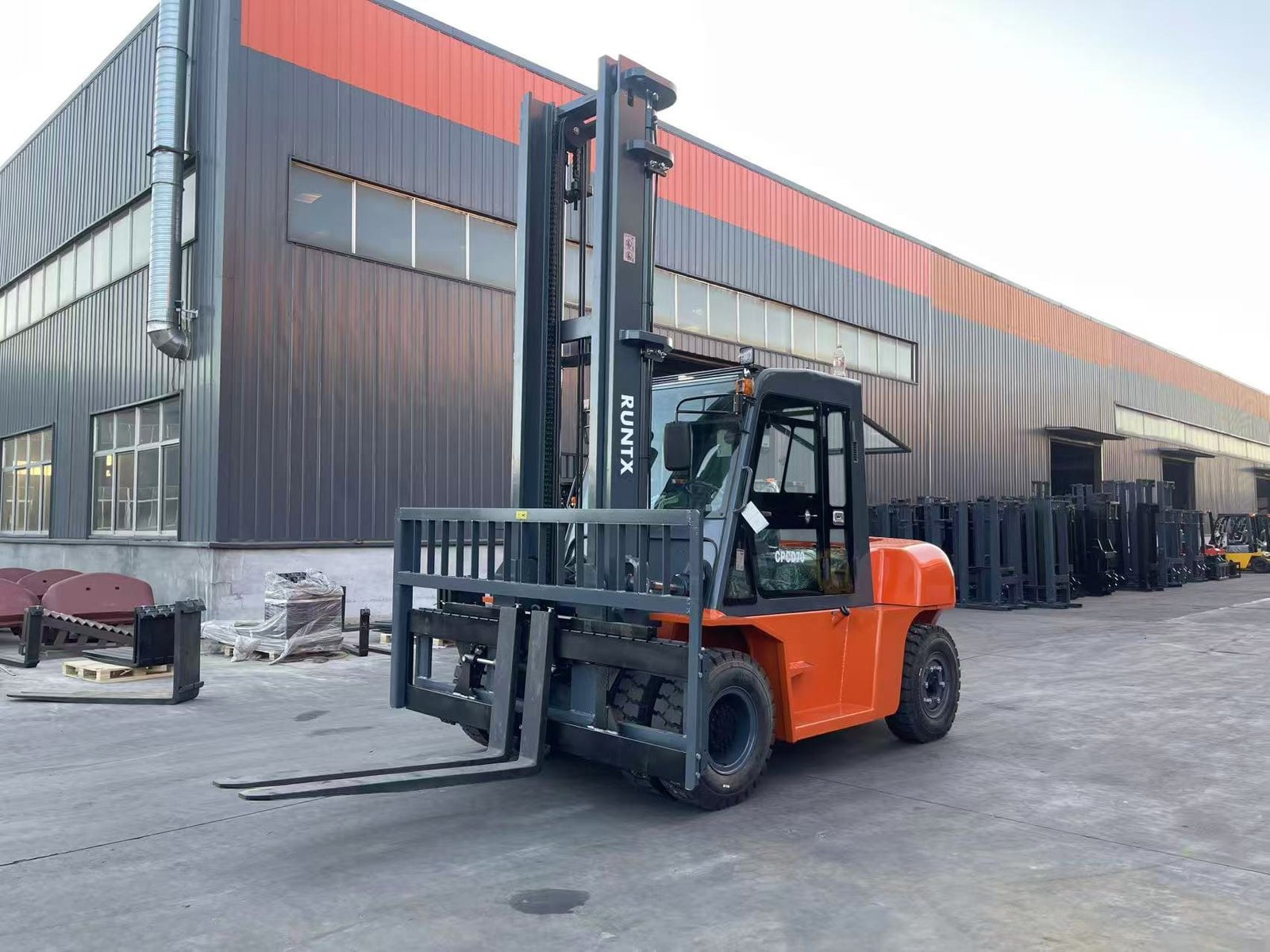
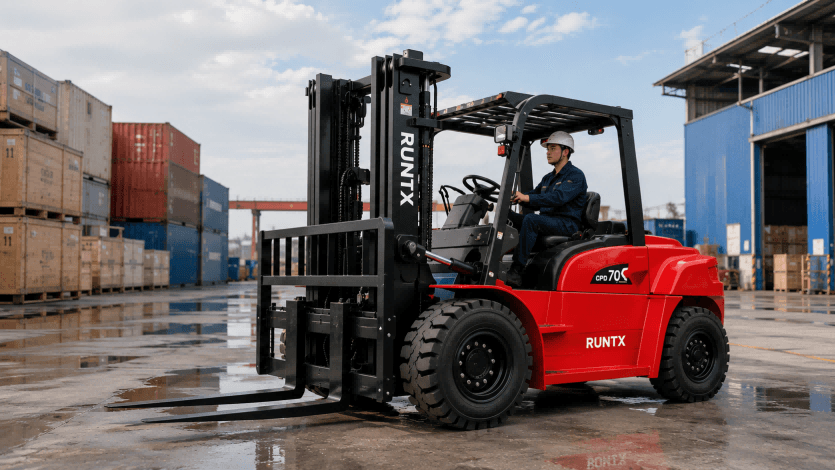
The current RUNTX heavy-duty range lists the CPCD70 at 7,000 kg rated capacity with a 600 mm load center and 3,000 mm standard lift height. Buyers can compare it within the RUNTX 5–10 Ton Diesel Forklift Series.
What makes the 7-ton class useful is not simply the extra two tons above a CPCD50. The heavier chassis, larger working envelope and stronger drivetrain are intended for repeated heavy-load cycles rather than occasional overload-style work.
5 Ton, 7 Ton or 8 Ton? The Difference Is Not Just Capacity
| Specification | CPCD50 | CPCD70 | CPCD80 |
|---|---|---|---|
| Rated Capacity | 5,000 kg | 7,000 kg | 8,000 kg |
| Load Center | 600 mm | 600 mm | 600 mm |
| Standard Lift Height | 3,000 mm | 3,000 mm | 3,000 mm |
| Minimum Turning Radius | 3,050 mm | 3,380 mm | 3,730 mm |
| Overall Width | 1,480 mm | 1,995 mm | 2,260 mm |
| Typical Buying Logic | Lower cost and easier maneuvering | Balanced heavy-duty capacity | More reserve for consistently heavier loads |
The dimensions tell an important story. Moving from five to seven tons is not free: the CPCD70 needs more room to turn and is roughly half a meter wider in the current series specification.
But moving again from seven to eight tons also increases the working envelope. If your site is already tight, buying one extra ton of theoretical capacity may create a machine that is less convenient during every ordinary move.
That is why seven tons can be a useful middle ground.
Long Loads Can Change the Decision Completely
This is especially relevant in steel, timber and machinery handling.
A buyer may tell us, “My load is only 6.2 tons, so a 7-ton forklift is enough.” Sometimes it is. Sometimes it is not.
If that 6.2-ton load is long enough to move the center of gravity farther forward than the truck’s rated 600 mm load center, the machine’s usable capacity falls. Long forks, fork positioners, clamps and sideshifters can also affect residual capacity.
OSHA’s own nameplate example shows a forklift rated at 5,000 lb with standard forks falling to 4,500 lb with a sideshifter installed in that specific configuration—a 10% reduction.
Source: U.S. Occupational Safety and Health Administration (OSHA), Powered Industrial Trucks – Nameplate Guidance.
There is no universal “10% rule.” The real reduction depends on the truck and attachment. The point is that your attachment should be part of the machine selection before the purchase order is signed, not something added casually afterward.
Do not send only “Need 7 ton forklift.” Send the supplier the maximum load weight, length and width, lift height, fork length and intended attachment. That information is much more useful than tonnage alone.
Your Yard May Be the Real Limiting Factor
A CPCD70 can have plenty of lifting capacity and still be the wrong machine for your site.
The current RUNTX specification lists a turning radius of around 3.38 meters and an overall width close to 2 meters. That is manageable in an open industrial yard, but it is very different from driving a compact 3-ton forklift through warehouse aisles.
Before buying, walk the actual route the forklift will use. Check the gate, truck loading zone, narrowest turn and any slope or damaged pavement.
This is not just a productivity issue. The UK Health and Safety Executive reports that vehicle overturns account for nearly one-fifth of workplace transport deaths. Among the contributing conditions HSE identifies are excessive slopes, slippery surfaces, soft or uneven ground, overloading and travelling too quickly around corners.
Source: UK Health and Safety Executive (HSE), Workplace Transport – Overturning.
For a contractor or rental company, this matters because sites change. A machine that works perfectly on a paved factory yard may be far less suitable on loose construction ground. If uneven terrain is the normal working environment rather than an occasional exception, a conventional CPCD70 may not be the category you should be buying.
When Paying for 7 Tons Can Improve ROI
The financial case becomes stronger when a 7-ton forklift removes a recurring bottleneck.
Imagine a small manufacturer that currently handles most loads with a 5-ton truck but hires external lifting equipment several times each month for heavier machine components. The question is no longer just what a CPCD70 costs. It is how much outsourced lifting, waiting time and production disruption the new forklift can eliminate.
Rental companies should look at the problem slightly differently. A 7-ton unit can open heavier jobs that the common 2.5–5 ton rental fleet cannot cover, but only if there is enough local demand to keep it working. A high-capacity machine sitting in the yard for three weeks does not generate a good return simply because the day rate is higher.
For a direct owner, utilization is the key number. If heavy loads appear several times a shift, the extra capacity is productive. If they appear four times a year, hiring specialized equipment may still make more sense.
Downtime Hits Small Fleets Harder
Once you move into heavier equipment, serviceability deserves more attention than buyers sometimes give it.
HSE states that lift trucks are involved in roughly one-quarter of all workplace transport accidents. Training, supervision and site planning therefore matter just as much as the machine itself.
Source: UK Health and Safety Executive (HSE), Managing Lift Trucks.
Historical U.S. Bureau of Labor Statistics data gives another useful picture of disruption. In 2017, forklift-related events caused 9,050 nonfatal workplace cases involving days away from work, with a median absence of 13 days compared with eight days across all cases.
Source: U.S. Bureau of Labor Statistics, Occupational Injuries, Illnesses, and Fatalities Involving Forklifts, 2017.
Those figures are injury data, not repair statistics, but they underline why correct selection and safe operation matter economically. For a small business with one heavy forklift, losing the machine or the operator can stop an entire loading process.
This is why buyers should ask for service intervals, common spare parts, filters, hydraulic components and technical documentation before comparing only the purchase price.

Not Sure Whether You Need 5, 7 or 8 Tons?
Send RUNTX your regular load weights, maximum dimensions, lift height, attachment requirement and site conditions. We can compare the CPCD70 with nearby capacity classes before you pay for a machine that is too small—or unnecessarily large.
Buying Direct Does Not Mean Buying a Fleet
One reason smaller companies hesitate before approaching a Chinese factory is the assumption that factory pricing requires a container full of identical forklifts.
RUNTX supports 1 Unit MOQ for suitable CPCD70 orders. A contractor or industrial company can therefore purchase one machine without committing to an unrealistic fleet quantity.
For dealers and rental companies, small-batch orders can mix capacities according to expected demand. OEM/ODM options can also include custom branding, body color, mast configuration, fork length, tires and specialized attachments.
International shipping should be discussed early as well. A 7-ton forklift is a substantial machine, and freight method, destination port and import documentation all affect the landed cost. RUNTX can assist with commercial invoices, packing lists, bills of lading, certificates and shipping coordination rather than leaving a first-time importer to solve those details after production.
Frequently Asked Questions
What is a 7 ton diesel forklift normally used for?
Typical applications include heavy machinery components, steel products, precast materials, timber packages, molds and other industrial loads that exceed the practical range of common 3–5 ton forklifts.
Should I buy a 7 ton or 8 ton forklift?
If regular loads remain comfortably within the CPCD70’s approved capacity at the actual load center, seven tons may offer a better balance of size and investment. An 8-ton machine makes more sense when loads frequently approach the 7-ton limit or the final configuration requires greater residual capacity.
Can a CPCD70 handle a 7 ton long load?
Not necessarily. Rated capacity applies at a specified load center. Long loads move the center of gravity forward and can significantly reduce usable lifting capacity. Provide the manufacturer with the actual load dimensions before ordering.
Is a 7 ton diesel forklift suitable indoors?
It may work in large, well-ventilated industrial buildings where local regulations permit diesel equipment, but its size, emissions and turning space make it more naturally suited to outdoor yards and heavy industrial sites.
Can I order only one CPCD70 from RUNTX?
Yes. RUNTX supports single-unit factory-direct purchasing for suitable projects, together with small-batch and OEM/ODM orders for distributors and fleet operators.

So, Is a 7 Ton Forklift Right for Your Site?
A CPCD70 makes the most sense when your operation has genuinely outgrown the 5-ton class but does not need to carry the cost and physical size of a larger heavy-duty machine every day.
The best candidates are sites with regular heavy loads, enough maneuvering space, suitable ground and a clear reason to own the capacity rather than rent it occasionally.
If your heaviest load is long, irregular or attachment-dependent, do the capacity calculation before choosing the truck. If your site is narrow or rough, check the machine against the actual route before comparing prices.
Seven tons is useful capacity when the work justifies it. It is wasted money when the number on the counterweight is doing more work than the forklift itself.
Check Your Loads Before Choosing Your Forklift
Tell us what you actually lift—not just the tonnage. Send RUNTX your load weight, dimensions, lift height, fork or attachment requirements and destination to receive a factory-direct CPCD70 configuration and quotation.