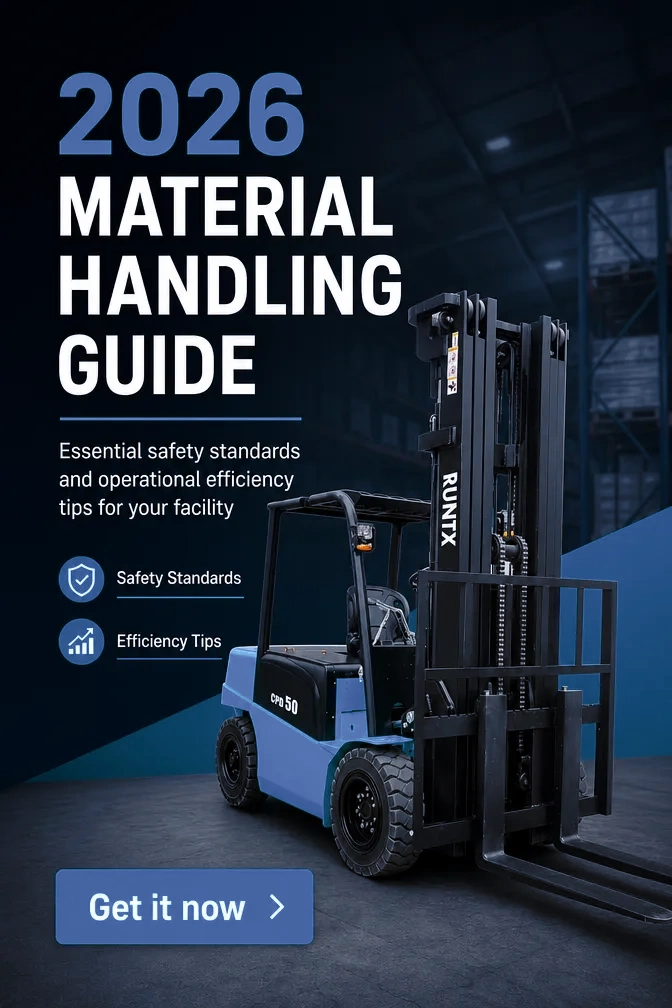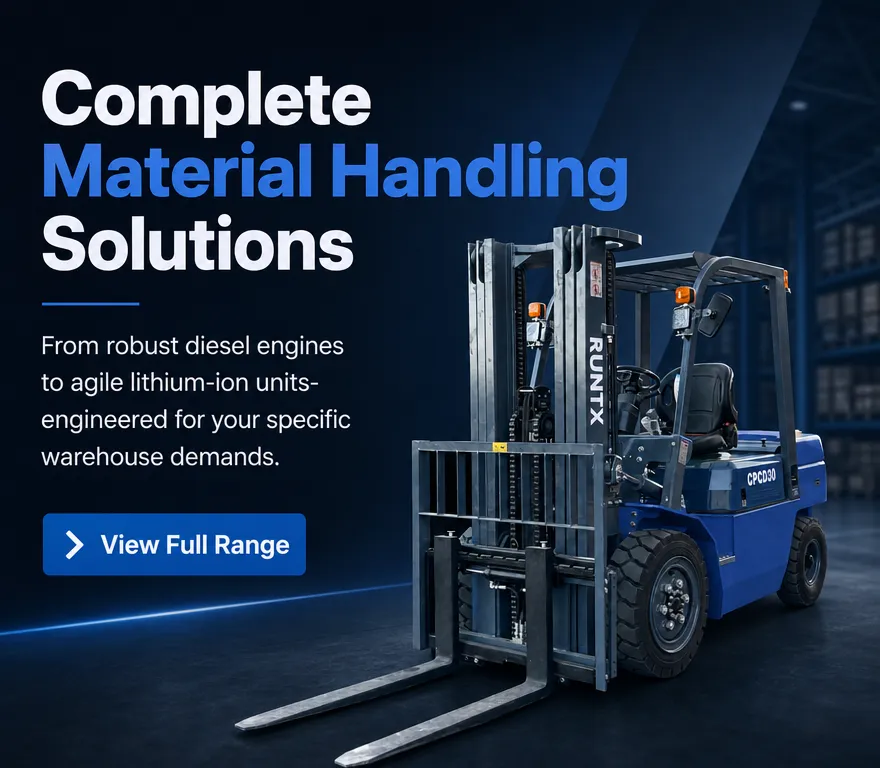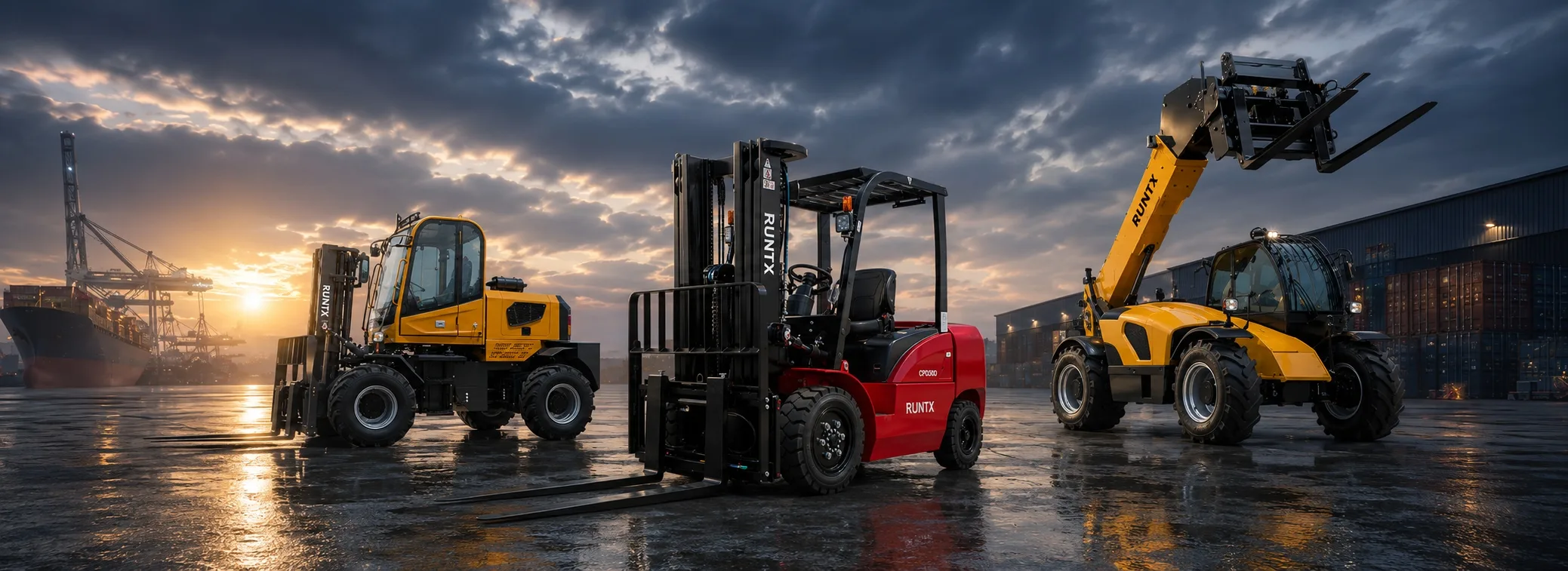
A forklift that is only 1.2 meters wide may still need more than 3 meters of aisle space to turn and place a pallet. Choosing between a counterbalance forklift, reach truck and VNA truck starts with the pallet and the right-angle stacking requirement—not the truck width alone.
Warehouse buyers often ask a simple question:
“My aisle is 3 meters wide. Which forklift can I use?”
The answer is rarely based on forklift width alone.
A truck may physically fit between two racks but still be unable to turn 90 degrees, align the pallet and insert the forks safely into the rack. Pallet depth, load orientation, turning radius, fork length and clearance all affect the real operating aisle.
That is why forklift manufacturers use a measurement commonly described as stacking aisle width, often shown as Ast.
For buyers designing a new warehouse—or trying to fit more pallet positions into an existing building—understanding Ast can prevent an expensive mistake. A counterbalance forklift, reach truck and VNA forklift may handle similar pallet weights, but they require very different warehouse layouts.

What Is Forklift Aisle Width?
Forklift aisle width is the clear operating space required for the truck to approach, turn and place or retrieve a load from racking.
It is different from the overall width of the machine.
For example, the current RUNTX CPD25 2.5 Ton 4-Wheel Electric Forklift is only 1,120 mm wide, but its minimum turning radius is 2,320 mm. The CPD30 is approximately 1,230 mm wide with a 2,480 mm turning radius.
So a 1.3-meter aisle obviously would not work just because the truck body fits inside it.
The truck needs room to swing the rear counterweight while positioning the forks perpendicular to the rack.
Toyota’s current warehouse guidance gives a useful industry reference: sit-down counterbalance forklifts commonly work in aisles around 12–14+ ft, while reach trucks commonly operate around 8–10 ft.
Source: Toyota Material Handling, “What Is a Reach Truck?”, 2026. These are general industry ranges, not RUNTX model-specific Ast values.
Counterbalance Forklift: Flexible, but It Needs Turning Space
A counterbalance forklift remains the most versatile option when the same truck needs to unload vehicles, travel outside, work in a yard and enter a warehouse.
The rear counterweight balances the load carried at the front. That simple layout works very well for general material handling, but it also gives the machine a relatively long body behind the front axle.
When the operator turns into a rack position, that rear section sweeps through the aisle.
The RUNTX CPCD30 3 Ton Diesel Forklift, for example, has a 2,400 mm minimum turning radius and a 1,225 mm overall width. The RUNTX CPD30 electric counterbalance truck has a 2,480 mm turning radius.
Those figures help explain why counterbalance trucks generally need wider warehouse aisles than specialized reach equipment.
If your operation includes loading docks, outdoor work and only moderate rack density, that extra aisle space may be a perfectly reasonable trade-off for a more flexible machine.

Reach Truck: Where Narrow-Aisle Warehousing Starts to Make Sense
A reach truck is built around a different idea.
Instead of carrying a large rear counterweight and turning a long chassis into the rack, it uses support legs and a reach mechanism that moves the forks or mast toward the pallet position.
That shorter working geometry is why reach trucks are common in high-density indoor warehouses.
The difference becomes clearer when we look at actual RUNTX specifications.
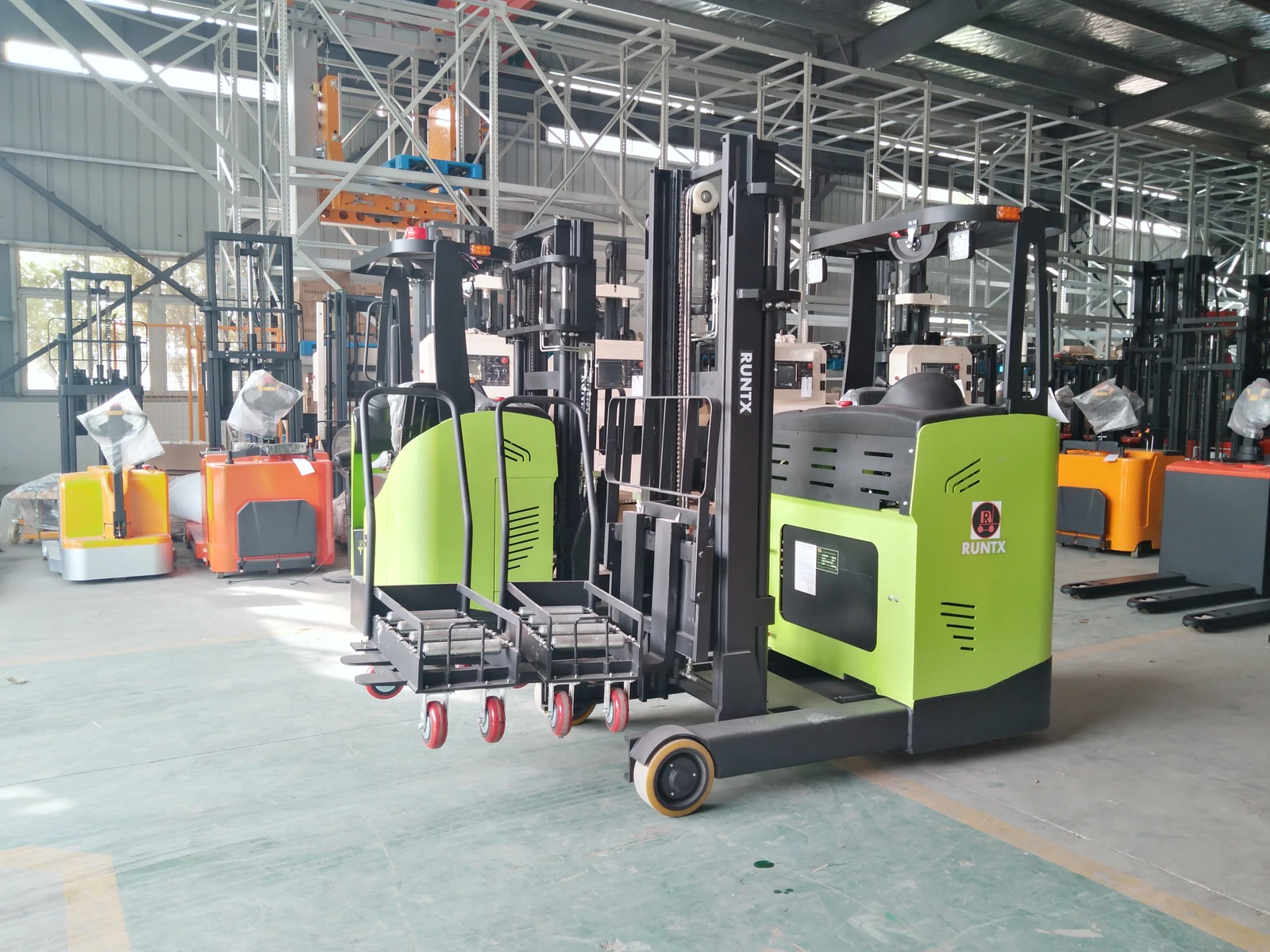
The RUNTX CQDA15 Rear Stand-on Reach Truck requires approximately 2,808 mm stacking aisle width for a 1000×1200 mm pallet when the operator pedal is folded.
Open the pedal and the requirement increases to approximately 3,212 mm.
That is more than 400 mm of extra aisle created simply by the operating configuration.
Another example, the RUNTX CQDS four-way reach truck series, requires approximately 2,705–2,900 mm for a 1000×1200 mm pallet depending on capacity and model.
Source: RUNTX CQDA15/CQD20A and CQDS Series published technical specifications.
This is why warehouse layout should be matched to the exact truck rather than designed around a generic phrase such as “reach truck aisle.”
VNA Forklift: When the Truck Stops Turning Into the Rack
Very Narrow Aisle equipment takes the concept further.
A three-way or turret-style VNA truck can rotate or shift its forks toward the rack while the truck itself remains aligned with the aisle.
The machine no longer needs the same 90-degree body rotation used by a conventional counterbalance forklift.
This is how operating aisles can move into the 1.5–2.4 meter range.
The current RUNTX CDDM12 VNA Tri-Lateral Stacker, for example, is specified for a 1,500 mm pallet-handling aisle with a 1000×1000 mm pallet. The CDDM16 uses approximately 1,600 mm with a 1200×1200 mm pallet.
Your broader RUNTX NA-series specification also shows how the requirement increases with truck capacity and pallet configuration:
| RUNTX VNA Model | Rated Capacity | Minimum Stacking Aisle |
|---|---|---|
| NA15 | 1,500 kg | 1,600 / 1,800 mm |
| NA20 | 2,000 kg | 1,800 / 2,000 mm |
| NA25 | 2,500 kg | 2,000 / 2,200 mm |
| NA30 | 3,000 kg | 2,200 / 2,400 mm |
The two aisle figures correspond to different pallet orientations specified in the RUNTX technical sheet. That detail is important because pallet orientation changes the space needed to stack.
Counterbalance vs Reach Truck vs VNA: Practical Comparison
| Equipment | Typical / Example Aisle | Best Use | Main Trade-Off |
|---|---|---|---|
| Counterbalance | Industry reference roughly 3.7–4.3 m for many sit-down trucks | Dock, warehouse and outdoor mixed work | Requires more right-angle turning space |
| Reach Truck | RUNTX examples approximately 2.7–3.2 m | High-density indoor pallet racking | More specialized; typically indoor-focused |
| VNA / 3-Way | RUNTX examples approximately 1.5–2.4 m | Maximum rack density and high-level storage | Requires more specialized warehouse design and guidance |
Toyota’s 2026 guidance similarly classifies standard aisles as roughly 10.5 ft or wider, narrow aisles as 8.5–10.5 ft and VNA applications as approximately 5–7 ft.
Source: Toyota Material Handling, Narrow Aisle Forklifts: Do More With Less, 2026. Actual required aisle width must be confirmed from the specific truck and pallet specification.
Pallet Size Can Change the Answer
Even the correct forklift model can produce the wrong warehouse layout if pallet dimensions are ignored.
Common pallets vary significantly between markets.
European operations frequently use 1200×800 mm or 1200×1000 mm pallets. The common North American size is approximately 1219×1016 mm. Australia commonly uses 1140×1140 mm, while 1100×1100 mm pallets are common in Japan, Korea and parts of Asia.
A 1200 mm dimension pointing into the rack creates a different turning and stacking geometry from an 800 mm dimension.
This is why a supplier asking only for “pallet size” is not always asking enough. We also need to know which side enters the rack first.
How Much Storage Can Narrower Aisles Actually Create?
This is where the economics become interesting.
Crown publishes a warehouse layout example comparing three equipment concepts in the same general floor-space scenario.
A traditional sit-down counterbalance layout using a 12 ft aisle provided 144 pallet positions. Moving to a 9 ft reach-truck aisle increased the example to 192 positions—approximately 33% more capacity.
A 6 ft VNA layout increased the same example to 240 pallet positions, approximately 67% above the counterbalance layout.
Source: Crown Equipment TSP warehouse capacity planning example. Results apply to the illustrated warehouse layout and should not be treated as a universal storage-density guarantee.
That last sentence matters.
You cannot assume that buying a VNA truck automatically increases your warehouse capacity by 67%. Building columns, fire exits, staging areas, rack depth, pallet size and ceiling height all change the result.
But the example demonstrates why aisle width deserves serious financial consideration: every meter given to traffic is a meter that cannot hold racking.
A Real 3.3 Meter Aisle Example
Consider a warehouse using approximately 1000×1200 mm pallets, loads up to 1.5 tons and an existing aisle around 3.3 meters wide.
A buyer might initially assume that a standard counterbalance forklift should work because 3.3 meters sounds generous compared with the width of the truck.
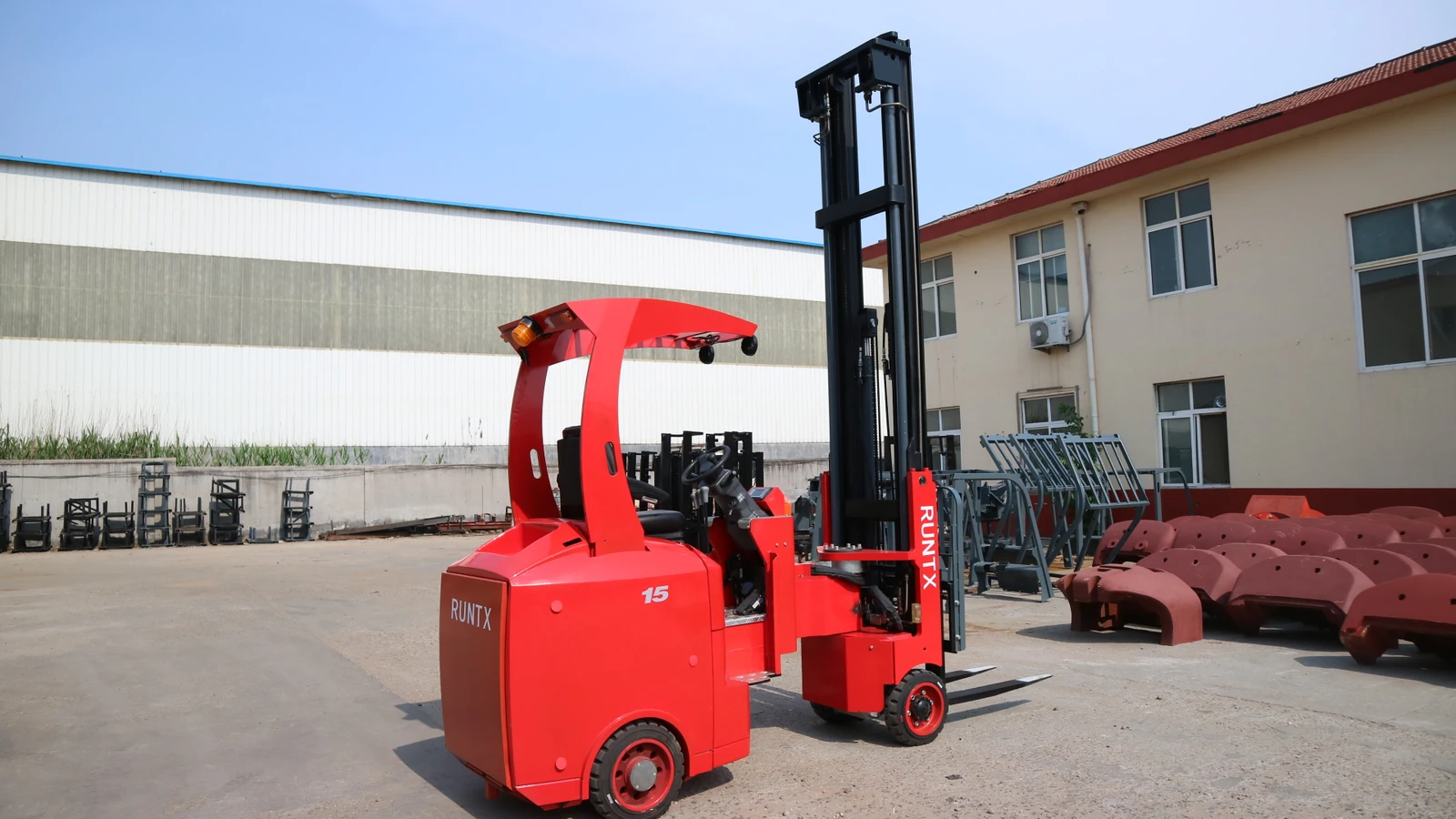
But right-angle stacking is the real question.
For this type of layout, a reach truck becomes much more interesting. The RUNTX CQDA15 requires around 2.8 meters with the pedal folded and roughly 3.2 meters with the pedal open for a 1000×1200 mm pallet.
That means a 3.3-meter aisle may comfortably support certain reach-truck configurations while leaving much less margin for many conventional sit-down counterbalance arrangements.
The final choice would still depend on rack height, pallet orientation and required operating clearance.
Why VNA Is Not Automatically the Best Choice
If narrower aisles create more storage positions, it might seem logical to make every warehouse VNA.
That would be a mistake.
VNA trucks are specialized machines. Many installations use rail or magnetic guidance to keep the truck precisely aligned inside the aisle. Your RUNTX CDDM-series equipment, for example, can work with guide-rail or optional navigation solutions.
The warehouse floor, rack alignment and main cross-aisles therefore become part of the equipment decision.
A VNA truck also does not replace every other machine in the building. Many operations still use pallet trucks or counterbalance forklifts for receiving and dock work, then transfer pallets to the VNA system for storage.
For a small warehouse that has enough space, a reach truck may offer a better balance between density, flexibility and capital cost.
Not Sure Which Forklift Fits Your Existing Aisle?
Send RUNTX your clear aisle width, pallet dimensions and orientation, maximum load, rack height and floor layout. We can compare counterbalance, reach-truck and VNA options before you purchase the equipment.

Frequently Asked Questions
How wide should a forklift aisle be?
There is no single correct width. Many conventional sit-down counterbalance forklifts work in approximately 12–14+ ft aisles, while reach trucks commonly work around 8–10 ft. The exact requirement depends on the truck, pallet dimensions and stacking orientation.
Can a reach truck work in a 3 meter aisle?
Many can. Several RUNTX reach-truck models specify pallet stacking aisles around 2.7–3.2 meters. The exact truck and pallet size must be checked before finalizing the rack layout.
What is the minimum aisle width for a VNA forklift?
RUNTX VNA examples range from approximately 1.5 meters for smaller tri-lateral models to around 2.4 meters for higher-capacity configurations. Pallet dimensions and truck design determine the final requirement.
Does pallet size affect aisle width?
Yes. Pallet depth and the direction in which the pallet enters the rack affect the truck’s right-angle stacking geometry and therefore the required Ast.
Should I choose the narrowest possible aisle?
Not automatically. Narrower aisles can increase storage density, but equipment cost, throughput, floor quality, rack design, guidance systems and cross-aisle requirements should be considered together.
Measure the Warehouse Before Choosing the Forklift
The right aisle width is not a number that should be copied from another warehouse.
A counterbalance forklift may be the best investment when flexibility and outdoor use matter most. A reach truck often makes sense when rack density and vertical storage become more important. VNA becomes attractive when maximizing pallet positions justifies a more specialized warehouse system.
Before requesting a quotation, measure the clear rack-to-rack aisle, pallet dimensions, pallet orientation, maximum load and required lift height.
Those five numbers tell an equipment supplier far more than simply saying:
“I need a forklift for a narrow warehouse.”
Planning a New Warehouse or Reworking Your Aisles?
Send us your aisle width, pallet size, rack height and load weight. RUNTX can compare counterbalance, reach-truck and VNA solutions and prepare a factory-direct proposal for one truck or a complete warehouse fleet.