From manufacturing relocation and warehouse expansion to data centers, infrastructure and port operations, Southeast Asia is becoming one of the most important growth regions for global material handling equipment suppliers.
“How big is the Southeast Asian market, really?”
For equipment manufacturers, distributors and procurement managers, this is no longer a simple regional market question. Southeast Asia is becoming a collection of very different industrial markets, each moving at a different speed and requiring a different equipment mix.
The opportunity is real, but the bigger story is not simply the number of forklifts or aerial platforms that could be sold. The structural change is happening underneath the equipment market: manufacturing investment is moving into ASEAN, warehouses are becoming more sophisticated, infrastructure projects are expanding, ports are handling enormous cargo volumes, and industrial customers are demanding safer and more productive equipment.
According to the ASEAN Investment Report 2025, FDI inflows into ASEAN increased 8% to approximately US$226 billion, while manufacturing FDI surged to around US$44 billion. That combination is particularly important for material handling suppliers because factories, logistics parks, distribution centers and export facilities all require equipment to move goods through increasingly complex supply chains.
Data Source: ASEAN Investment Report 2025, ASEAN Secretariat and UNCTAD.

1. Southeast Asia Is Not One Market — It Is Several Growth Cycles
One of the biggest mistakes in regional market analysis is treating ASEAN as one homogeneous market.
In reality, Malaysia may be driven by semiconductor plants and data centers, Thailand by industrial clusters and infrastructure, Indonesia by urbanization and large-scale construction, Vietnam by export-oriented manufacturing and logistics, while Singapore remains a highly automated gateway for regional trade.
This difference directly changes equipment demand.
A newly built electronics factory may prioritize electric forklifts, warehouse stackers and pallet trucks. A construction contractor may need diesel forklifts, rough-terrain machines and boom lifts. A container terminal may require reach stackers and container handlers. A high-rise maintenance contractor may prioritize electric scissor lifts or boom lifts.
The opportunity is therefore not simply to “sell more forklifts.” It is to match the equipment portfolio to each country’s industrial development cycle.
2. The Market Numbers Are Large — But the Equipment Mix Matters
Research published in January 2026 estimates that the Southeast Asia construction equipment market was approximately 53,208 units in 2024 and could reach 69,611 units by 2030, representing a CAGR of 4.58%.
Importantly for material handling manufacturers, the report identifies forklifts and telescopic handlers as the largest segment within Southeast Asia’s material handling equipment category. Demand is being supported by manufacturing expansion, warehouse construction and logistics-park development.
Data Source: Arizton Advisory & Intelligence, Southeast Asia Construction Equipment Market Research Report 2025–2030.
The aerial platform market tells a similar story. Future Market Insights estimates the ASEAN aerial work platform market at US$363.4 million in 2025, with the market projected to reach approximately US$1.424 billion by 2035, equivalent to an estimated 8.2% CAGR.
Construction represents the largest end-use segment in the study, while warehousing and logistics already account for a significant share of demand. Boom lifts, scissor lifts and vertical mast lifts therefore increasingly sit alongside forklifts as part of the same industrial equipment ecosystem.
Data Source: Future Market Insights, ASEAN Aerial Work Platform Market, 2025–2035.
3. Malaysia: Manufacturing, Data Centers and Logistics Are Changing Equipment Demand
Malaysia is one of the clearest examples of how industrial investment creates secondary equipment demand.
Its industrial ecosystem combines electronics and electrical manufacturing, semiconductor-related investment, logistics, automotive production and rapidly expanding digital infrastructure.
In 2025, Malaysia recorded approximately RM426.7 billion in approved investments, up 11% year on year. MIDA reported particularly strong investment in information and communications, with data centers, cloud computing and AI infrastructure becoming major contributors.
Data Source: Malaysian Investment Development Authority (MIDA), 2025 Investment Performance.
The warehouse market is also becoming more sophisticated. JLL reported that Kuala Lumpur’s Grade A logistics warehouse stock reached approximately 36.78 million sq ft by Q1 2026, while demand continued from logistics, automotive, medical and electronics sectors.
For equipment suppliers, this environment creates demand across multiple categories: electric and diesel forklifts, pallet trucks, stackers, VNA equipment, scissor lifts and boom lifts.
4. Thailand: A Mature Industrial Base With Increasing Demand for Local Support
Thailand is different. It is not simply an emerging market; it already has a mature industrial ecosystem spanning automotive, electronics, logistics, petrochemicals and infrastructure.
The Eastern Economic Corridor is a major part of this development. The EEC combines industrial estates, ports, airports, high-speed rail and supporting infrastructure, creating a concentration of manufacturing and logistics activity.
Data Source: Eastern Economic Corridor Office (EECO), Thailand.
What is changing is the competitive requirement for equipment suppliers. Customers increasingly expect not only competitive pricing but also localized spare-parts availability, service engineers and faster response times.
This is visible in the strategies of major Chinese equipment manufacturers. Zoomlion, for example, has continued expanding its Thai service network, with multiple local service centers and spare-parts support. Its Thai operation has also supplied forklifts and aerial work platforms alongside construction machinery.
Data Source: Zoomlion Thailand corporate announcements, 2024–2026.
The implication for Chinese manufacturers is clear: the next stage of competition is moving from price competition toward service capability and local market depth.
5. Indonesia: Scale, Infrastructure and Industrial Relocation
Indonesia brings a different advantage: scale.
The country’s large population, industrialization, mining activity, infrastructure development and logistics requirements create a diversified equipment market rather than a single-industry opportunity.
The development of Nusantara is one visible example, but the wider investment story is more important. Manufacturing, logistics, energy and infrastructure projects all require equipment capable of working in demanding environments.
For these applications, standard warehouse forklifts may not be enough. Buyers may need diesel forklifts, rough-terrain forklifts, telescopic handlers, heavy-duty lifting equipment and mobile elevating work platforms.
At the same time, Indonesia is becoming an important digital-infrastructure market. The ASEAN Guide for Sustainable Data Centre Development identifies Greater Jakarta as having more than 1 GW of data-center pipeline, highlighting the scale of digital infrastructure investment already developing in the country.
Data Source: ASEAN Guide for Sustainable Data Centre Development, ASEAN Secretariat, 2025.

6. Vietnam: Manufacturing Relocation Is Creating More Warehouse Demand
Vietnam is increasingly positioned inside global manufacturing supply chains, particularly in electronics, consumer goods and industrial production.
The consequence is not limited to factory construction. Every additional production cluster requires raw-material storage, finished-goods warehousing, loading docks, internal transportation and distribution infrastructure.
That makes warehouse equipment especially relevant: electric pallet trucks, stackers, forklifts, order pickers and narrow-aisle solutions can become part of the same investment cycle.
This is also where automation and equipment efficiency begin to matter. As facilities become larger and more standardized, buyers are increasingly evaluating equipment based on fleet uptime, battery systems, serviceability, residual value and total operating cost rather than purchase price alone.
7. Ports Are Another Major Opportunity: Think Beyond Forklifts
Southeast Asia’s equipment opportunity does not stop at factories and warehouses.
Singapore handled approximately 44.66 million TEUs in 2025, an 8.6% increase from the previous year. That scale illustrates the importance of containerized trade and port logistics in the region.
Data Source: Singapore Maritime and Port Authority / Port Technology International reporting on 2025 container throughput.
For ports, inland container depots and freight terminals, the equipment discussion is different. Productivity depends on container cycle times, lifting height, reach capability, attachment design, visibility, stability and powertrain reliability.
This creates a market for container reach stackers and container handlers in addition to conventional forklifts.
For a supplier with a broad portfolio, this matters because the same customer may purchase warehouse forklifts for an inland distribution center, heavy diesel trucks for industrial yards and port machines for container handling.
8. Rental and Electrification Will Shape the Next Phase
Rental is becoming an increasingly important procurement model across ASEAN construction equipment markets. Mordor Intelligence estimates that internal-combustion equipment still represented the majority of the ASEAN construction equipment rental market in 2025, while electric drive equipment is projected to record faster growth through 2031.
Another market study estimates the Southeast Asian construction equipment rental market at approximately US$4.95 billion in 2025, with a forecast CAGR of 6.92% through 2034.
Data Source: Mordor Intelligence and IMARC Group, Southeast Asia/ASEAN Construction Equipment Rental Market studies, 2025–2026.
This is particularly relevant for equipment manufacturers. Rental fleets generally prioritize machines that are easy to maintain, durable across multiple operators, supported by readily available parts, and configured for high utilization.
For indoor warehouses, manufacturing plants and commercial facilities, electric forklifts and electric aerial platforms are likely to gain further traction. For construction, mining, outdoor logistics and heavy industrial applications, diesel and rough-terrain equipment will remain important.
9. What This Means for Chinese Equipment Manufacturers
The strongest conclusion is not that Chinese manufacturers will automatically replace European, Japanese or American suppliers.
The market is becoming more competitive, and international customers are becoming more demanding.
Chinese suppliers increasingly have advantages in manufacturing scale, product variety, engineering customization and price-to-performance ratio. But those advantages must be combined with quality control, documentation, local service, spare-parts support and reliable export execution.
For a manufacturer such as RUNTX, this creates an opportunity to operate as a broader material-handling partner rather than a single-product forklift vendor.
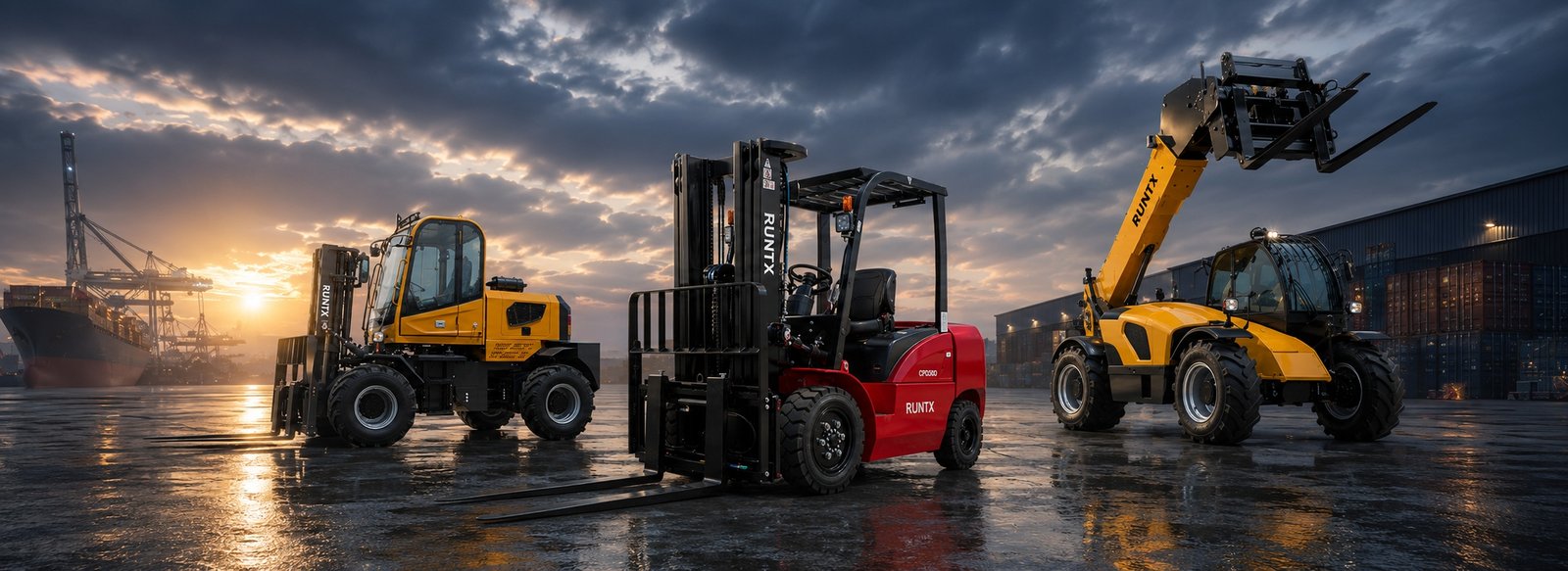
RUNTX’s product range includes diesel forklifts, electric forklifts, rough-terrain and telescopic forklifts, warehouse equipment, mobile elevating work platforms such as scissor and boom lifts, plus port machines including container reach stackers and container handlers.
This product structure is particularly relevant to Southeast Asia because the region’s demand is fragmented across construction sites, factories, warehouses, logistics parks, industrial yards and ports.
10. The Real Opportunity Is Not “Selling to Southeast Asia”
The more important question for a distributor or procurement manager is: Which Southeast Asian industrial ecosystem are you entering?
Malaysia may require a combination of warehouse equipment, electric forklifts and access platforms for advanced manufacturing and data-center construction. Thailand may reward suppliers with strong local service capability. Indonesia may favor heavy-duty equipment and rugged configurations. Vietnam may create increasing demand for warehouse and factory logistics equipment. Singapore emphasizes productivity, safety and highly engineered logistics solutions.
There is no single ASEAN equipment strategy.
There are several markets moving at different speeds—and suppliers that understand those differences are more likely to win long-term fleet business.

Frequently Asked Questions
Is Southeast Asia a good market for forklift manufacturers?
Yes, particularly for suppliers targeting manufacturing, warehousing, logistics, construction and port-related applications. Current investment and construction-equipment data indicate continued structural demand across multiple ASEAN economies.
Which Southeast Asian countries should forklift exporters prioritize?
Malaysia, Thailand, Indonesia and Vietnam are strong candidates, but the right market depends on the supplier’s product mix. Singapore is especially relevant for high-specification logistics and port applications.
Are electric forklifts replacing diesel forklifts in Southeast Asia?
Not completely. Electric equipment is increasingly attractive for warehouses and indoor manufacturing, while diesel remains important for outdoor yards, construction, ports and heavy-duty applications. Application should determine the powertrain.
Are aerial work platforms growing in ASEAN?
Yes. Future Market Insights estimates the ASEAN AWP market could grow at approximately 8.2% CAGR between 2025 and 2035, supported by infrastructure, construction, logistics, urbanization and workplace-safety requirements.
Can RUNTX support Southeast Asian distributors with OEM or ODM equipment?
RUNTX provides factory-direct material handling solutions and OEM/ODM support. Equipment configurations can be discussed around application, capacity, mast height, powertrain, attachments, branding and destination-market requirements.
Conclusion: Southeast Asia Is Moving From Opportunity to Execution
The Southeast Asian material handling market is no longer simply an emerging-market story.
Manufacturing investment is rising. Warehouses are becoming larger and more automated. Data-center and infrastructure construction is creating new equipment demand. Ports are handling record volumes. Rental is becoming more important. Electrification is accelerating in applications where it makes economic and operational sense.
For global distributors and industrial buyers, the opportunity is substantial—but the winning strategy will not be based on price alone.
The next phase of Southeast Asian equipment sourcing will favor manufacturers that can combine product breadth, engineering customization, quality consistency, export capability, spare-parts support and long-term technical service.
Looking for a Southeast Asia Equipment Supply Partner?
Tell us your country, application, required capacity and equipment type. RUNTX can prepare a product recommendation, technical configuration, OEM/ODM proposal and wholesale quotation for your market.