Most forklift buyers overthink capacity. They either buy too small and outgrow the machine in a year, or they buy too big and pay for tonnage they never use. The 3-ton diesel class avoids both mistakes. It sits exactly where global demand actually concentrates, and it delivers the outdoor toughness that lighter electric units simply cannot match. This guide breaks down why, using real specifications from the RUNTX CPCD30 and verifiable third-party industry data.
The 3-Ton Class Is Where the Market Actually Buys
Forklift demand is not evenly spread across capacity ranges.
- The below-5-ton lifting capacity segment is expected to lead global forklift demand in 2025, according to IMARC Group’s forklift truck market analysis.
- Class V industrial trucks — the internal-combustion counterbalance category that includes diesel forklifts like the CPCD30 — held roughly 50.2% of the global forklift truck market in 2024, per the same IMARC Group report.
- Diesel-powered models remain the preferred choice for heavy-duty, rough-terrain, and outdoor construction work, especially where infrastructure for electric charging is limited, according to Coherent Market Insights’ industrial truck market report.
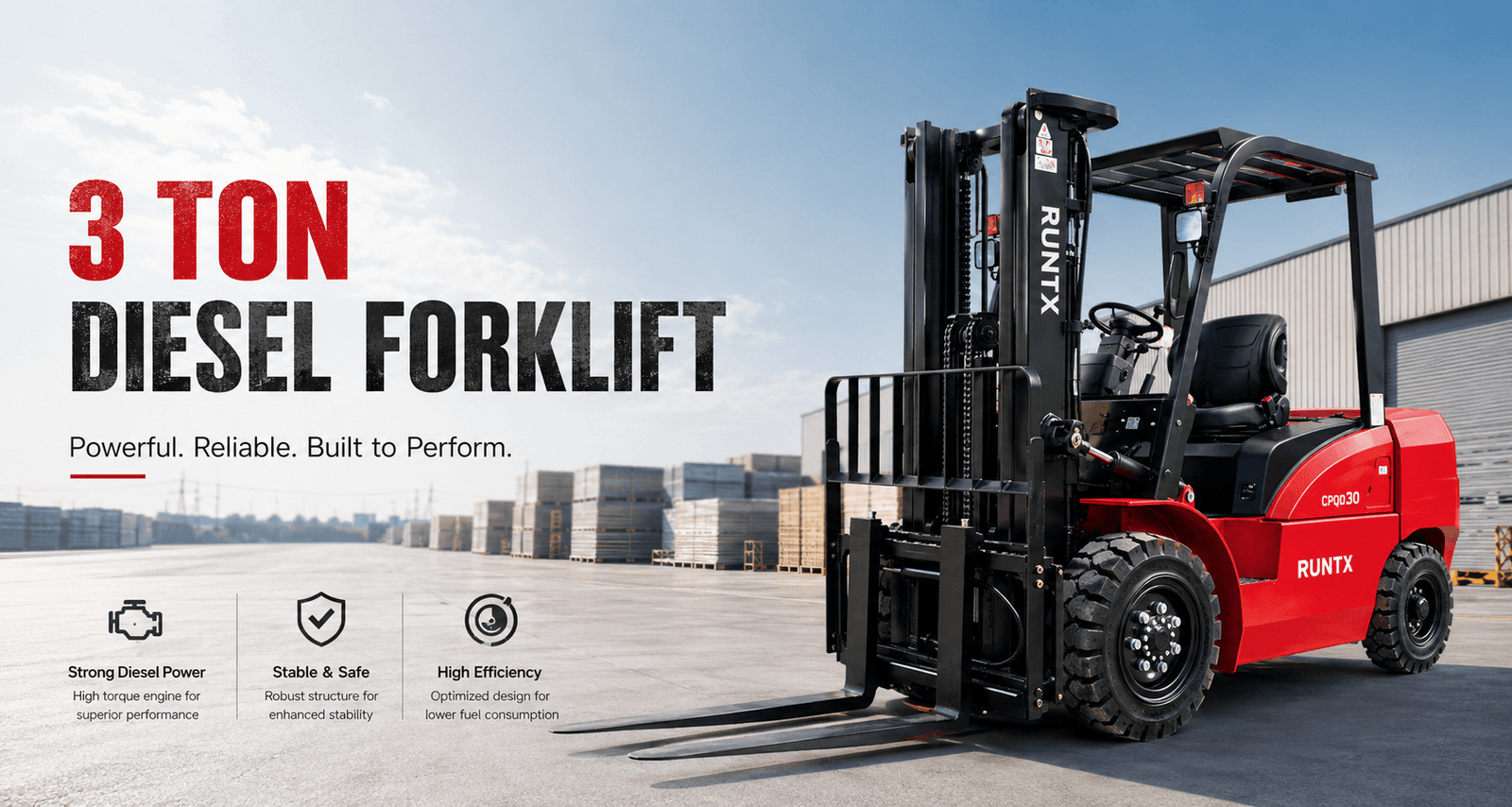
Put together, these three facts describe one machine profile: a mid-capacity diesel counterbalance truck built for the outdoors. That is precisely the segment the CPCD30 was engineered for.
Real Numbers From the RUNTX CPCD30
No marketing language here — just the datasheet.
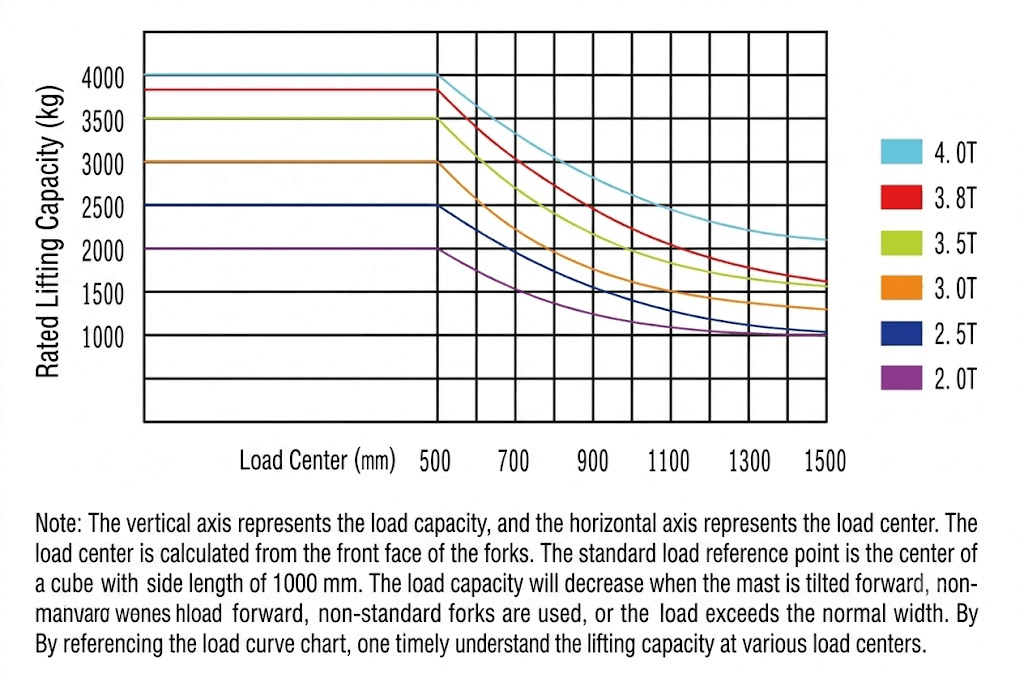
- Load capacity: 3,000 kg at a 500 mm load center.
- Operating weight: 4,300 kg for stable counterbalance on uneven ground.
- Max drive speed: 18.5 km/h loaded, 19 km/h unloaded.
- Max gradeability: 15% loaded, 20% unloaded — enough for loading dock ramps and yard slopes.
- Max traction force: 20 kN.
- Min turning radius: 2,560 mm for maneuvering in tighter yards.
- Overall footprint: 2,825 mm long, 1,230 mm wide, with a 1,750 mm wheelbase.
- Front tires: 28×9-15-14PR pneumatic, built for gravel, dirt, and broken pavement.
Every figure above comes directly from the CPCD30 specification sheet. Full details and configuration options are on the CPCD30 product page.
Diesel Refuels in Minutes. Electric Waits for Hours.
Uptime is the real cost driver in material handling, not the sticker price.
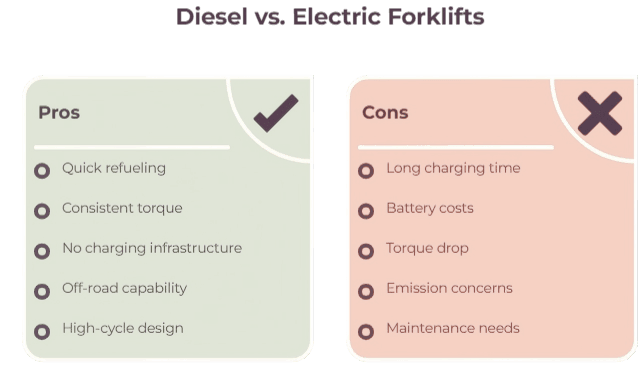
- A diesel forklift refuels in roughly 5 to 10 minutes and returns to full power immediately.
- A standard electric forklift battery needs 6 to 8 hours for a full charge, plus cooldown time before it can be recharged again.
- Multi-shift electric operations often require a second battery, a dedicated swap station, and ventilated charging infrastructure — capital costs diesel simply avoids.
- Diesel torque output stays flat through the whole shift, while electric units can lose lift and travel speed as charge drops.
For a single-shift warehouse, this difference barely matters. For a 24/7 lumber yard, port, or construction site, it decides whether your operation stalls or keeps moving. That is why RUNTX’s full diesel range — including narrow-aisle-capable and heavy-duty configurations — is built around this same refuel-and-go logic. Browse the complete lineup on the diesel forklift collection page.
Cleaner Than You Think: Modern Diesel Meets Global Emission Standards
“Diesel” no longer means “dirty.” The technology has moved on.
- Under the U.S. EPA’s Tier 4 Final nonroad diesel rule, exhaust emissions from covered nonroad diesel engines are cut by more than 90% compared to pre-regulation levels.
- The same EPA rule reduces allowable sulfur content in nonroad diesel fuel by more than 99%, protecting the emission-control hardware itself.
- The CPCD30 platform is offered with a wide range of engine choices spanning China II through China IV and Euro II through Euro V emission standards, so buyers can match the exact compliance level their region or job site requires.
- Rated power across available engines runs from about 34.6 kW to 44.8 kW, with both mechanical and hydraulic (torque-converter) transmission options — letting you tune the truck for pure fuel economy or for heavier, more demanding duty cycles.
This is not a one-size-fits-all machine. It is a platform you configure once and run for years.
Built to Handle What Warehouses Can’t
The CPCD30 is not designed for polished concrete. It is designed for everything else.
- Pneumatic tires absorb shock on gravel, mud, and unpaved yards where solid-tire electric trucks struggle.
- A 130 mm minimum ground clearance keeps the undercarriage clear of ruts, curbs, and construction debris.
- A 2,145 mm overhead guard height and reinforced mast are built for repeated, high-cycle loading — not occasional pallet moves.
- Optional working attachments, including side-shifters, fork positioners, and rotators, adapt the same base truck to lumber, drum handling, or paper roll operations.
Who Should Choose the CPCD30
This machine is the right fit if your operation matches any of the following:
- Outdoor yards, construction sites, or lumberyards without reliable grid power for charging.
- Multi-shift or around-the-clock operations where downtime for charging is not acceptable.
- Rough, unpaved, or sloped terrain where pneumatic tires and high traction force matter.
- Buyers who need a specific emission tier (Tier/China/Euro standard) to satisfy import or job-site regulations.
- Fleets that want one durable platform instead of frequent replacement.
If your day-to-day looks like this, a 3-ton diesel forklift is not a compromise — it is the calculated choice backed by where the global market itself is spending its money.
Note: All specifications referenced in this article are drawn directly from RUNTX’s CPCD30 technical datasheet.
Ready to Put a 3-Ton Diesel Forklift to Work?
The RUNTX CPCD30 is built for outdoor, multi-shift, high-cycle operations — and it’s available with the exact engine and emission configuration your project requires. Talk to our team about specs, lead times, and pricing.