A smaller turning circle does not always mean a better forklift. Compare real warehouse dimensions, lifting capacity and ownership costs before choosing between three and four wheels.
Running a small warehouse means making every square meter count. If your forklift struggles to turn between pallet racks, operators spend time repositioning the truck instead of moving goods. But choosing a compact machine solely because it has three wheels can create another problem: insufficient capacity, unsuitable tires or unexpected limitations as your business grows.
The 3-wheel vs 4-wheel electric forklift decision is about more than wheel count. Warehouse aisle width, turning radius, load center, battery configuration and operating conditions should all influence your investment.
This guide uses actual RUNTX U Series technical specifications to compare both designs and help warehouse owners, contractors, independent buyers and forklift distributors choose equipment that fits their operations and budgets.
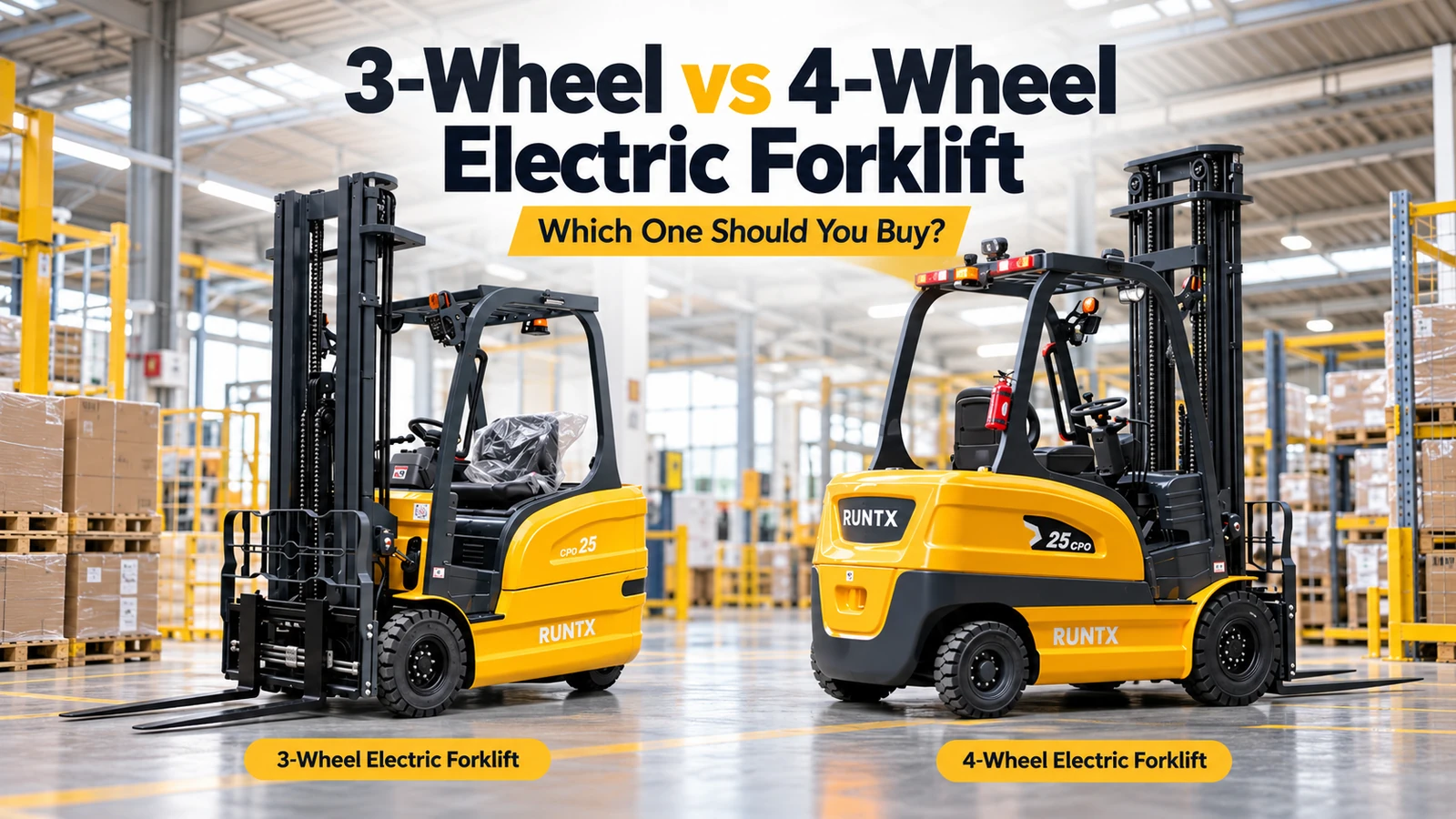
3-Wheel vs 4-Wheel Electric Forklift: Key Differences
A 3-wheel electric forklift typically uses two front wheels and a compact rear steering arrangement. Its geometry often makes it suitable for frequent turning and maneuvering around closely spaced storage areas.
A 4-wheel electric forklift uses a four-wheel chassis arrangement. Depending on its dimensions, tire configuration and rated capacity, it can serve a wider variety of warehouse and industrial applications.
Neither layout is automatically superior. A specially designed short-wheelbase four-wheel forklift may turn more tightly than a conventional three-wheel model. Likewise, having four wheels does not remove the need to follow the manufacturer’s stability and load-capacity instructions.
| Buying Factor | 3-Wheel Electric Forklift | 4-Wheel Electric Forklift |
|---|---|---|
| Typical application | Compact indoor warehouse operations | Warehousing and varied industrial handling |
| Maneuverability | Often compact, depending on model | Short-wheelbase versions may also turn tightly |
| Capacity range | RUNTX U Series: 1–2.5 tons | RUNTX U Series catalog: 1–10 tons |
| Working surface | Generally smooth, firm warehouse floors | Depends on tires, chassis and site conditions |
| Selection priority | Maneuvering space and pallet dimensions | Capacity, load handling and versatility |
Real RUNTX Specifications: Compare Four Electric Forklifts
Rather than comparing hypothetical vehicles, consider four actual machines from the RUNTX U Series: CPD20S and CPD25S three-wheel models, alongside CPD20 and CPD25 four-wheel configurations.
All four have a standard lifting height of 3,000 mm and a specified load center of 500 mm. That makes the comparison particularly useful for buyers considering common warehouse pallet-handling tasks.
| Specification | CPD20S 3-Wheel | CPD20 4-Wheel | CPD25S 3-Wheel | CPD25 4-Wheel |
|---|---|---|---|---|
| Rated capacity | 2,000 kg | 2,000 kg | 2,500 kg | 2,500 kg |
| Load center | 500 mm | 500 mm | 500 mm | 500 mm |
| Standard lifting height | 3,000 mm | 3,000 mm | 3,000 mm | 3,000 mm |
| Minimum turning radius | 1,793 mm | 2,190 mm | 1,993 mm | 2,320 mm |
| Aisle width, 1,200 × 1,000 mm pallet | 3,460 mm | 3,800 mm | 3,660 mm | 3,900 mm |
| Battery specification | 48 V / 300 Ah | 48 V / 350 Ah | 48 V / 300 Ah | 48 V / 350 Ah |
| Weight including battery | 2,900 kg | 2,850 kg | 3,500 kg | 3,400 kg |
Source: RUNTX Electric Forklift Catalog, three-wheel and four-wheel standard-model specifications. The CPD20 figures refer to the standard-wheelbase version, not the optional short-wheelbase configuration. Specifications should be reconfirmed for the final quotation.
The standard CPD20S has a published turning radius 397 mm smaller than the standard CPD20. For a 1,200 × 1,000 mm pallet orientation, the specified aisle requirement is also 340 mm narrower.
These are differences between published machine specifications, not independently verified improvements in warehouse productivity. The actual usable aisle must also account for pallet overhang, racks, pedestrian routes and operating clearances.
A Surprising Result: A Short-Wheelbase 4-Wheel Forklift Can Turn Tighter
One of the biggest mistakes in electric forklift selection is assuming that three wheels always mean a smaller turning radius.
RUNTX also offers a short-wheelbase CPD20 four-wheel configuration with a published 1,760 mm turning radius, compared with 1,793 mm for the CPD20S three-wheel model.
That is a 33 mm advantage for the short-wheelbase four-wheel machine on this particular specification. However, its published aisle requirement for a 1,200 × 1,000 mm pallet is 3,350 mm versus 3,460 mm for CPD20S. Buyers should compare the complete maneuvering envelope rather than the turning radius alone.
Before ordering a compact electric forklift, measure your actual aisle width, pallet orientation, rack clearance and turning points. Ask for the manufacturer’s operating-aisle specification for your exact forks, mast and attachment combination.
Explore the RUNTX 3-Wheel Electric Forklift Series and 4-Wheel Electric Forklift Series for available capacity options.

Which Electric Forklift Is Better for a Small Warehouse?
Small E-Commerce and Distribution Warehouses
Warehouses with frequent pallet retrieval, tight corners and limited staging space should prioritize working aisle width and turning geometry. A compact three-wheel forklift may work well if its load capacity and battery configuration fit daily demand.
For example, a buyer considering 2-ton loads can review the RUNTX CPD20S 2 Ton 3-Wheel Electric Forklift alongside compact four-wheel alternatives.
Manufacturing Workshops and Mixed-Use Facilities
Workshops handling machinery components, packaged raw materials and heavier pallets may benefit from a broader four-wheel capacity selection.
The RUNTX U Series four-wheel catalog extends beyond the three-wheel range, making it suitable for buyers who expect their lifting requirements to increase. The RUNTX CPD25 2.5 Ton Electric Forklift is one option for comparing standard warehouse loads.
Indoor and Outdoor Material Handling
Electric forklifts produce no combustion exhaust at the vehicle, which makes them useful for many indoor applications. However, outdoor suitability depends on tires, moisture protection, gradients and ground conditions—not simply whether a forklift has four wheels.
For rough or damaged surfaces, request confirmation of the machine’s approved operating environment rather than assuming a standard electric counterbalance truck is a rough terrain forklift.
Battery, Charging and Operating Cost: What Buyers Should Calculate
Battery selection can have a greater impact on daily operating cost than the difference between three and four wheels.
For example, the catalog lists a 48 V / 300 Ah battery for CPD20S and a 48 V / 350 Ah battery for the standard CPD20. Their nominal electrical energy values are approximately 14.4 kWh and 16.8 kWh, respectively, calculated by multiplying nominal voltage by ampere-hours.
These figures do not represent guaranteed usable energy or working hours. Actual runtime depends on battery chemistry, discharge limits, lifting frequency, driving distance, load weight and temperature.
To calculate electricity cost, multiply the actual metered charging consumption by your local electricity tariff. Also include charger losses, battery replacement, tires, scheduled maintenance and downtime.
For illustration, 12 kWh of metered electricity at $0.15/kWh costs $1.80 per charge. This is a calculation example, not a measured RUNTX energy-consumption claim.
Battery chemistry must also be confirmed. Lead-acid and lithium-ion systems have different charging practices, initial costs and maintenance considerations. Do not assume that every model uses the same chemistry simply because the catalog lists voltage and capacity.

Operator Safety and Maintenance: Three Important Reference Points
For small businesses, a forklift breakdown affects more than repair expenses. It can disrupt receiving schedules, warehouse access and customer deliveries.
The RUNTX U Series uses AC drive control and offers features described in the product catalog such as electrical fault diagnostics, emergency power-off and overload protection. Confirm the exact equipment features for the selected configuration.
As a useful regulatory reference, the U.S. Occupational Safety and Health Administration requires powered industrial trucks to be examined at least daily before service. When equipment is used around the clock, examination is required after each shift.
OSHA also requires each operator’s performance to be evaluated at least once every three years, with refresher training under specified circumstances. These requirements emphasize that safe performance depends on both the machine and the people operating it.
Battery charging is another important consideration. OSHA requires charging installations to be located in designated charging areas, with additional precautions applicable to the charging activity and battery type.
These are U.S. regulatory references, not universal rules for every export destination. Buyers should verify local safety, electrical and workplace requirements before commissioning equipment.
Buying Directly from RUNTX: Single Units and Dealer Orders
RUNTX supplies three-wheel and four-wheel electric forklifts for warehouses, contractors, equipment businesses and international distributors.
For eligible direct purchases, RUNTX supports 1 Unit MOQ, allowing small buyers to request a factory-direct quotation without committing to a large fleet. Distributors can also discuss small-batch pricing and mixed-model orders.
OEM/ODM options include customized colors, branding and compatible attachments, subject to technical approval. RUNTX can assist with export documentation and freight coordination to help overseas buyers understand the purchasing process.
Need an Electric Forklift for a Small Warehouse?
Tell RUNTX your pallet size, maximum load, aisle width and operating hours. We can recommend suitable three-wheel or four-wheel configurations and prepare a factory-direct quotation for one machine or a small fleet.

Electric Forklift Buying Checklist
Before selecting a model, prepare the following information:
- Load: Maximum pallet weight, dimensions and load center.
- Warehouse: Clear aisle width, turning points and rack clearance.
- Lift height: Highest required pallet position and lowered-mast clearance.
- Floor: Surface condition, slopes and dock transitions.
- Power: Daily working hours, charging breaks and available electrical supply.
- Customization: Fork lengths, attachments, branding and battery preferences.
- Import: Destination, required certifications and shipping terms.
Request the final load-capacity chart and dimensional drawing. A model that fits the aisle but cannot safely handle the intended load is not the right investment.
Frequently Asked Questions
Is a 3-wheel electric forklift better for narrow aisles?
Often, but not always. Some short-wheelbase four-wheel forklifts have smaller turning radii than conventional three-wheel models. Compare the working aisle requirement for your actual pallet size and configuration.
Can a 3-wheel electric forklift lift 2.5 tons?
Yes. The RUNTX CPD25S has a catalog-rated capacity of 2,500 kg at a 500 mm load center. Actual permitted loads depend on the approved capacity chart, lift height and attachment configuration.
Does a 4-wheel forklift always have better stability?
No universal conclusion can be drawn from wheel count alone. Stability depends on vehicle engineering, center of gravity, load positioning, traveling conditions and operator behavior.
How long does an electric forklift battery last?
Runtime varies with usable battery energy, duty cycle, load weight, battery condition and charging practices. Request a duty-cycle-based estimate instead of relying on a universal number of operating hours.
Can I purchase one electric forklift from RUNTX?
Yes. RUNTX supports eligible single-unit orders, along with small-batch wholesale and OEM/ODM arrangements. Final configurations, prices and shipping terms are confirmed individually.
Choose the Right Electric Forklift for Your Warehouse
Compare three-wheel, four-wheel and short-wheelbase electric forklifts with RUNTX. Request technical specifications, factory-direct single-unit pricing or flexible dealer quotations.
Technical reference: RUNTX Electric Forklift Catalog. Safety references: U.S. OSHA 29 CFR 1910.178. Confirm current configuration specifications and local regulatory requirements before ordering.