More traction is not always better value. Learn when a 4WD forklift earns its extra cost, when 2WD is enough, and how to choose the right machine for your actual job site.
A forklift that works perfectly on concrete can become an expensive problem on a gravel construction site. Spinning tires, uneven loading areas and unexpected downtime can slow down an entire small business. Yet buying the biggest 4WD forklift available is not necessarily the answer.
For contractors, lumber yards, farm operators and rental businesses, the smarter question is whether a 2WD or 4WD rough terrain forklift provides enough traction, ground clearance and lifting capacity without creating unnecessary ownership costs.
This guide compares both drivetrains using real RUNTX equipment specifications, explains where articulated steering fits in, and shows how to evaluate a forklift purchase without relying on exaggerated performance claims.
4WD vs 2WD Forklift: What Is the Real Difference?
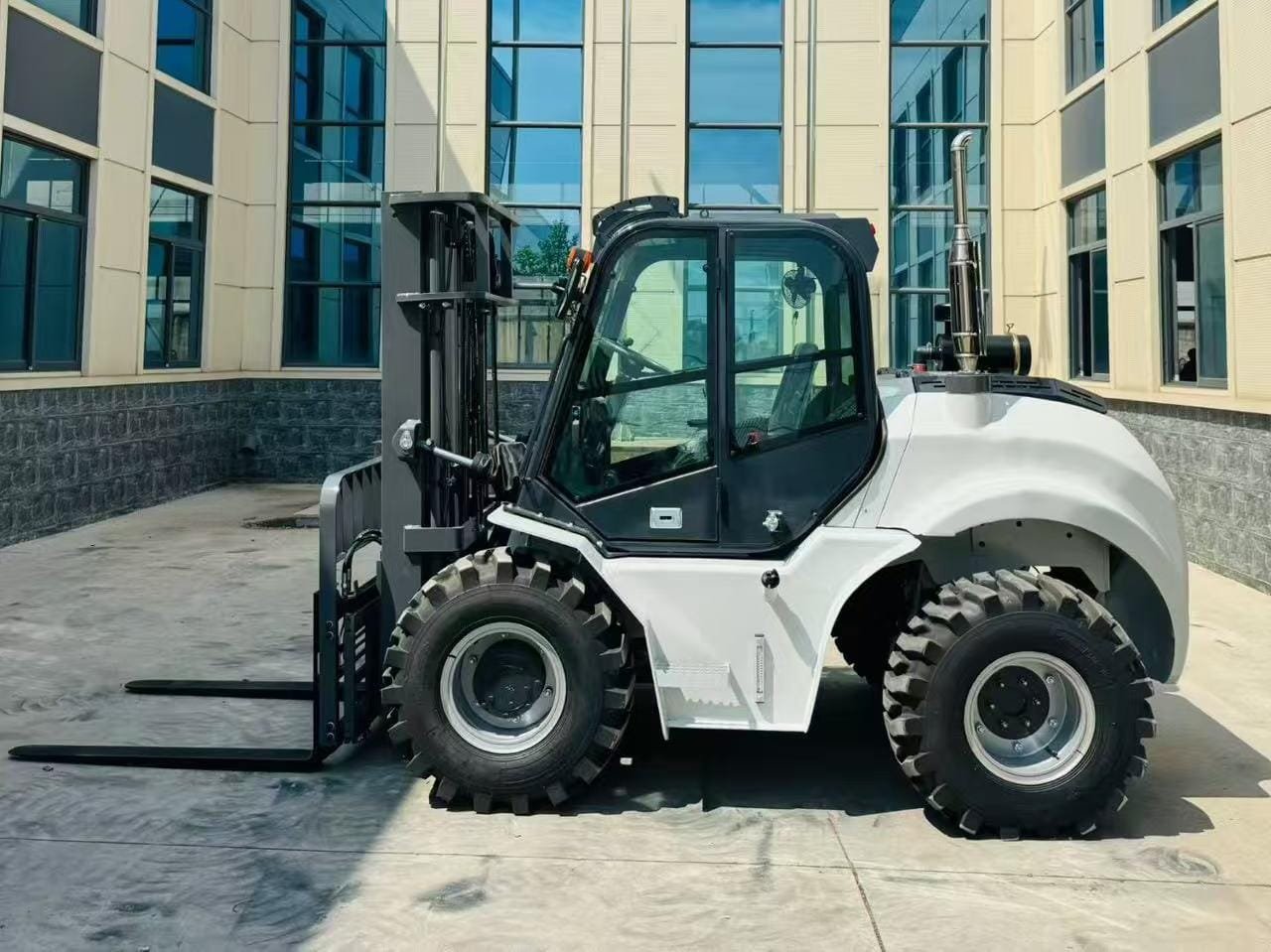
A two-wheel-drive forklift transmits driving power through one axle. On firm, relatively level ground, it can provide dependable material handling with a comparatively straightforward drivetrain.
A four wheel drive forklift delivers driving power to both axles. This can help maintain traction when individual wheels encounter loose gravel, soft soil or inconsistent ground conditions.
However, 4WD does not automatically increase lifting capacity or eliminate rollover risks. Tires, weight distribution, load center, surface conditions and operator technique all affect real-world performance.
| Factor | 2WD Forklift | 4WD Forklift |
|---|---|---|
| Best working surface | Firm yards and maintained access roads | Variable outdoor surfaces requiring additional traction |
| Drivetrain | One driven axle | Both axles driven |
| Maintenance | Generally fewer driven components | Additional drivetrain components to inspect |
| Purchase budget | Often lower for comparable configurations | May require a higher initial investment |
| Typical buyer | Small yards with predictable routes | Construction, agriculture and outdoor rental operations |
These are general drivetrain differences, not guaranteed performance or pricing results. Compare the actual vehicle configuration before making a decision.
Compare Real RUNTX Rough Terrain Forklift Specifications
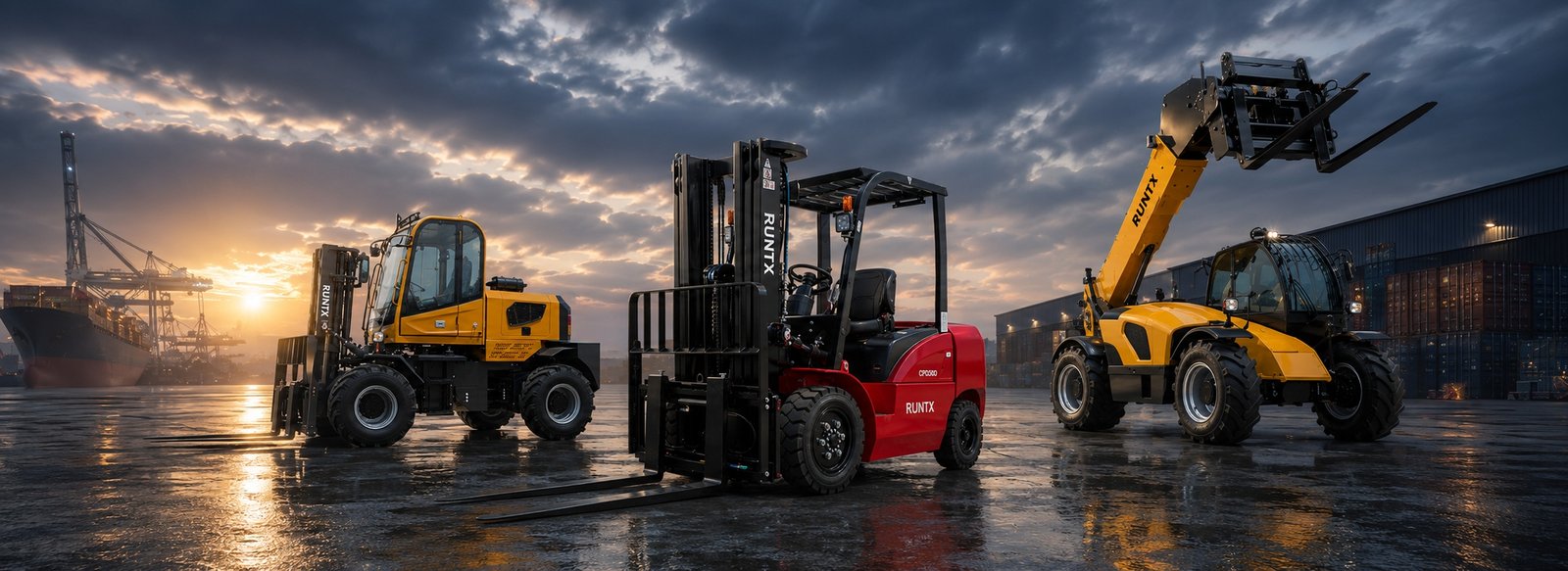
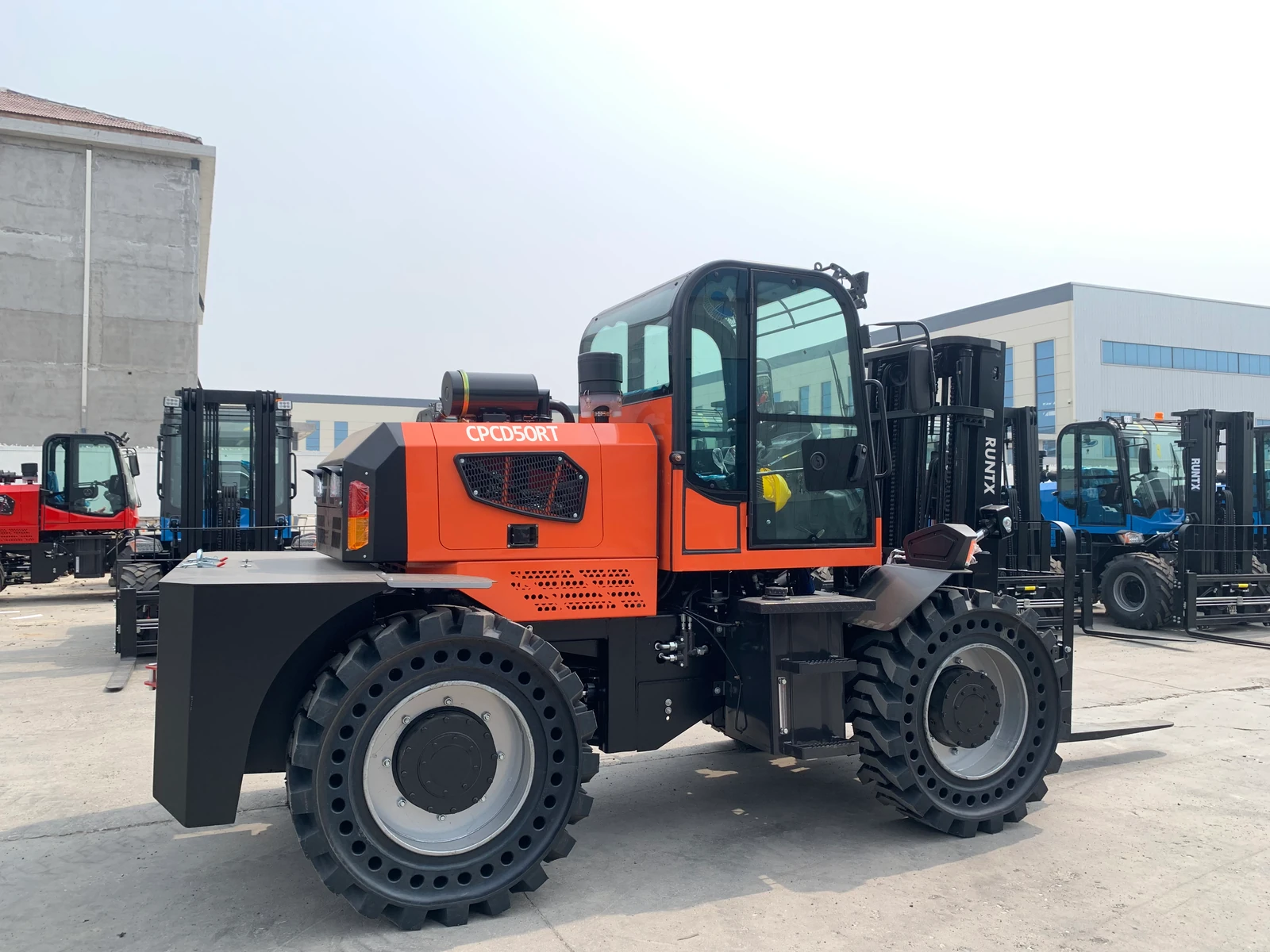
RUNTX offers compact diesel rough terrain forklifts in both 2WD and 4WD configurations. The catalog includes 2WD compact models from 2.5 to 4 tons and 4WD compact models from 3 to 4 tons.
Consider the 3-ton CPCD30RT configurations below. Both have a rated capacity of 3,000 kg at a 500 mm load center, but their drivetrain and performance specifications differ.
| Specification | CPCD30RT 2WD Compact | CPCD30RT 4WD Compact |
|---|---|---|
| Rated capacity | 3,000 kg | 3,000 kg |
| Load center | 500 mm | 500 mm |
| Standard lift height | 3,000 mm | 3,000 mm |
| Maximum gradeability (catalog) | 20% | 35% |
| Maximum travel speed (loaded) | 22 km/h | 20 km/h |
| Minimum turning radius | 2,910 mm | 3,120 mm |
| Operating weight | 4,800 kg | 5,050 kg |
Source: RUNTX Rough Terrain Forklift Catalog, compact 2WD and 4WD specification tables. Figures are catalog values for the listed configurations. Gradeability is a performance specification, not permission to operate on an equivalent slope with every load.
The catalog shows a 15-percentage-point difference in specified maximum gradeability. That illustrates a potential traction advantage under the manufacturer’s test conditions, but it does not establish the safe operating slope at a customer’s site.
The 2WD model also has a smaller published turning radius. That matters for businesses where available maneuvering space is limited. You can explore the RUNTX rough terrain forklift range to compare available models and configurations.
When Should You Choose a 4WD Rough Terrain Forklift?
Construction Sites and Unpaved Access Roads
Building sites frequently have gravel, compacted soil, temporary access roads and changing ground conditions. A suitable 4WD rough terrain forklift can help deliver pallets of bricks, timber or building materials where a conventional warehouse forklift would be inappropriate.
Ground clearance, tire tread and load stability must still be checked. Four-wheel drive cannot make unstable soil or an unsupported excavation edge safe.
Agricultural and Timber Operations
Farms, nurseries and timber yards may have wet tracks and irregular surfaces. Extra traction can be valuable, especially when a machine travels between different outdoor work areas.
For these buyers, daily reliability often matters more than maximum travel speed. Ask about tire availability, hydraulic service access and the practicality of local spare-parts support.
Equipment Rental Businesses
A rental company must consider several customers rather than one fixed job site. A versatile 4WD machine may serve a broader mix of outdoor projects, but only when rental demand justifies its higher ownership cost.
If most customers operate on prepared surfaces, a simpler 2WD model could provide better financial utilization.
What About Articulated Rough Terrain Forklifts?
Drivetrain and steering design are separate decisions. A forklift can use 4WD without having an articulated frame.
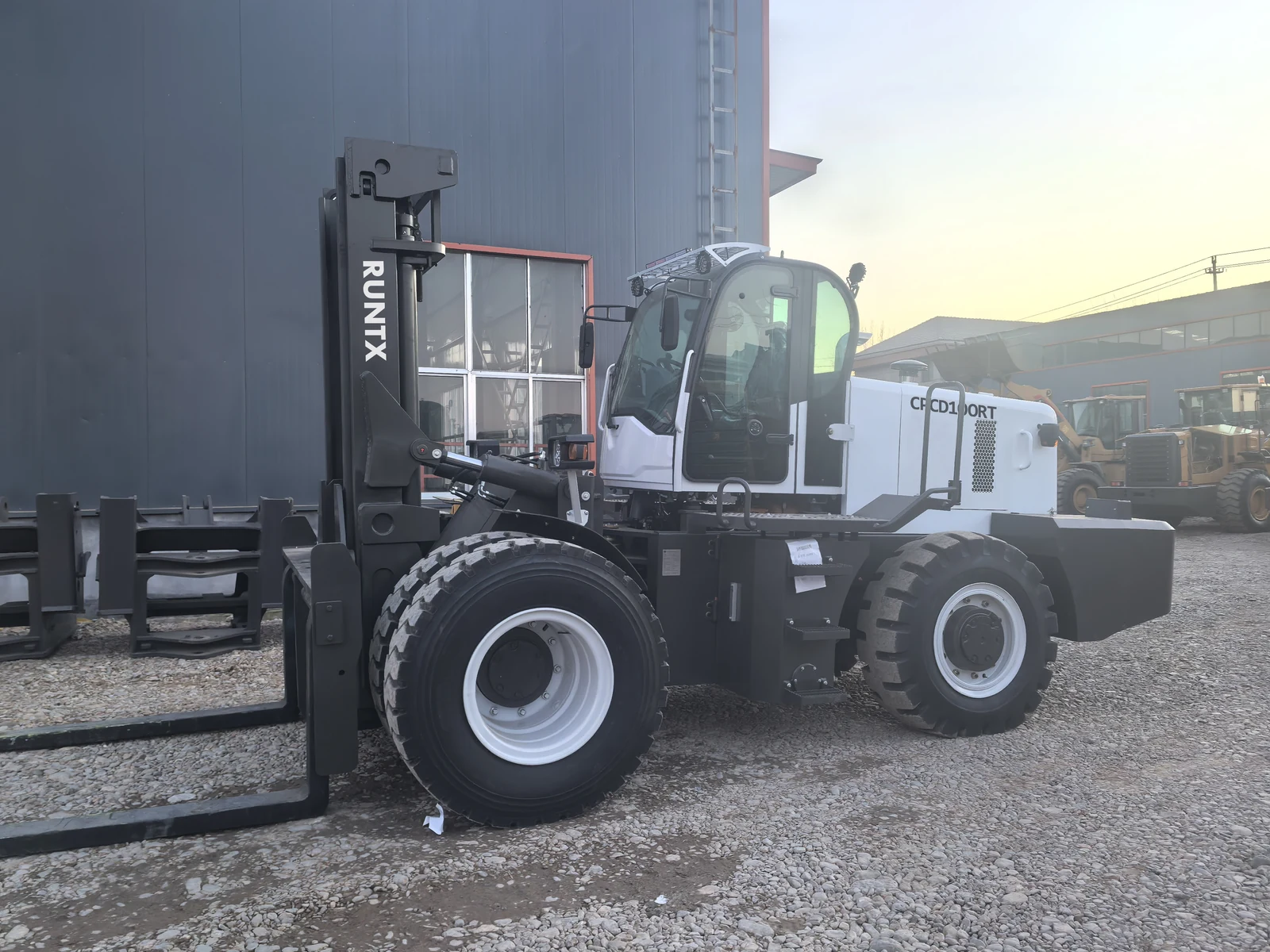
RUNTX also offers front- and rear-articulated rough terrain forklifts. An articulated steering arrangement changes how the vehicle negotiates corners and obstacles. It can be useful in complicated yards, but its turning characteristics must be evaluated with the complete machine and load.
For example, the RUNTX catalog lists a 3,600 mm minimum turning radius for the 3-ton rear-articulated CPCD30-RT, compared with 4,500 mm for the front-articulated version.
This is a published model-specific difference, not proof that rear articulation is always safer or more maneuverable in every condition. A buyer should review articulation clearances, steering behavior, load charts and operator training requirements.
For heavier applications, see the RUNTX 5 Ton Rear-Articulated Rough Terrain Forklift.
Safety: Traction Is Not the Same as Stability
More driven wheels may help a forklift move, but they do not prevent tipovers caused by excessive speed, poorly positioned loads or unsuitable slopes.
Under OSHA’s U.S. powered industrial truck standard, when loaded trucks travel on grades exceeding 10%, the load must face upgrade. OSHA also requires powered industrial trucks to be inspected at least daily, or after each shift when used around the clock.
These rules provide useful safety reference points, although applicable requirements differ by jurisdiction and equipment classification. The manufacturer’s approved operating instructions and local site risk assessment must govern actual use.
OSHA additionally requires an operator performance evaluation at least once every three years, with refresher training in specified circumstances. For small companies, properly training one or two operators can help avoid preventable equipment damage and disruption.
Check surface support, slope, load center, tire condition, visibility and the manufacturer’s approved capacity chart. Never interpret a published gradeability percentage as a blanket safe-slope limit.
4WD Forklift Cost: Calculate the Total Ownership Value
For a small contractor, the cheapest quotation is not always the cheapest machine to own. A useful rough terrain forklift cost comparison should include acquisition price, freight, import charges, fuel, tires, routine maintenance, repairs and resale assumptions.
One useful calculation is:
For example, if a machine operates 1,000 productive hours annually, every additional $1,000 of annual ownership expense represents $1 per productive hour. This is an arithmetic illustration, not a claimed RUNTX operating-cost figure.
Estimate downtime separately. Record hours lost to poor traction, equipment recovery, maintenance or unsuitable site access. A 4WD forklift earns its premium when its real operational value exceeds the additional purchase and maintenance expense.

Why Buy Directly from RUNTX?
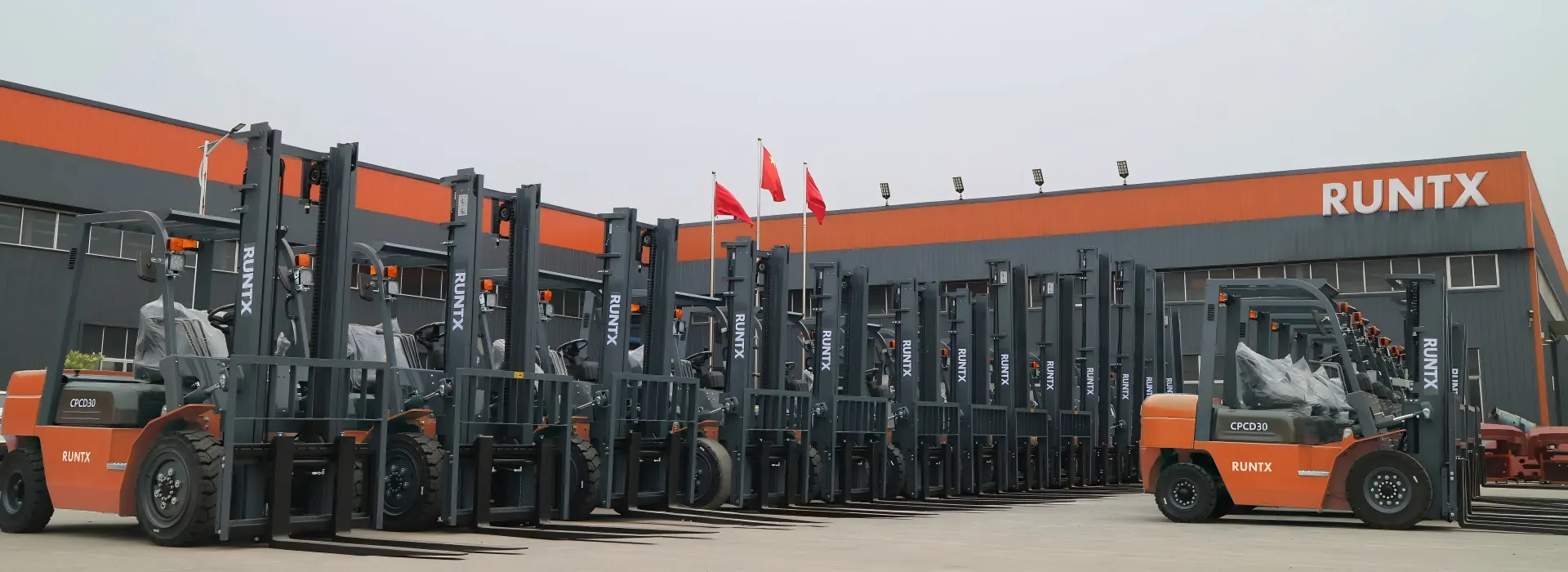
RUNTX supplies diesel rough terrain forklifts for small contractors, equipment businesses and distributors. Factory-direct sourcing helps buyers discuss model selection and configuration requirements before committing to a purchase.
RUNTX supports 1 Unit MOQ for suitable direct purchases, alongside small-batch wholesale discussions for rental fleets and distributors. OEM/ODM options include custom colors, branding and compatible attachments, subject to technical confirmation.
For first-time international buyers, RUNTX can also assist with export documents, freight coordination and shipping arrangements. Import permits, local compliance requirements, duties and destination customs clearance should be confirmed before ordering.
Not Sure Whether You Need 2WD or 4WD?
Send RUNTX your maximum load, working surface, aisle dimensions and delivery country. We can help identify suitable rough terrain forklift configurations and prepare a factory-direct quotation for a single machine or small fleet.
Rough Terrain Forklift Buying Checklist
Before requesting a quotation, prepare the information that determines whether a machine actually fits your work:
- Load: Maximum weight, dimensions and load center.
- Lifting: Required height, fork length and attachments.
- Ground: Gravel, compacted soil, mud, concrete or mixed surfaces.
- Access: Gate width, turning space, slopes and overhead clearance.
- Usage: Daily operating hours and expected annual utilization.
- Destination: Country, port, required documentation and local emissions rules.
Request the actual capacity chart, engine details, maintenance schedule and confirmed dimensional drawing rather than relying only on a marketing brochure.
Frequently Asked Questions
Is a 4WD forklift always better than a 2WD forklift?
No. Four-wheel drive can improve traction on variable surfaces, while two-wheel drive may be a more economical choice on firm and predictable routes. Capacity, tires, terrain and overall ownership cost should determine the final choice.
Can a 3 ton 4WD forklift work on muddy construction sites?
A suitable rough terrain model may operate on certain muddy surfaces, but safe use depends on soil bearing capacity, ground conditions, tire specification and load stability. Avoid unsupported or unstable ground.
What is the difference between 4WD and articulated steering?
4WD describes which wheels receive driving power. Articulated steering describes how sections of the vehicle turn relative to each other. The two features address different operating requirements.
Does RUNTX offer customizable rough terrain forklifts?
Yes. RUNTX offers OEM/ODM options such as colors, branding and selected attachments, subject to the model configuration and engineering approval.
Can I order only one forklift from China?
RUNTX supports single-unit orders for suitable products and can help coordinate international shipping documentation. Final pricing, delivery terms and specifications are confirmed individually.
Find the Right Rough Terrain Forklift for Your Business
Compare 2WD, 4WD and articulated configurations with RUNTX. Request a single-unit factory quotation, small-batch dealer pricing or detailed technical specifications for your project.
Technical reference: RUNTX Rough Terrain Forklift Catalog. Safety guidance: U.S. OSHA 29 CFR 1910.178. Always confirm the approved specifications and applicable safety requirements for your market.