When does a 12 ton diesel forklift make more sense than a smaller truck—or a much larger heavy-duty machine? This guide explains real applications, load-center limits, operating space, attachments and the buying factors that matter most for smaller industrial operators.
There is an awkward point in heavy material handling where a normal industrial forklift simply stops being enough.
A 5-ton or 7-ton machine may handle most daily work comfortably, but then the business begins moving larger molds, fabricated steel assemblies, machinery, precast products or oversized construction materials. Suddenly, the existing forklift is working too close to its limit—or the company is repeatedly hiring outside lifting equipment whenever a heavier job appears.
For a small contractor, equipment rental business or growing factory, that is often where a 12 ton diesel forklift starts to make financial sense.
It offers substantially more capacity than common warehouse and yard forklifts without moving immediately into the size, cost and operating-space requirements of 15-ton, 16-ton or even larger heavy-duty trucks.
But a 12-ton nameplate does not mean every 12-ton object is automatically safe to lift. Load dimensions, load center, attachment weight and lifting height still determine what the machine can actually do.
It is: “Are my regular loads heavy enough to justify 12-ton capacity, and can the machine handle their real dimensions safely without becoming unnecessarily expensive to operate?”

1. What Kind of Work Actually Needs a 12 Ton Diesel Forklift?
A 12-ton forklift sits in an interesting position between conventional industrial forklifts and true heavy-duty machines. It is large enough for serious industrial cargo but still practical for businesses that do not need a 16–30 ton machine every day.
Typical applications include large machinery components, steel fabrications, molds and dies, precast concrete products, stone, heavy timber packages and oversized palletized materials. It can also support loading and unloading operations in industrial yards where conventional 5–8 ton forklifts no longer provide enough reserve capacity.
The RUNTX heavy-duty series includes the CPCD120, rated at 12,000 kg with a 600 mm load center and 3,000 mm standard lifting height. Buyers can review it within the RUNTX 4.5–12 Ton Diesel Forklift Series, which allows direct comparison with the CPCD60, CPCD70, CPCD80 and CPCD100.
That comparison is important. If the heaviest regular load is only five or six tons, purchasing a 12-ton machine simply because it feels “safer” may not be good fleet economics. If the operation regularly handles nine, ten or eleven tons, however, a smaller truck may leave too little useful reserve once load dimensions and attachments are considered.
2. Why “12 Ton Capacity” Does Not Tell the Whole Story
This is where heavy forklift purchasing becomes more technical.
Forklift capacity is tied to a specified load center. The farther the load’s center of gravity moves away from the fork face, the greater the overturning moment acting on the machine. Long machinery, deep crates and irregular steel structures can therefore be much more demanding than a compact load of the same weight.
Attachments matter too. OSHA provides a useful real-world example of a forklift rated for 5,000 lb with standard forks. With a sideshifter installed, the machine’s stated capacity becomes 4,500 lb in that particular configuration—a 10% reduction.
Source: U.S. Occupational Safety and Health Administration (OSHA), Powered Industrial Trucks – Nameplate Guidance.
The exact reduction is not universal, but the principle is. Attachments add weight and may move the load farther forward. OSHA specifically notes that attachments can affect capacity, visibility and center of gravity.
For a buyer considering a CPCD120, the supplier should therefore know more than the maximum cargo weight. Provide the load dimensions, center of gravity, lifting height and proposed attachment before finalizing the truck.
For expensive or unusually shaped cargo, asking for a load-capacity assessment before production is much cheaper than discovering after delivery that the machine cannot safely handle the real job.
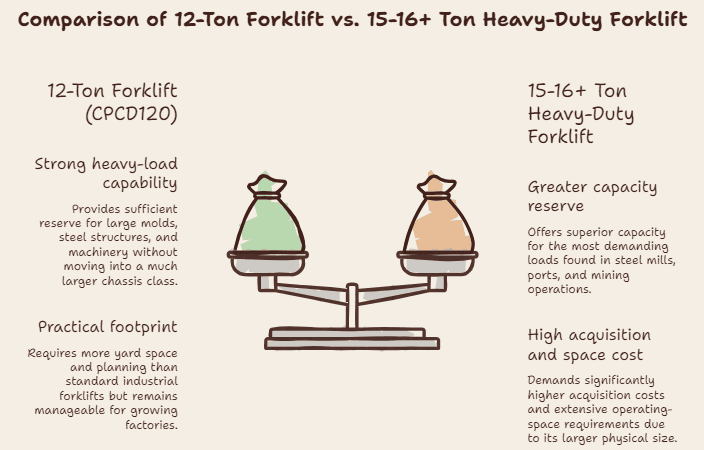
3. How Does a 12 Ton Forklift Compare with Smaller and Larger Machines?
| Capacity Class | Typical Work | Main Advantage | Main Trade-Off |
|---|---|---|---|
| 5–7 Ton | Building materials, timber, machinery parts, industrial pallets | Lower purchase cost and easier maneuvering | Limited reserve for genuinely heavy cargo |
| 10 Ton | Heavy machinery and larger industrial loads | Good step into heavy handling | May offer little reserve when regular loads approach 10 tons |
| 12 Ton – CPCD120 | Large molds, steel structures, machinery, precast and project cargo | Strong heavy-load capability without moving immediately into a much larger chassis class | Needs more yard space and planning than standard industrial forklifts |
| 15–16+ Ton | Steel mills, ports, mining, very heavy industrial cargo | Greater capacity reserve for demanding loads | Higher acquisition cost, size and operating-space requirements |
The CPCD120’s published operating weight is approximately 13,900 kg, compared with 13,100 kg for the CPCD100 in the same RUNTX series. That difference illustrates an important point: moving into the 12-ton class means buying a substantially heavier counterbalanced machine, not simply a 10-ton forklift with a bigger number on the side.
The chassis, counterweight, axle loading and hydraulic system all have to support the higher load moment.
If your workload has already moved significantly beyond this class, the next decision should be based on actual load requirements rather than automatically pushing the CPCD120 beyond its intended range. RUNTX also offers heavier models such as the CPCD160 16 Ton Heavy-Duty Diesel Forklift.
4. Heavy Loads Make Yard Conditions More Important
Operators sometimes focus so heavily on lifting capacity that they forget the machine still has to travel, turn and stop.
A 12-ton forklift carrying a heavy load places far greater demands on the working surface than a common 3-ton warehouse truck. Soft ground, broken pavement, slopes and uneven transitions become more important because stability changes as the machine moves.
The UK Health and Safety Executive notes that vehicle overturns cause nearly one-fifth of workplace transport deaths. It specifically identifies overloaded or unevenly loaded vehicles, excessive speed, unsuitable tasks and soft or uneven ground among the factors that can contribute to overturning.
Source: UK Health and Safety Executive (HSE), Workplace Transport – Overturning Guidance.
For a smaller business, the practical lesson is simple: do not choose the forklift first and inspect the yard later.
Check the working surface, aisle and gate widths, turning area, gradients and loading zones before confirming the machine. If the CPCD120 must repeatedly make awkward multi-point turns or travel across unsuitable ground, its extra capacity will not automatically translate into higher productivity.

5. Downtime Matters More When You Own Only One Heavy Forklift
A large logistics company may have several machines available if one forklift requires service. A small manufacturer or contractor may have exactly one heavy-duty unit.
That makes maintenance access and parts support disproportionately important.
Heavy lifting also means safety incidents can create expensive interruptions. HSE reports that lift trucks are involved in about one-quarter of workplace transport accidents.
Source: UK Health and Safety Executive (HSE), Managing Lift Trucks.
Historical U.S. Bureau of Labor Statistics data gives another useful perspective. In 2017, forklift-related incidents resulted in 9,050 nonfatal workplace cases involving days away from work. The median absence was 13 days, compared with eight days across all cases.
Source: U.S. Bureau of Labor Statistics, Occupational Injuries, Illnesses, and Fatalities Involving Forklifts, 2017 data.
For a small operation, thirteen days illustrates why operator training, preventive maintenance and correct machine sizing are financial issues as much as safety issues.
Before buying, ask for the maintenance schedule, filter and wear-part list, spare-parts availability and technical documentation. Easy access to service information is often worth more over several years than a small saving on the initial purchase price.
Not Sure Whether 10 Ton, 12 Ton or 16 Ton Is Right?
Send RUNTX your heaviest regular load, dimensions, lift height, fork requirements and working surface. Our team can compare suitable configurations before you pay for capacity you do not need—or buy a machine with too little reserve.
6. When Does the CPCD120 Make Financial Sense?
A 12-ton forklift earns its place when heavy handling is frequent enough that renting external lifting equipment or repeatedly reorganizing jobs around a smaller forklift begins costing the business more than owning the correct machine.
Think in working cycles rather than purchase price alone. How often do loads exceed the comfortable working range of your current truck? How much time is lost waiting for rented lifting equipment? Are heavy jobs becoming a regular source of revenue rather than an occasional exception?
If a 12-ton forklift allows one operator to complete routine load transfers that currently require additional hired equipment, the machine may remove a real operational bottleneck. If it spends most of its life handling 3-ton pallets, the capital is probably being used poorly.
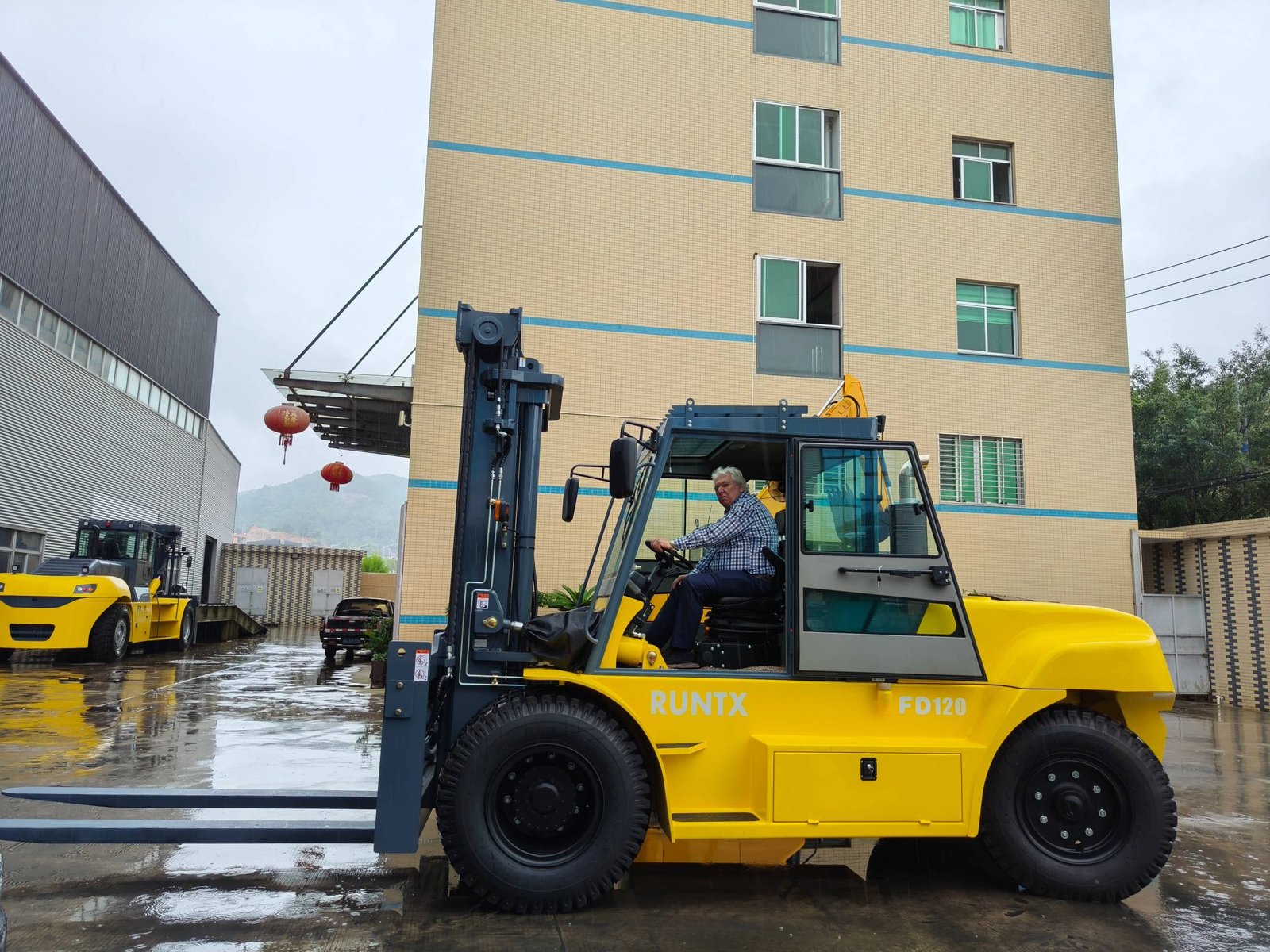
Real-world evaluation matters here. RUNTX has previously hosted an Australian customer for hands-on testing of the CPCD120 before export. Buyers interested in how a heavy-duty machine can be evaluated before purchase can read the Australian CPCD120 Factory Testing Case.
7. Factory-Direct Purchasing Does Not Have to Mean a Fleet Order
Heavy equipment sourcing can be intimidating for smaller buyers because factory quotations are often associated with large MOQs.
RUNTX supports 1 Unit MOQ for suitable orders, allowing an independent factory, contractor or rental company to purchase one CPCD120 without committing to an entire fleet.
Factory-direct procurement also makes configuration discussions easier. Depending on the application, OEM/ODM support can cover body color and branding as well as mast, forks, tires, attachments and engine or market-specific requirements.
For distributors and growing rental businesses, small-batch pricing can be discussed when several capacities are needed.
International logistics is part of the decision too. A 12-ton forklift is not a small parcel shipment. RUNTX can assist with export documents and shipping coordination so first-time buyers can compare FOB, CIF and suitable transport arrangements before the machine leaves the factory.
Frequently Asked Questions
What can a 12 ton diesel forklift lift?
Typical applications include heavy machinery, steel structures, molds, precast products, stone and oversized industrial loads. Actual permissible capacity depends on load center, lift height and attachments rather than weight alone.
Is a CPCD120 better than a 10 ton forklift?
Not automatically. A 12-ton model makes sense when regular loads require additional capacity reserve. If most loads remain comfortably below 10 tons, a smaller machine may offer a better balance of acquisition cost and maneuverability.
Can I install a sideshifter or other attachment?
Heavy-duty forklifts can be configured with suitable attachments, but the attachment must be included in the capacity assessment because it can change load center, truck weight and residual capacity.
Can a 12 ton forklift work outdoors?
Diesel forklifts are commonly used for outdoor heavy handling, but the working surface, gradients, tire configuration and environmental conditions should be confirmed before ordering.
Can I buy only one RUNTX CPCD120?
Yes. RUNTX supports single-unit purchasing for suitable projects as well as small-batch and OEM/ODM orders for distributors and fleet operators.
Final Takeaway: Buy Capacity You Can Actually Use
A 12-ton diesel forklift is not simply a bigger version of a warehouse truck. It represents a step into genuinely heavy material handling, where load center, yard conditions, attachments and maintenance planning matter much more.
For businesses regularly moving loads beyond the comfortable range of 5–8 ton equipment, the CPCD120 can provide useful additional capacity without immediately moving into the much larger 15–20 ton class.
For a small contractor or industrial owner, that balance can be the real advantage: enough machine for the heavy work you actually have, without paying for capacity that spends most of its life unused.
Need a 12 Ton Forklift for Your Heavy Loads?
Buying one heavy-duty forklift? Request single-unit factory pricing. Building a rental or dealer fleet? Ask for small-batch terms. Send us your load weight, dimensions, lift height and destination for a configuration proposal.