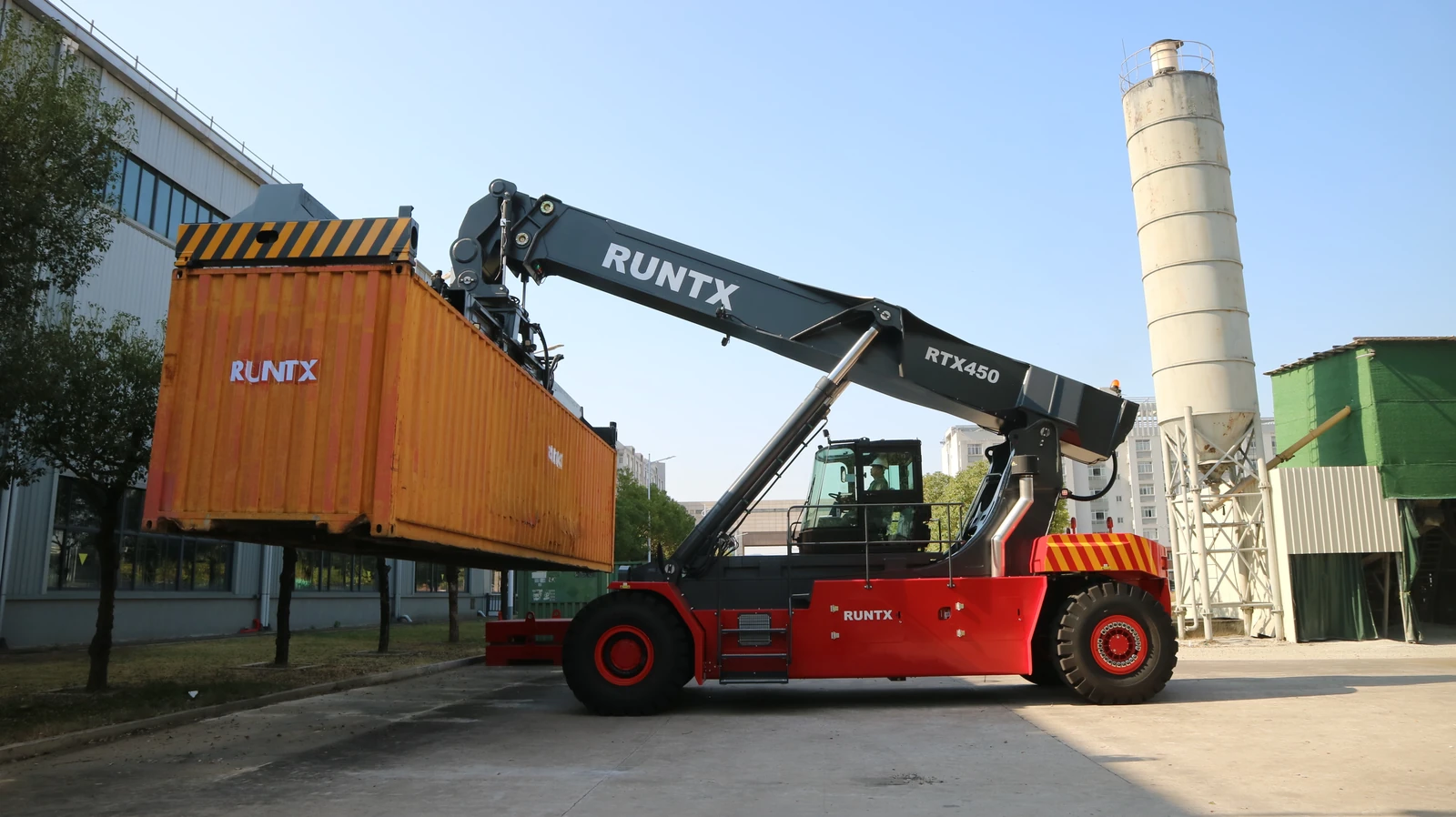
A 45-ton reach stacker does not necessarily lift 45 tons in every row. Understanding how capacity changes as the boom reaches farther forward is one of the most important parts of choosing a machine for a port or container yard.
“45 ton reach stacker” sounds straightforward until you ask one more question:
45 tons in which row?
For many first-time buyers, this is where reach stacker specifications become confusing. A machine may be marketed around a 45-ton maximum capacity, but that figure usually refers to the first-row condition. Once the boom extends forward to place or retrieve a container from the second or third row, allowable lifting capacity can fall significantly.
That is not a weakness in the machine. It is simply the physics of reach.
The farther the load moves away from the front axle and chassis, the larger the overturning moment becomes. To stay within the machine’s stability envelope, the permitted container weight has to reduce as outreach increases.
For a small port, inland terminal or independent container yard, understanding this relationship matters far more than simply buying the model with the biggest number in the brochure.
Why Row Capacity Matters More Than the Maximum Number
A reach stacker is valuable because it can do something an ordinary container handler cannot do as easily: reach over the first row and work deeper into the stack.
That flexibility is one reason reach stackers are so popular in regional terminals and intermodal yards. One machine can handle truck loading, yard stacking and retrieval across multiple rows without requiring a fixed crane system.
But every extra meter of forward outreach changes the load moment.
Industry load charts make that very clear. Konecranes, for example, publishes several 45-ton reach stacker configurations with very different row capacities. One 45-ton model is listed at 45-27-14 tons across the first three rows, while another is rated at 45-31-16 tons. Heavier-duty versions reach 45-35-20 tons or even more.
Source: Konecranes Reach Stacker Technical Data. These values are examples from Konecranes models and are not RUNTX RTX450 ratings.
That spread is important. Two machines can both be advertised as “45-ton reach stackers” and still have a very different second- and third-row capability.
This is why buyers should never stop at maximum capacity.
First Row, Second Row, Third Row: What Actually Changes?
The first row is the easiest operating position because the container is closest to the machine.
The boom extension is limited, the load stays closer to the chassis, and the reach stacker can use more of its maximum rated capacity.
Move to the second row and the boom has to extend farther. The container’s center of gravity is now farther from the machine’s support base. By the third row, the leverage against the machine is greater again.
One useful real-world example comes from Hyster’s RS45 reach stacker. The manufacturer publishes a 45-ton first-row capacity, but second-row capacity varies between approximately 27 and 31 tons depending on the specific configuration.
Source: Hyster RS45 Reach Stacker specifications. These values are manufacturer examples and are not RUNTX RTX450 load-chart values.
The lesson is simple: “45 ton” describes the maximum condition, not every working position.
A Useful Industry Comparison
| Example Configuration | 1st Row | 2nd Row | 3rd Row | What It Tells Buyers |
|---|---|---|---|---|
| Industry Example A | 45 t | 27 t | 14 t | High first-row capacity with a sharper reduction at deeper reach |
| Industry Example B | 45 t | 31 t | 16 t | Better second-row reserve for heavier containers |
| Industry Example C | 45 t | 35 t | 20 t | Designed for stronger multi-row capacity |
Source: Published Konecranes reach stacker capacity examples. The table illustrates industry variation only; it is not an RTX450 load chart.
The comparison exposes a common buying mistake.
If your terminal frequently places loaded containers in the second row, a 45-27-14 configuration and a 45-35-20 configuration are not functionally equivalent, even though both carry a 45-ton headline rating.
For an operator who mostly handles the first row, however, paying for extreme deep-row capability may not generate enough additional value.
The Physics Is Simple: Reach Creates Leverage
You do not need to be an engineer to understand what is happening.
Imagine holding a heavy box against your chest. It is manageable. Now extend your arms and hold the same box farther away. The weight has not changed, but the load on your body feels much greater.
A reach stacker experiences the same basic effect.
The telescopic boom allows the spreader to travel forward and upward. That gives the machine its flexibility, but every increase in horizontal reach changes the overturning moment acting on the chassis.
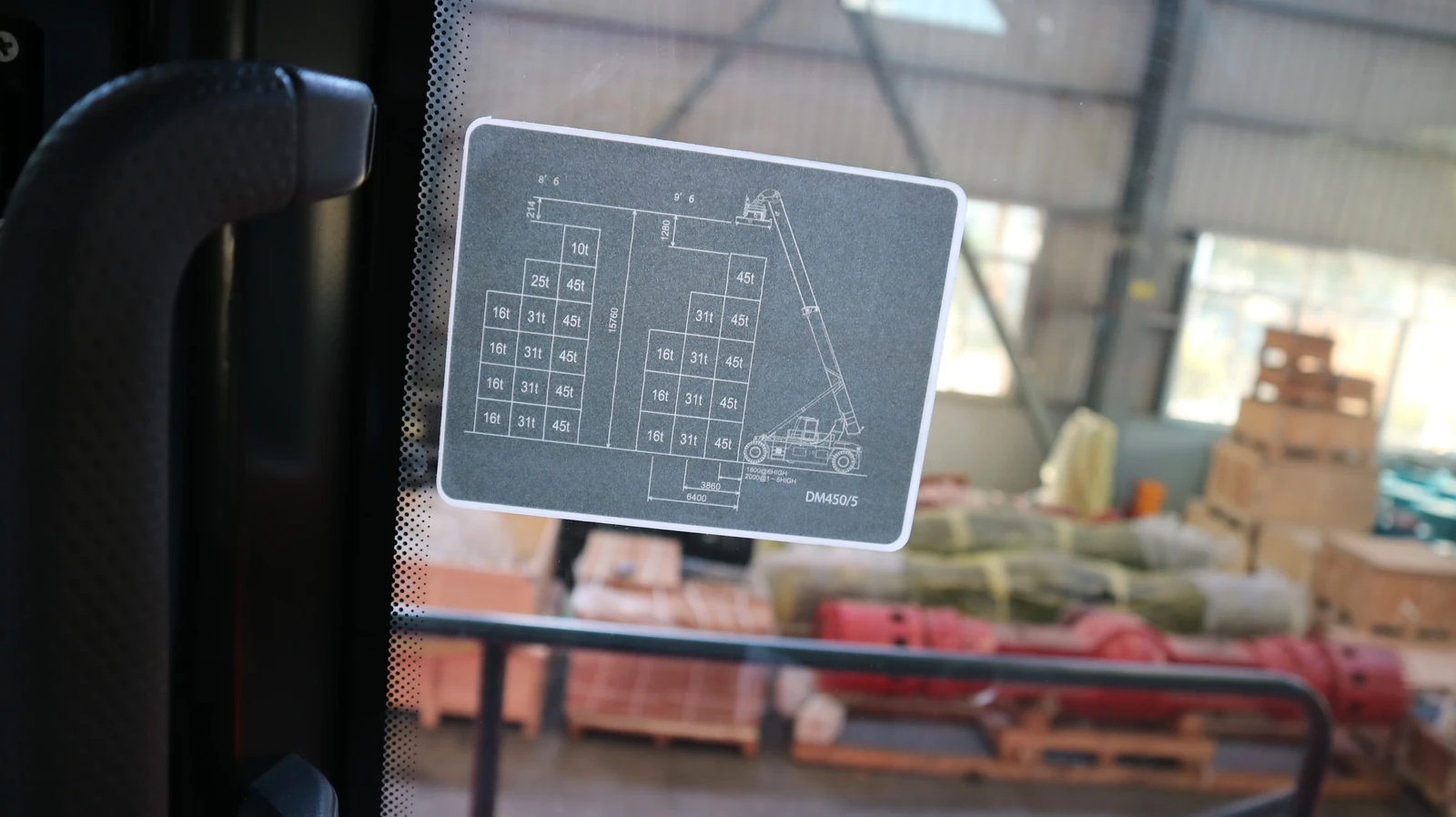
This is why a reach stacker’s load chart combines several variables rather than one single capacity number:
boom extension, boom angle, row depth, lifting height, container weight and sometimes spreader or attachment configuration all influence the allowable load.
ISO 3691-2:2023 specifically covers variable-reach container handlers and reach stackers and includes requirements relating to load charts, marking and container-handling equipment.
Source: ISO 3691-2:2023, Industrial trucks — Safety requirements and verification — Part 2.
That is why the manufacturer’s official load chart matters more than a marketing headline.
What This Means for a Small Port
A large container terminal may have several machines and enough yard space to assign each reach stacker to a particular zone.
A smaller terminal often expects one machine to do everything.
That makes equipment selection more sensitive.
If most containers are handled in the first row and transferred quickly between truck and stack, extreme third-row lifting capacity may not be worth paying extra for.
If yard space is limited and containers must regularly be stored two or three rows deep, deeper-row capacity becomes far more important because reorganizing the first row every time wastes machine hours.
World container traffic makes these decisions increasingly relevant. UNCTAD reports that ports handled approximately 920 million TEU in 2024, representing 6.9% year-on-year growth. Developing Asian economies alone handled around 60% of global container port traffic.
Source: UN Trade and Development (UNCTAD), Container Port Throughput Data, updated April 2026.
Even smaller terminals are being asked to move more containers through limited yard space. That makes row depth and equipment utilization increasingly important.
Reach Stacker Productivity Depends on the Job
Capacity is only one side of the buying decision. Productivity changes depending on what the machine is doing.
A published intermodal-terminal study uses an average reach stacker cycle time of approximately 3 to 3.5 minutes per move. It also cites typical reach stacker productivity around 25 moves per hour for railcar loading or unloading, 15 moves per hour for stacking and 10 moves per hour for road-truck handling.
Source: Stoilova & Martinov, research on container-handling equipment selection in rail-road intermodal terminals. Figures are planning benchmarks, not guaranteed machine performance.
This variation helps explain why row capability matters financially.
If a machine repeatedly has to move a first-row container just to access a second- or third-row box, the yard creates extra moves that generate no direct revenue.
A reach stacker with suitable deeper-row capability may reduce unnecessary reshuffling, but only when the actual container weights stay inside its load chart.
Do Not Buy a Reach Stacker From the “45 Ton” Number Alone
Send RUNTX your maximum container weight, target stacking rows, stacking height, 20 ft / 40 ft mix and yard layout. Our engineering team can provide the official RTX450 load chart and help confirm whether the machine fits your operating pattern.
Where the RUNTX RTX450 Fits
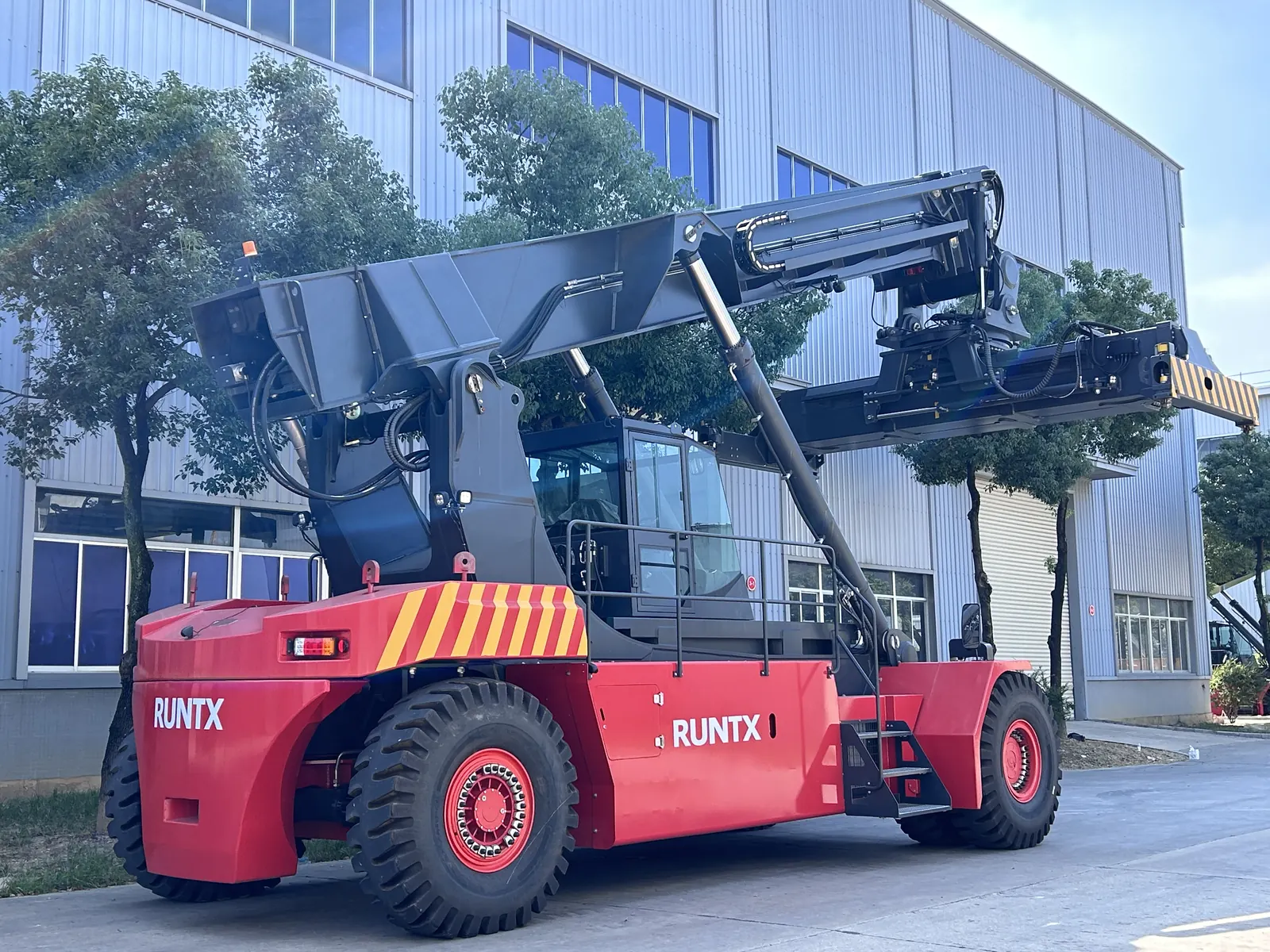
The RUNTX RTX450 45 Ton Container Reach Stacker is designed for laden-container handling in ports, railway intermodal yards and heavy logistics hubs.
Its current published specification lists a maximum lifting capacity of 45,000 kg, a maximum lifting height of 15,760 mm, a Cummins QSM11 diesel engine rated at 250 kW and an operating weight of approximately 71,400 kg. The wheelbase is 6,400 mm.
Those figures tell you the machine belongs in the heavy laden-container class, but they do not by themselves tell you second- or third-row capacity.
For that, buyers should request the official RTX450 load chart for the exact production configuration.
This is particularly important if your purchasing decision depends on handling 30-ton or heavier containers beyond the first row. The answer cannot safely be inferred from another manufacturer’s machine, even if both are marketed as 45-ton reach stackers.
Why Two 45-Ton Machines Can Have Different Row Capacity
Industry technical data shows that chassis and boom design make a major difference.
Konecranes publishes 45-ton reach stacker configurations ranging from 45-27-14 to 45-45-45 tons across the first three rows, depending on model design, wheelbase and whether support systems are used.
Source: Konecranes Reach Stacker Technical Data. Values illustrate differences between machine configurations and are not directly comparable to RTX450 without its official load chart.
That is an enormous difference.
Some published 45-ton models use a 6,400 mm wheelbase and prioritize compact terminal operation. Other configurations extend to 7,250, 7,500 or even 8,000 mm wheelbases to improve deeper-reach capability.
Longer wheelbases and heavier chassis can improve the stability envelope, but they also affect turning space, machine weight and purchase cost.
A small terminal should therefore resist the temptation to buy the strongest possible deep-row specification unless it actually needs it.
Container Weight Distribution Matters Too
Row number is not the only thing operators should consider.
A terminal may have a maximum legal container gross weight, but not every box arrives at that weight. If most loaded containers in the second row are 18 to 25 tons, the machine requirement is very different from a yard where 30-ton-plus containers are common.
That is why purchasing should start with historical container data whenever possible.
Look at the heaviest regular container, not just the absolute heaviest box handled once every two years. Then compare that distribution with the machine’s load chart.
A machine that covers 99% of normal operations efficiently may generate a better return than a much more expensive configuration purchased for one rare exceptional lift.
First-Row Strength vs Deep-Row Flexibility: Think About Yard Economics
A reach stacker earns money when it moves containers efficiently, not when it simply has unused theoretical capacity.
For a terminal that operates mainly truck-to-stack with shallow storage, first-row performance and cycle time may be more important than extreme third-row strength.
For a constrained inland depot, deeper-row access may be the feature that prevents unnecessary reshuffling and allows the same footprint to hold more containers.
This is where ROI becomes very site-specific.
There is no universally “best” reach stacker load chart. There is only the load chart that best matches your mix of container weight, row depth and yard geometry.
Factory-Direct Buying Still Requires Engineering Input
RUNTX supports 1 Unit MOQ for suitable port-equipment projects, which means regional terminals and independent logistics businesses do not need to commit to a fleet-sized order.
Factory-direct purchasing can also include OEM/ODM branding, color requirements, spreader configuration and project-specific options.
But reach stackers are not machines that should be selected only from a price list.
The better procurement conversation includes container weights, target rows, lifting height, annual throughput, pavement conditions and yard dimensions before the final quotation is confirmed.
International buyers can also receive support with export documentation, shipping coordination and heavy-equipment transport planning.
Buyers who want a broader introduction before requesting a load chart can also read our complete reach stacker buying guide.
Frequently Asked Questions
Can a 45 ton reach stacker lift 45 tons in the second row?
Not necessarily. The 45-ton figure usually refers to a maximum condition, commonly in the first row. Published industry examples show second-row ratings that can be significantly lower depending on the machine design.
Why does reach stacker capacity fall in deeper rows?
The farther the boom extends forward, the farther the container’s center of gravity moves away from the machine. This increases the overturning moment, so permitted load must be reduced to remain inside the machine’s stability envelope.
How much can the RUNTX RTX450 lift in the second and third rows?
RUNTX currently publishes a 45,000 kg maximum capacity for the RTX450, but this article does not assign second- or third-row ratings without the official load chart. Buyers should request the current chart for the exact machine configuration before making a purchasing decision.
Is higher third-row capacity always better?
No. Stronger deep-row capacity can be valuable in dense yards, but it may come with a larger chassis, longer wheelbase, higher machine weight and higher purchase cost. A shallow yard may not benefit enough to justify the difference.
What information should I send before requesting a reach stacker quotation?
Provide maximum and typical container weights, 20 ft / 40 ft mix, required stacking height, target number of rows, annual or daily container moves and basic yard dimensions.
The Number Buyers Should Ask for Is Not Just “45 Tons”
A reach stacker is valuable because it can reach.
That same reach is also why its lifting capacity changes from row to row.
For serious procurement, the headline maximum capacity should only be the beginning of the conversation. The official load chart tells you what the machine can actually handle at the positions your yard uses every day.
If most work happens in the first row, a strong first-row machine may be enough. If your terminal relies on second- and third-row storage, then deeper-row capacity becomes one of the most important specifications in the entire purchase.
The right machine is not the reach stacker with the biggest brochure number.
It is the one whose load chart matches your containers.
Know Your Row Capacity Before You Buy
Send RUNTX your container weights, row-depth requirements, stacking height and yard layout. Our engineering team can provide the current RTX450 load chart and prepare a factory-direct configuration for your terminal.