A customer from Côte d’Ivoire visited the RUNTX forklift factory in China to inspect our diesel forklift production and take a closer look at the CPCD50 5-ton diesel forklift for heavy-duty material handling.
For an overseas buyer, a specification sheet can answer a lot of questions. It can tell you the rated capacity, engine model, mast height and overall dimensions.
What it cannot show is how the machine actually feels when you stand next to it.
That becomes especially important when moving into the 5-ton forklift class. A CPCD50 is no longer a compact warehouse truck. It is a much heavier industrial machine built for larger loads, outdoor yards, construction materials and demanding loading work.
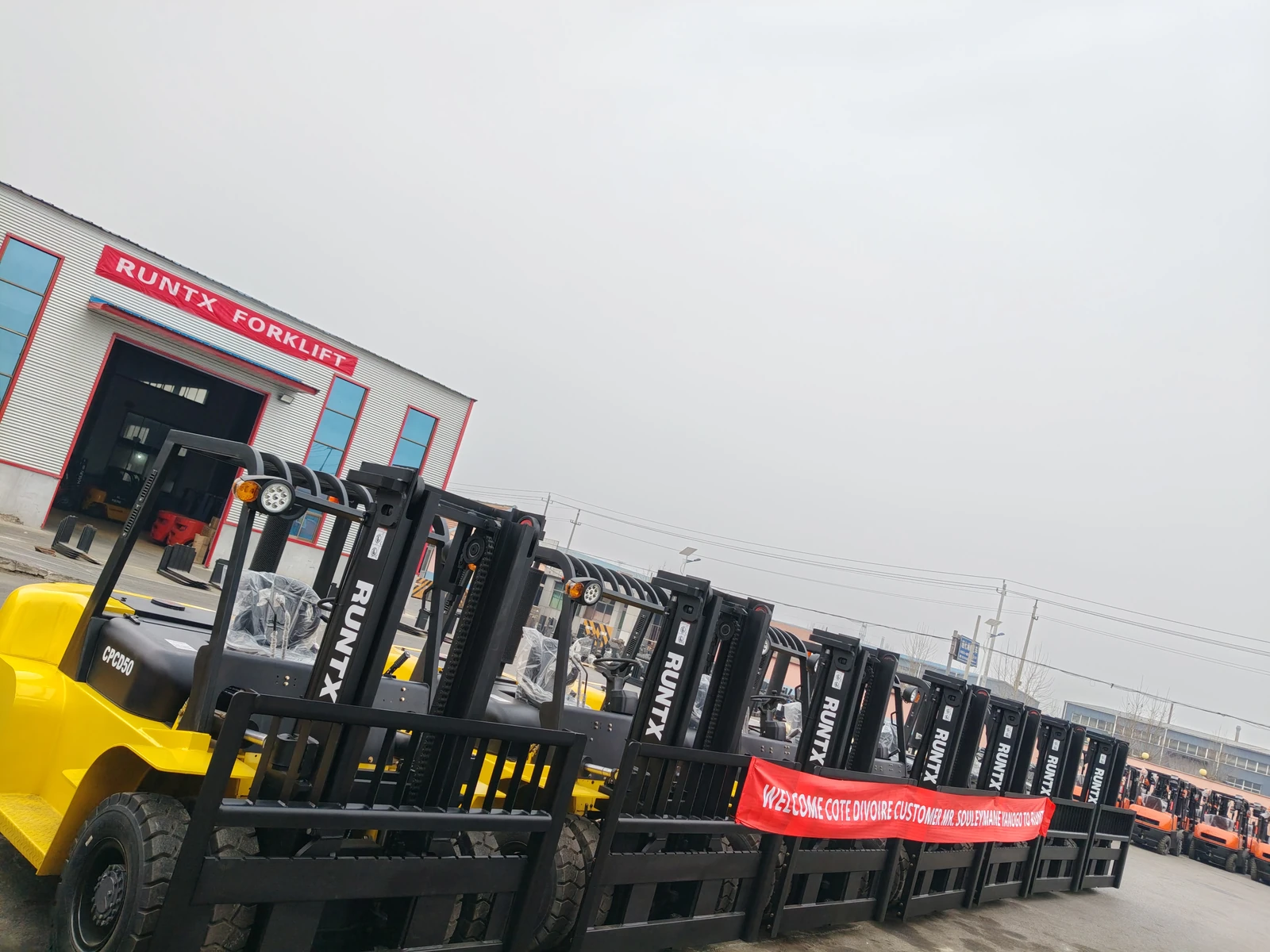
Recently, a customer from Côte d’Ivoire visited the RUNTX forklift manufacturing facility in China for an in-person equipment inspection. During the visit, the customer focused particularly on our CPCD50 5 Ton Diesel Forklift, while also viewing other completed forklifts prepared around the factory.
The visit gave the customer an opportunity to move beyond online communication and see the machines directly before making future purchasing decisions.
Seeing the CPCD50 at Full Scale Makes a Difference
A 5-ton forklift often looks surprisingly similar to a smaller diesel forklift in product photos.
In person, the difference is much easier to understand.
The RUNTX CPCD50 5 Ton Diesel Forklift is designed around a 5,000 kg rated capacity and a 600 mm load center. The current configuration uses an 85 kW XICHAI 4DF3 diesel engine with a heavy-duty hydraulic transmission.
That larger load center and heavier chassis make the CPCD50 better suited to industrial cargo that has already moved beyond the comfortable working range of normal 2.5- or 3-ton forklifts.
For buyers working with building materials, machinery components, steel products, timber or larger palletized goods, seeing the truck physically can make the specification much easier to understand.
You can judge the width of the machine, the mast structure, tire size, operator position and overall footprint in a way that is difficult to communicate through a catalogue alone.
Getting Into the Operator Seat Answers Different Questions
One of the photos from the visit shows the customer seated in the CPCD50 operator position.
This is a useful part of any factory inspection because forklift selection is not only about lifting capacity.
The driver spends hours interacting with the steering system, pedals, hydraulic controls, mast and surrounding traffic. Visibility around the mast and the general driving position therefore affect how practical the truck feels during real work.
For a 5-ton machine, this matters even more because the forklift is physically larger than the common warehouse class. A buyer may want to understand how easily the operator can see the forks, how the cab area is arranged and whether the machine feels appropriate for the intended yard or loading environment.
That kind of evaluation is difficult to reproduce in an online quotation.
Visit Highlight:
The Côte d’Ivoire customer focused on the CPCD50 5-ton diesel forklift during the factory visit, inspecting the machine directly and experiencing the operator position while reviewing the wider RUNTX diesel forklift lineup.
Why the 5 Ton Class Attracts Industrial Buyers
The jump from a 3-ton forklift to a 5-ton forklift is not simply an extra two tons of capacity.
It usually reflects a change in the type of work being done.
A 3-ton machine is commonly used for standard pallets, warehouse logistics and general manufacturing. A 5-ton truck starts to make more sense when the loads become denser, longer or more difficult to handle.
That can include concrete products, metal fabrication, industrial machinery, stone, timber and heavier construction materials.
The current CPCD50 configuration uses a 600 mm load center rather than the 500 mm load center commonly found in smaller forklift classes. For real buyers, that is an important detail because larger industrial loads are often physically deeper as well as heavier.
RUNTX also offers different engine, tire, mast and attachment configurations depending on the application and destination market. This allows a CPCD50 intended for a construction-material yard to be specified differently from one being purchased for a distributor or rental fleet.

A Factory Visit Is Also About Comparing More Than One Machine
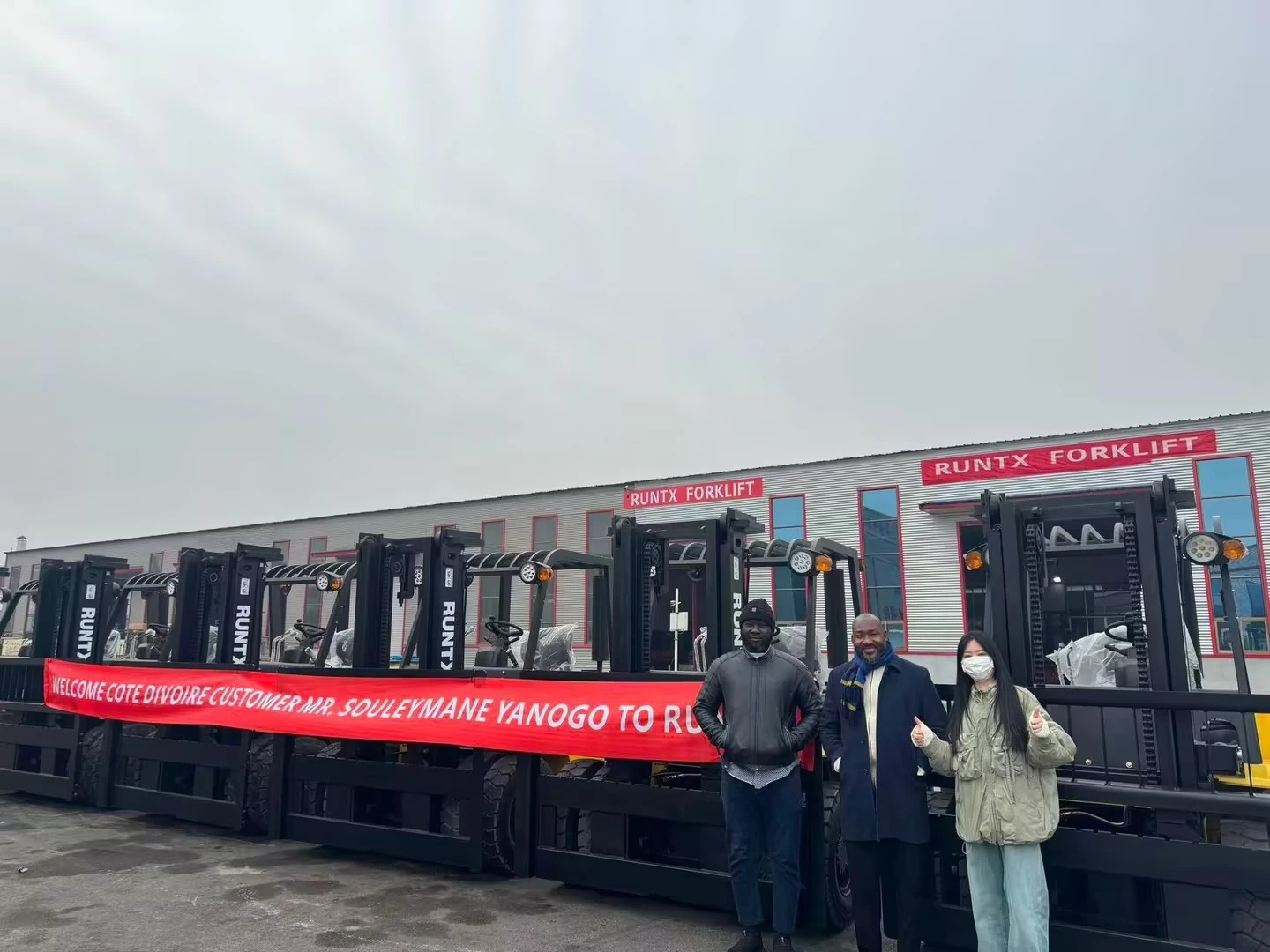
The other photos from this visit show multiple RUNTX forklifts positioned together outside the production facility.
For a customer still evaluating capacity, that kind of lineup can be useful.
A buyer may arrive asking for a 5-ton truck and then realize that a nearby capacity class better matches the actual load profile. A distributor may be interested in several models instead of only one. A rental company may need to think about which capacities local customers request most often.
That is why RUNTX also offers a wider 3–5 Ton Diesel Forklift Series, allowing customers to compare different capacities within the same product family.
The goal of an in-person inspection should not be to convince the customer to buy the largest machine possible. It should be to understand which machine fits the work.
Planning to Visit a Forklift Factory in China?
Tell RUNTX which capacity, application and market you are evaluating before your visit. Our team can prepare suitable models and configurations so you can compare the machines directly at the factory.
From One Machine to a Longer-Term Supply Relationship
International equipment purchasing often begins with one model.
A customer may initially be focused on a single CPCD50, while a distributor may eventually need several capacities, custom colors or market-specific engine configurations.
RUNTX supports 1 Unit MOQ for suitable projects, so smaller contractors and direct users can purchase without committing to an unrealistic fleet quantity.
For distributors and rental companies, small-batch and mixed-model orders can also be discussed. OEM/ODM options include custom branding, body colors, mast specifications, tires, forks and attachments.
Export support is another part of the process. International buyers can receive assistance with shipping coordination and standard export documentation, which is particularly helpful for first-time importers or smaller businesses without a dedicated logistics department.
Factory visits add another layer of confidence because customers can see where the equipment is produced and communicate directly with the team before the machine leaves China.

Why In-Person Inspection Still Matters
Digital sourcing has made it possible to compare dozens of forklift suppliers without leaving the office.
That is useful, but heavy equipment is still a physical product.
A factory visit gives a buyer the chance to inspect the machine from several angles, compare different capacities and understand details that may otherwise remain hidden inside a quotation.
For this Côte d’Ivoire customer, the CPCD50 was the main point of interest during the visit. The available photos capture that process clearly: the customer at the factory, the 5-ton forklift under close inspection and a wider lineup of RUNTX diesel forklifts prepared around the facility.
For RUNTX, that kind of direct contact is an important part of supporting international buyers—from a first single-unit purchase to larger dealer or fleet projects.
More overseas visits, factory inspections and delivery projects can be found in the RUNTX Customer Case Studies.
Note: To protect customer privacy and commercial confidentiality, personal identity and specific cooperation terms are not disclosed in this case.
Interested in a CPCD50 5 Ton Diesel Forklift?
Send RUNTX your load weight, lift height, engine requirement and destination. We can prepare a factory-direct CPCD50 configuration for a single machine, rental fleet or distributor project.