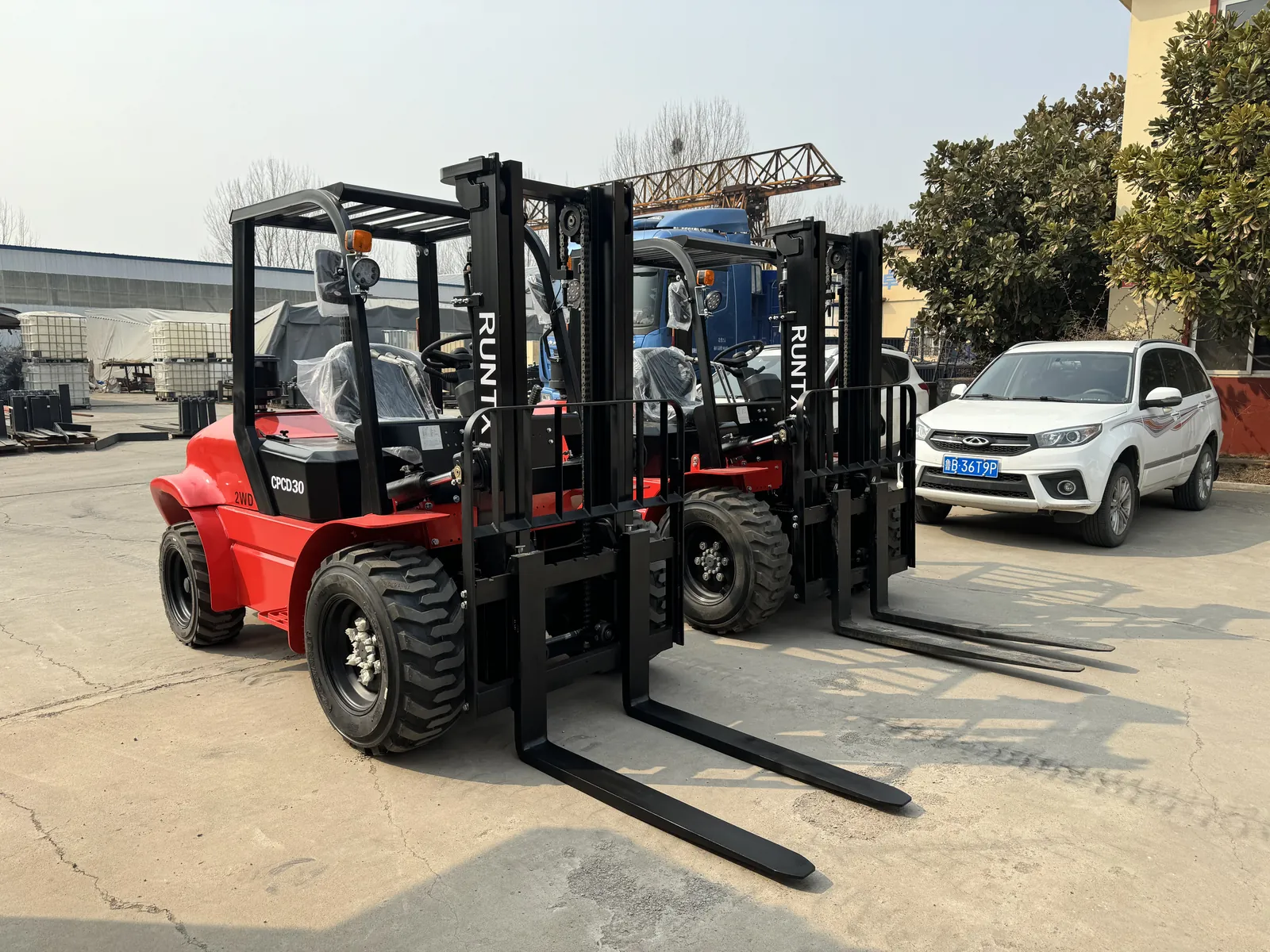
Two RUNTX CPCD30 3-ton 2WD rough terrain forklifts have completed production and testing for a customer in Mexico and are now waiting for final packing before container loading and shipment.
Some forklift orders are straightforward warehouse machines. Others are selected for work that happens well beyond a smooth concrete floor.
That was the case with a recent order from a customer in Mexico, who purchased two RUNTX CPCD30 3-ton 2WD rough terrain forklifts.
The machines have now completed production and factory testing and are waiting for final protective packing before container loading and export.
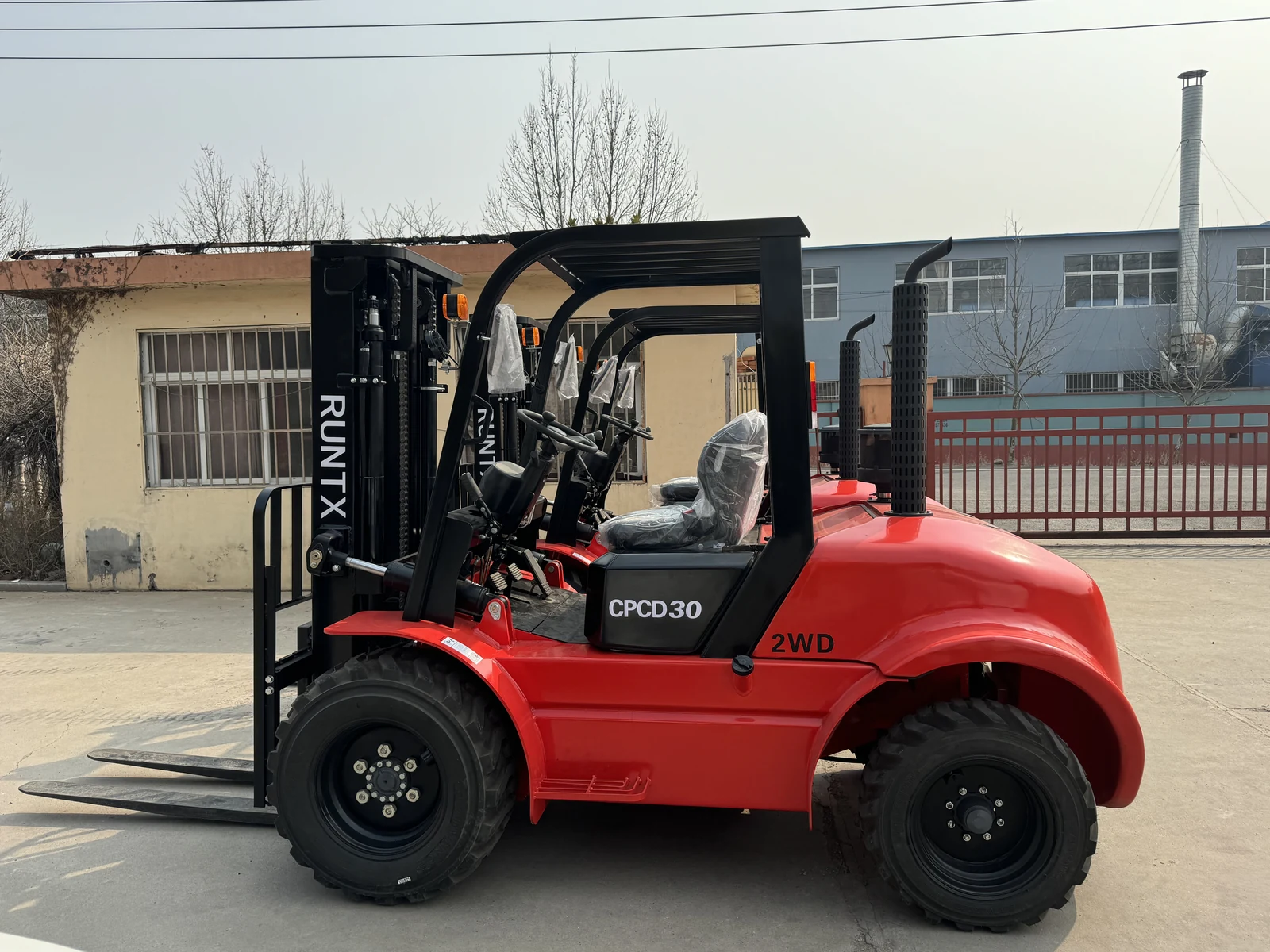
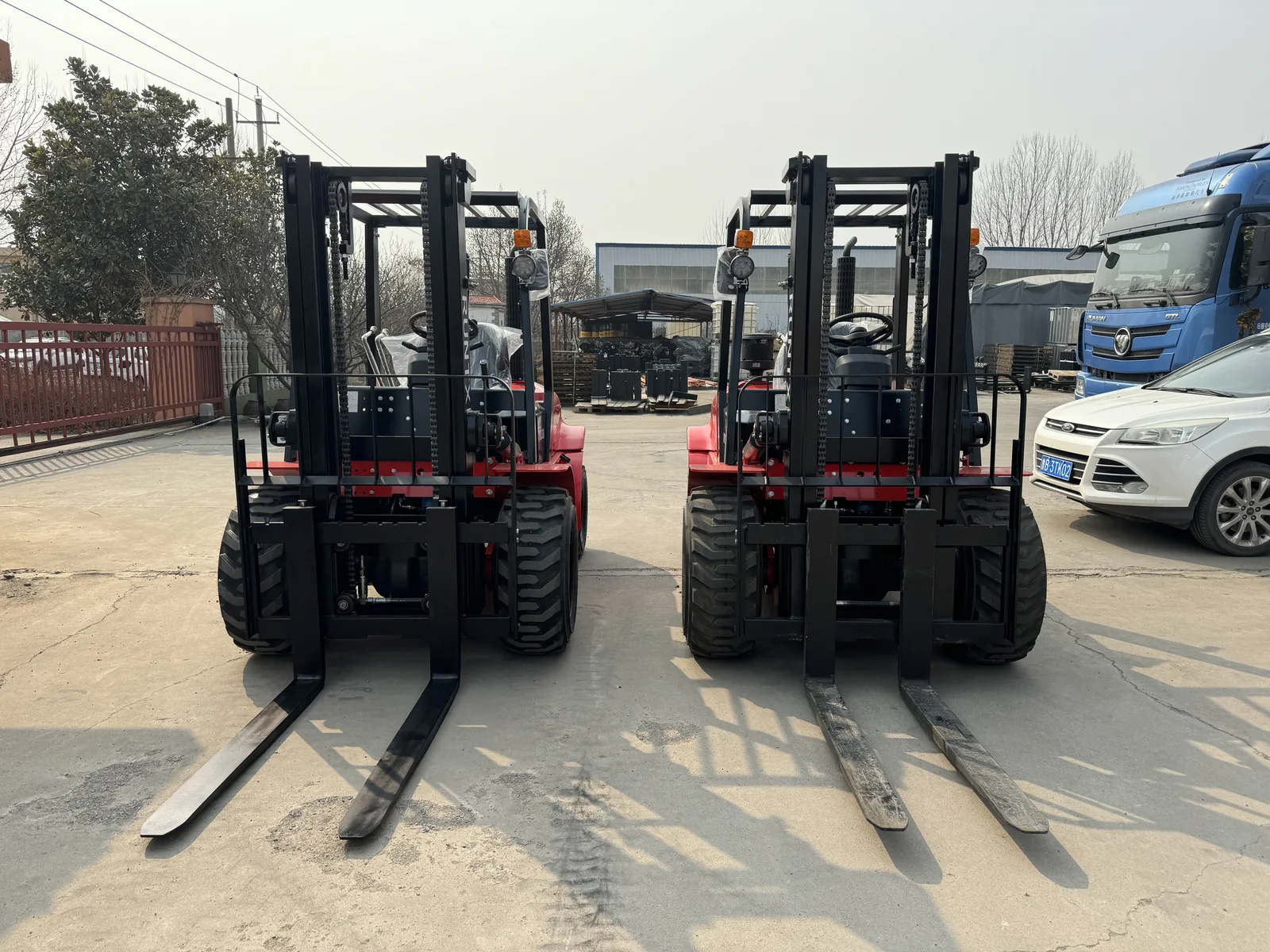
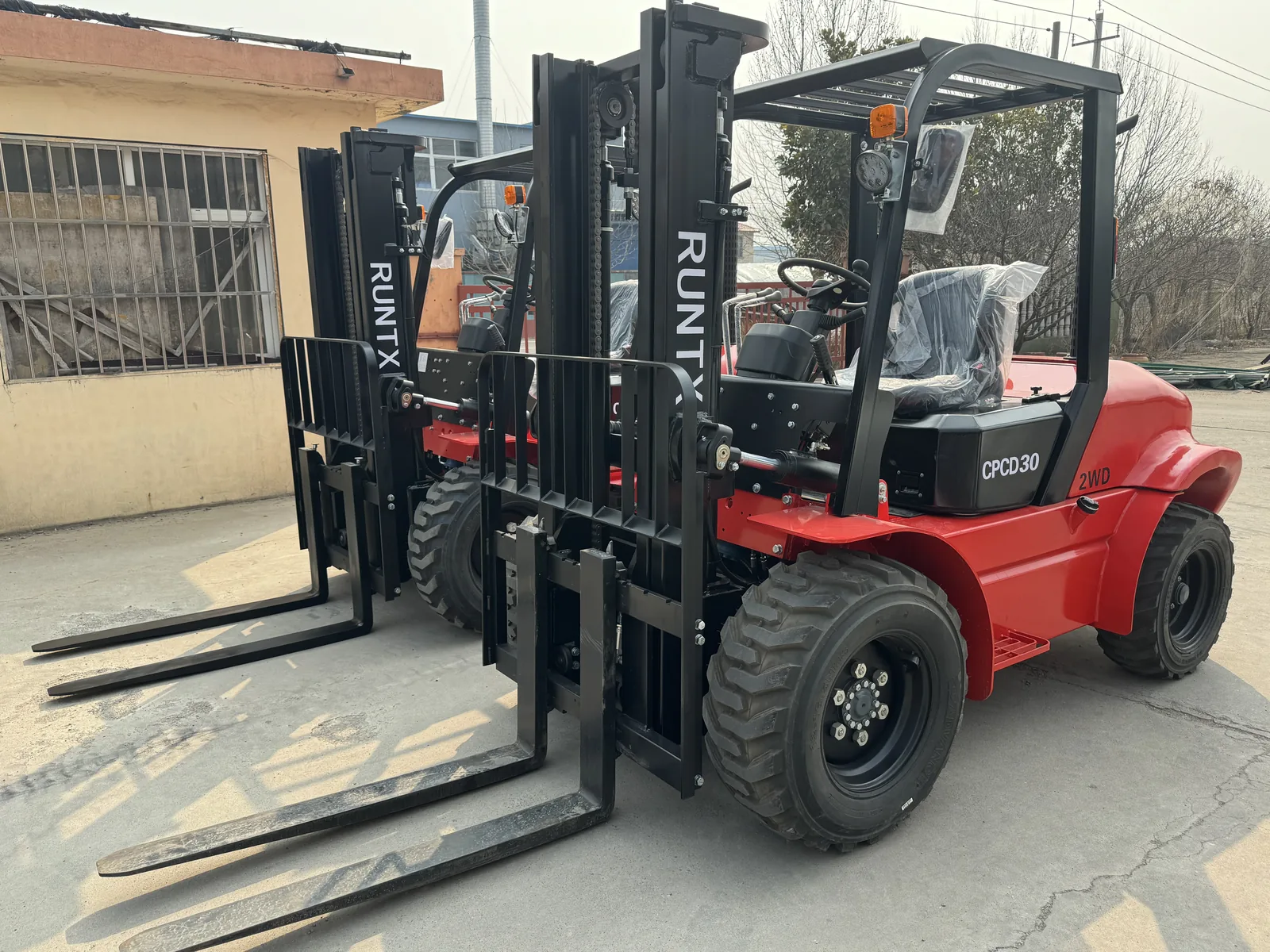
The photos from this project show both forklifts together at the factory after testing. The red bodywork, large off-road tires and clearly marked 2WD configuration make the machines easy to distinguish from a standard industrial diesel forklift.
For buyers working on construction sites, agricultural facilities, outdoor storage yards or uneven industrial ground, this type of machine offers a different balance of traction, ground clearance and load-handling ability than a conventional warehouse truck.
Why the Customer Chose a 3 Ton 2WD Rough Terrain Forklift
The 3-ton capacity class is one of the most versatile sizes in material handling.
It is large enough for many construction materials, palletized goods and machinery components, but still compact enough to remain practical for small contractors and medium-sized industrial sites.
The difference here is the chassis and tire configuration.
A standard CPCD30 is typically designed around paved industrial surfaces. A rough terrain model uses larger-profile tires and a higher-clearance chassis to better cope with uneven outdoor conditions.
The current RUNTX CPCD30RT 3 Ton Rough Terrain Diesel Forklift is designed specifically for unpaved surfaces and outdoor job sites, making it a better fit for applications where traction and ground clearance matter more than very tight warehouse maneuvering.
In this Mexican order, the customer selected the 2WD configuration, which can be a practical choice when the site requires rough-terrain capability but does not need the added complexity and cost of a full 4WD system.
2WD Does Not Mean “Light Duty”
There is sometimes a misconception that a 2WD rough terrain forklift is simply a standard forklift with larger tires.
That is not really the point.
The value comes from building the machine around outdoor mobility. Larger tread blocks improve traction on loose or uneven surfaces, while the raised chassis gives the truck more clearance than a low-profile warehouse forklift.
For a contractor working on compacted soil, gravel yards or unfinished industrial ground, that difference can be more useful than having four-wheel drive that may rarely be needed.
A 2WD machine can also be easier to maintain and more cost-efficient for buyers whose sites are rough but not extreme.
This makes it a good middle-ground option for small businesses that want stronger outdoor capability without jumping immediately to the highest-spec rough terrain platform.
Project Status:
Both CPCD30 3-ton 2WD rough terrain forklifts have completed production and factory testing. The machines are currently waiting for final export packing before container loading and shipment to Mexico.
Factory Testing Before Packing
Before a forklift is packed for export, it needs to be checked as a working machine rather than simply inspected as a finished product.
That includes basic steering, braking, mast operation, hydraulic response and general driving functions.
The machines in these photos have already completed this stage. Protective film remains on the seats, mirrors and some operator-area components because the forklifts have not yet entered the final packing process.
This is one of the last points where any small issue can be corrected easily before the machines are loaded into a container.
For international buyers, that matters because a minor problem at the factory is simple to solve. The same problem after ocean freight, customs clearance and local delivery becomes much more inconvenient.
Why Two Identical Machines Can Make Sense
The customer ordered two units rather than one, which can be a practical decision for businesses with repeated outdoor handling work.
Two matching machines simplify operator training and spare-parts planning. The same controls, tires, engine platform and maintenance procedures can be used across both forklifts.
For a contractor or rental business, that consistency also makes it easier to move equipment between jobs.
Instead of maintaining two completely different machines, the owner can standardize common filters, wear parts and maintenance routines.
That is especially useful for smaller businesses, where a complicated mixed fleet can create unnecessary service costs.
Waiting for Packing and Container Loading
The next stage for these two CPCD30 units is export preparation.
Once final packing is complete, the machines will be positioned for container loading and secured for international transport.
RUNTX uses protective wrapping on vulnerable components and prepares export loading according to machine dimensions and shipping requirements.
For overseas customers, we can also assist with commercial invoices, packing lists, bills of lading, certificates and other standard export documents.
This type of support is particularly useful for first-time importers or smaller buyers who may not have a dedicated international logistics team.
Need a Rough Terrain Forklift for Outdoor Work?
Tell RUNTX your load capacity, ground conditions, lift height and whether you need 2WD or 4WD. We can recommend a suitable rough terrain configuration before production.
Flexible Ordering for Small Contractors and Dealers
Not every buyer needs a full fleet.
RUNTX supports 1 Unit MOQ for suitable rough terrain forklift projects, which allows small contractors or direct users to purchase according to actual demand.
For rental companies and distributors, small-batch pricing and mixed-model orders can also be discussed.
OEM/ODM options include custom body color, branding, mast configuration, tires, forks and attachments depending on the application.
Buyers can also compare the wider RUNTX Rough Terrain Forklift Range if they are deciding between 2WD, 4WD or different capacity classes.
From Production Completion to Shipment
This Mexican order is currently at the final factory stage.
The two CPCD30 2WD rough terrain forklifts have been built, tested and inspected. What remains is protective packing, container loading and export shipment.
For international buyers, this stage is often the most reassuring part of the order because the equipment is no longer just a specification on a purchase contract.
The machines physically exist, the requested configuration has been completed, and they are ready to begin the journey to the customer.
More international deliveries, factory inspections and customer projects can be found in the RUNTX Customer Case Studies.
Note: To protect the customer’s commercial confidentiality, company identity and specific cooperation terms are not disclosed in this case.
Need a CPCD30 Rough Terrain Forklift?
Send us your working surface, load capacity, lift height and destination. RUNTX can prepare a factory-direct 2WD or 4WD rough terrain forklift configuration for a single unit or small fleet.