A forklift rated for 5,000 kg does not necessarily lift 5,000 kg in every situation. Load center, mast height, load shape and attachments can all reduce the capacity available at the forks.
A forklift data plate may say “3,000 kg,” “5,000 kg” or “10,000 kg,” but that number is only meaningful when another number is read with it: the load center.
This is one of the most common points buyers overlook when comparing forklifts.
A customer may tell a supplier, “My heaviest load is four tons, so a five-ton forklift gives me one ton of reserve.” On paper, that sounds reasonable.

In practice, it may be completely wrong.
If the load is long, its center of gravity sits farther away from the mast. If longer forks are fitted, or a sideshifter moves the load farther forward, the effective load center increases again. Raise the same load higher on a tall mast and the truck’s available residual capacity can decrease further.
That is why forklift capacity should always be understood as capacity at a specified load center and lifting condition, not as one fixed number.
What Is Forklift Load Center?
The load center is the horizontal distance from the vertical face of the forks to the center of gravity of the load.
For a load with evenly distributed weight, the calculation is simple.
If a pallet or crate is 1,000 mm deep in the direction of the forks, its theoretical load center is approximately:
1,000 mm ÷ 2 = 500 mm load center
That is why many smaller industrial forklifts are rated at a 500 mm load center.
A 1,200 mm-deep load would have a theoretical center around 600 mm. Larger industrial trucks commonly use this 600 mm rating because the loads they handle are often physically larger as well as heavier.
OSHA defines the same principle in imperial units and notes that many forklifts are rated around a 24-inch load center, based on a conventional 48-inch-deep pallet.
Source: U.S. Occupational Safety and Health Administration (OSHA), Powered Industrial Trucks – Load Composition.
Why Capacity Falls as the Load Center Moves Forward
The easiest way to understand the physics is to think about leverage.
Hold a heavy object close to your body and it is easier to support. Extend your arms and hold the exact same object farther away, and it suddenly feels much heavier.
The object did not gain weight. Its distance from the pivot increased.
A forklift works on the same basic principle.
The overturning effect is determined by the load moment:
Load Moment = Load Weight × Load Center Distance
OSHA provides a clear example. A forklift rated for 5,000 lb at a 24-inch load center has a rated load moment of 120,000 inch-pounds.
If the actual center of the load moves to 28 inches, the approximate allowable capacity becomes:
24 ÷ 28 × 5,000 = approximately 4,285 lb
That is roughly a 14.3% reduction in allowable weight caused only by moving the load center four inches farther forward.
Source: OSHA Powered Industrial Trucks – Load Composition. OSHA notes that this field calculation is an estimate; manufacturer load charts provide the more accurate capacity.
A More Extreme Example: 24 Inches vs 36 Inches
The effect becomes much larger when the load is unusually long.
OSHA gives another example of a forklift capable of lifting 4,000 lb at a 24-inch load center.
When the load center increases to 36 inches, the approximate allowable load falls to:
24 ÷ 36 × 4,000 = 2,666 lb
That means the available capacity falls by about 33%.
Source: U.S. Occupational Safety and Health Administration (OSHA), Powered Industrial Trucks – Load Composition.
This is why long timber, machinery crates, steel products and oversized building materials can create problems even when their actual weight appears comfortably below the forklift’s headline capacity.
What the RUNTX CPCD50 Load Chart Shows
The RUNTX CPCD50 provides a useful real-world example.
The RUNTX CPCD50 5 Ton Diesel Forklift is rated at 5,000 kg with a 600 mm load center in its standard configuration.
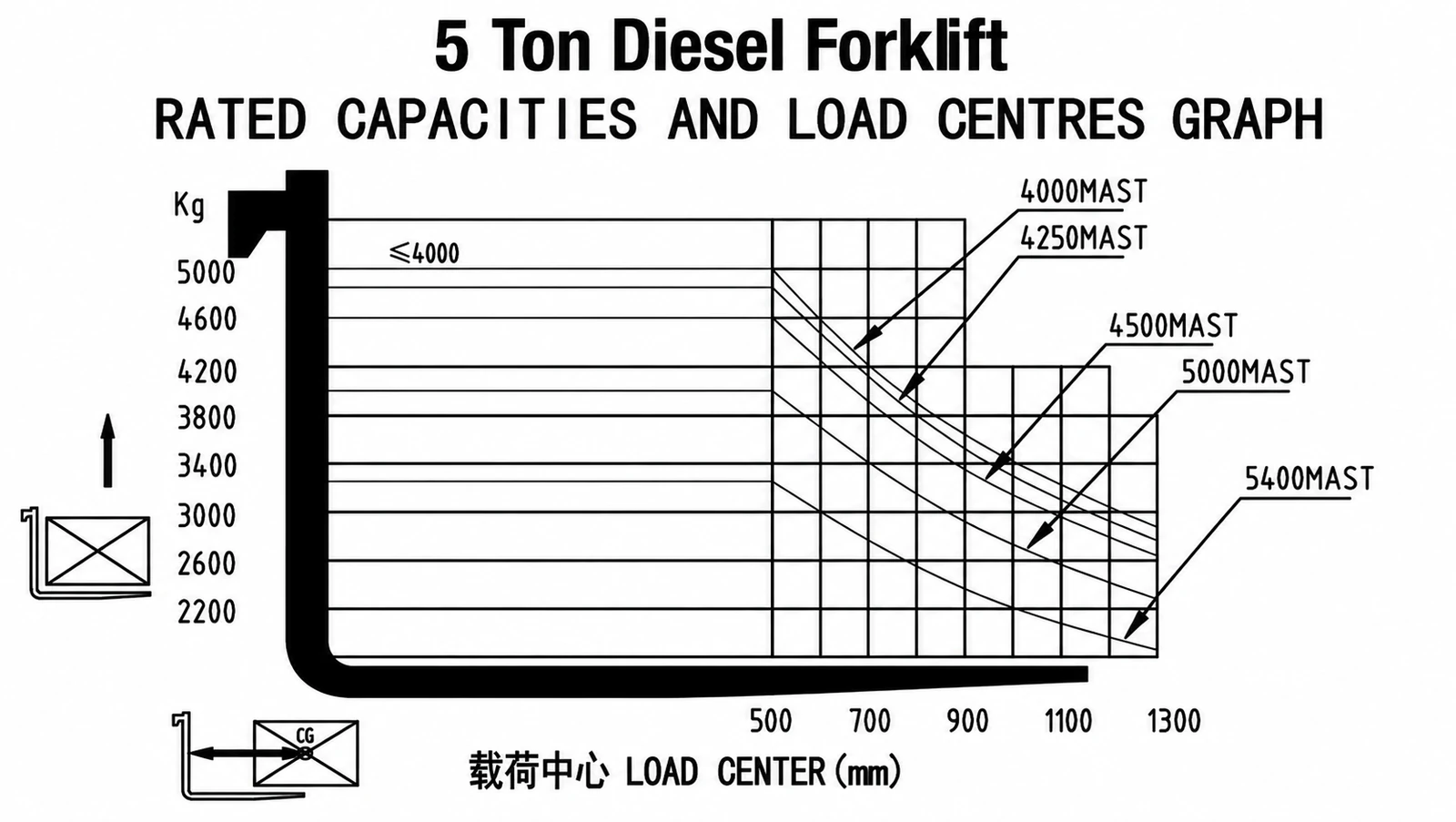
But the official CPCD50 capacity graph makes something very clear: the truck does not maintain 5,000 kg at every horizontal load center or every mast height.
The chart plots load centers from approximately 500 mm to 1,300 mm and includes several mast-height configurations from approximately 4,000 mm to 5,400 mm.
As the load center moves farther forward, every capacity curve slopes downward.
The higher-mast configurations also show lower residual capacity than shorter mast configurations under comparable extended-load conditions.
RUNTX CPCD50 Load-Chart Takeaway:
A 5-ton nameplate describes the truck’s rated condition. As the load center increases toward 900, 1,100 or 1,300 mm—or as higher mast configurations are used—the residual lifting capacity shown on the official chart decreases significantly.
This is exactly why the factory load chart should be checked when a customer handles oversized cargo.
A simple calculation is useful for understanding the physics, but the manufacturer’s capacity curve is the document that should guide the final equipment selection.

Load Center and Mast Height Work Together
Buyers sometimes understand the horizontal load center but forget about lifting height.
A load at 500 mm from the fork face and one meter above the ground is not the same stability condition as the same load several meters in the air.
As the load rises, the combined center of gravity of the forklift and load also moves upward. That reduces the stability margin.
The RUNTX CPCD50 graph shows separate curves for approximately 4,000 mm, 4,250 mm, 4,500 mm, 5,000 mm and 5,400 mm mast configurations.
The practical lesson is straightforward:
a customer asking for both a long load center and a high mast should never select the forklift by rated tonnage alone.
The combination matters.
500 mm vs 600 mm Load Center: Why Forklift Classes Change
| Forklift / Load Type | Typical Rated Load Center | What It Means |
|---|---|---|
| RUNTX CPCD30 | 500 mm | Suitable for many standard pallet and industrial loads around 1,000 mm deep |
| RUNTX CPCD35 / CPCD40 | 500 mm | Higher rated weight, but still based on the same standard load-center geometry |
| RUNTX CPCD50 | 600 mm | Designed around larger industrial loads with a deeper rated load geometry |
| Oversized Machinery Crate | May exceed 600 mm | Requires residual-capacity verification from the load chart |
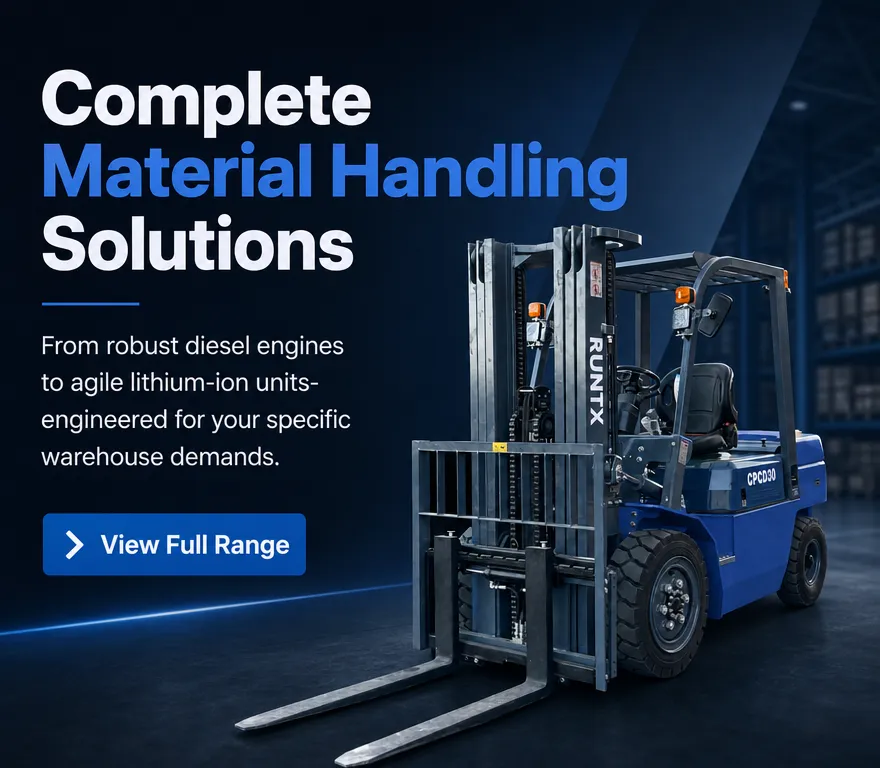
The current RUNTX CPCD30 3 Ton Diesel Forklift is rated at 3,000 kg at a 500 mm load center, while the CPCD50 moves to a 600 mm rated center.
That difference reflects the fact that heavier industrial loads are often physically larger too.
Long Forks Do Not Automatically Increase Load Center—but the Load Often Does
This is another common misunderstanding.
Simply installing longer forks does not automatically mean the load center equals half the fork length.
The important number is the actual center of gravity of the load being carried.
If 1,800 mm forks are installed but the pallet remains 1,000 mm deep and sits against the carriage, the load may still have a center near 500 mm.
If those longer forks are used to support a 2,000 mm-deep crate, however, the load center may move toward approximately 1,000 mm.
That is a completely different lifting condition.
For buyers ordering custom forks, RUNTX therefore needs the load dimensions as well as the load weight.
Attachments Can Reduce Capacity Again
Sideshifters, fork positioners and clamps make a forklift more productive, but they also add weight in front of the truck and may move the load farther away from the mast.
OSHA gives a real nameplate example where a forklift rated at 5,000 lb using standard forks is rated at 4,500 lb with a sideshifter installed.
That is a 10% reduction in that specific truck-and-attachment combination.
Source: U.S. Occupational Safety and Health Administration (OSHA), Powered Industrial Trucks – Nameplate and Attachment Guidance.
That does not mean every sideshifter reduces capacity by exactly 10%.
OSHA specifically notes that attachments can affect the truck’s center of gravity, visibility and capacity, and that the weight of the attachment itself reduces the load the truck can carry.
Source: OSHA Powered Industrial Trucks – Attachments.
Handling a Long or Oversized Load?
Do not send RUNTX only the weight. Send the load length, width, center of gravity, required lift height and attachment configuration. Our team can check the appropriate forklift and residual capacity before production.
Why “Buy One Size Bigger” Is Not Always the Right Answer
When buyers first learn about load-center derating, the instinct is often to simply choose a larger forklift.
Sometimes that is correct. Sometimes it creates a different problem.
A larger truck costs more, takes more space to turn and may consume more fuel or require larger transport equipment.
If the problem is caused by a rare oversized load handled once a month, buying a much larger forklift for every daily pallet movement may not be good fleet economics.
The better approach is to identify the regular working condition:
What is the heaviest normal load? How deep is it? How high does it need to go? Which attachment is actually installed?
Once those four variables are known, the correct capacity class becomes much easier to select.

Load Placement Matters Even When the Weight Is Correct
A correctly sized forklift can still become unstable if the load is positioned badly.
OSHA recommends keeping the heaviest portion of the load toward the mast and minimizing the distance between the front wheels and the load’s center of gravity.
It also warns that placing a long rectangular load lengthwise rather than widthwise can move the center of gravity farther forward and exceed the truck’s rated capacity.
Source: U.S. Occupational Safety and Health Administration (OSHA), Powered Industrial Trucks – Load Composition.
This is especially relevant for machinery crates and building materials where the load shape may be much longer than a standard pallet.
What Buyers Should Send Before Asking for a Forklift Quote
A buyer asking only for “a 5-ton forklift” leaves out some of the most important engineering information.
For a standard pallet job, that may be enough to begin a quotation.
For an unusual load, RUNTX recommends providing:
maximum load weight, load length in the fork direction, load width, approximate center of gravity, required lifting height, fork length and any attachment requirement.
With those details, the factory can select the correct capacity class and check the relevant load chart rather than relying on a rough assumption.
RUNTX supports 1 Unit MOQ for suitable projects as well as small-batch and distributor orders. OEM/ODM requirements such as forks, attachments, tires, mast height and market-specific configurations can also be discussed before production.

Frequently Asked Questions
What is load center on a forklift?
Load center is the horizontal distance from the vertical face of the forks or attachment to the center of gravity of the load. Forklift capacity is rated at a specific load center.
Does a longer load reduce forklift capacity?
Usually yes if the longer load moves the center of gravity farther forward. As load-center distance increases, the allowable load must normally decrease to remain within the forklift’s stability limits.
Can a 5 ton forklift always lift 5 tons?
No. A 5-ton rating applies only under the rated load-center and configuration conditions. Higher mast height, longer load center and attachments can all reduce residual capacity.
What is the load center of the RUNTX CPCD50?
The current CPCD50 specification is rated at 5,000 kg with a 600 mm load center. Its official capacity graph should be consulted for longer load centers and higher mast configurations.
Does a sideshifter reduce forklift capacity?
It can. Attachments add weight and may increase the effective load center. The forklift’s updated data plate or manufacturer capacity chart should be used for the final truck-and-attachment configuration.
Can I calculate forklift capacity myself?
A load-moment calculation can provide a useful estimate, but OSHA recommends consulting the manufacturer for precise information. The official load chart is the correct reference for the actual forklift configuration.
The Most Important Forklift Number May Not Be the Tonnage
Buyers naturally focus on rated capacity because it is the easiest number to compare.
But a 3-ton, 5-ton or 10-ton rating tells only part of the story.
The same load becomes more demanding when it moves farther away from the mast, rises higher or sits on a heavier attachment.
That is why the best equipment decision begins with the load itself.
Know its weight. Know its dimensions. Know where its center of gravity sits. Know how high it needs to go.
Once those numbers are clear, the correct forklift capacity becomes much easier to determine.
Not Sure What Capacity Your Load Really Needs?
Send RUNTX your load weight, dimensions, lift height and attachment requirements. We can check the relevant load center and residual capacity before recommending a forklift.