A higher forklift mast is not automatically a better mast. The right choice depends on three measurements buyers often confuse: maximum lift height, mast lowered height and free lift.
A buyer may ask for a 4.5-meter forklift mast because the highest rack beam is around four meters.
That sounds straightforward until another detail appears:
the forklift also needs to pass through a 2.3-meter doorway—or lift pallets inside a shipping container.
Now maximum lift height is only one part of the problem.
The buyer also needs to know how tall the mast is when fully collapsed and how far the forks can rise before the mast itself begins extending upward.
This is where terms such as duplex mast, triplex mast, full free lift and lowered mast height start to matter.
For small warehouses, contractors and first-time forklift buyers, the most useful way to think about mast selection is not “two stages versus three stages.” It is:
How high must I lift, and how much overhead space do I have while doing it?
Duplex and Triplex Describe Mast Stages—not the Whole Specification
A duplex mast uses two sets of mast rails. A triplex mast uses three.
That sounds like a small structural difference, but the extra nested mast section allows a triplex system to achieve substantially more extended height while remaining relatively compact when lowered.
OSHA describes duplex masts as two-stage systems and triplex masts as three-stage systems. Its general forklift guidance also notes that a triplex mast can extend farther than a duplex while retaining a similar amount of free lift in common designs.
Source: U.S. Occupational Safety and Health Administration (OSHA), Powered Industrial Trucks – Mast and Carriage.
But there is an important detail buyers should not miss:
“Duplex” does not automatically mean “full free lift.”
RUNTX, for example, offers three distinct configurations for suitable forklift models:
2-Stage Wide View Mast, 2-Stage Full Free Mast and 3-Stage Full Free Mast.
The stage count tells you how the mast telescopes. The “full free” specification tells you something different: how much the forks can rise before the mast rails extend above their collapsed height.
What Is Free Lift on a Forklift?
Free lift is the vertical distance the forks can travel upward before the mast begins extending above its lowered height.
This matters most when the forklift is operating under a ceiling, inside a trailer or container, beneath sprinklers, or through a low doorway.
OSHA’s generic mast guidance illustrates the difference clearly. It describes simplex masts as typically having only around 4–6 inches of free lift, while common duplex and triplex designs may provide approximately 50–60 inches.
Source: OSHA Powered Industrial Trucks – Mast and Carriage. Actual free lift varies by forklift and mast design.
Those figures are general industry examples, not RUNTX model guarantees, but they show why free lift changes how a forklift can be used in a confined space.
If the forks can rise only a few centimeters before the mast starts extending, the truck may enter a low space but still be unable to lift the pallet once it is inside.
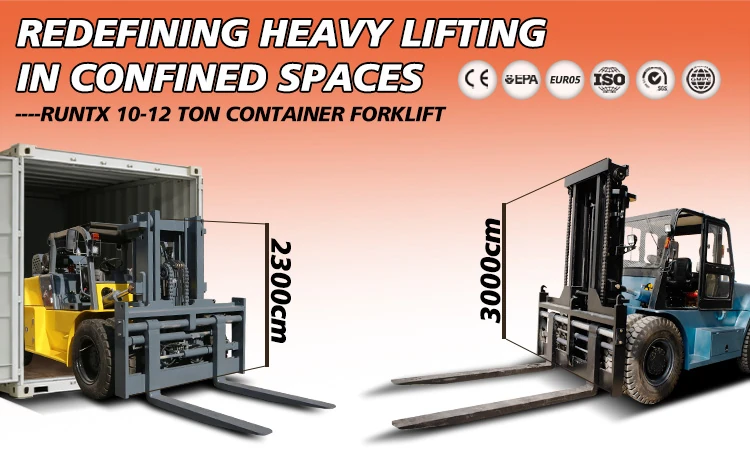
Why Full-Free Masts Matter Inside Containers
This is one of the most common real-world questions RUNTX receives.
A customer says the forklift needs to enter a shipping container, so the first concern is usually:
“Is the mast low enough to fit through the container opening?”
That is only the first check.
The second question is whether the forks can lift high enough inside the container without causing the mast to extend into the roof.
OSHA specifically warns buyers and operators to consider both overall lowered mast height and free fork height when working inside trucks, semi-trailers and other confined spaces. Its guidance notes that semi-trailer clearance may be around 8 ft, and gives an example where an 8 ft mast enters an 8.5 ft space—but extending that mast to reach a higher pallet could strike or puncture the roof.
Source: OSHA Powered Industrial Trucks – Critical Forklift Measurements.
This is exactly where a full-free mast earns its value.
The forks rise while the outer mast remains at approximately its collapsed height for the initial part of the lift. That gives the operator usable vertical movement without immediately consuming additional overhead clearance.
Practical RUNTX Selection Rule:
If the forklift must work inside containers, trailers or another low-clearance space, do not ask only for maximum lift height. Confirm mast lowered height and available free lift before selecting the configuration.
2-Stage Wide View Mast: Simple and Practical for Standard Work
A conventional two-stage wide-view mast remains a very practical choice when the operating environment does not impose severe overhead restrictions.
Its structure is relatively straightforward, and the wide-view arrangement is intended to preserve good forward visibility through the mast.
For routine pallet handling, outdoor yards and warehouses with standard door heights, there is often little reason to pay for additional mast complexity if the truck only needs a common 3-meter lifting height.
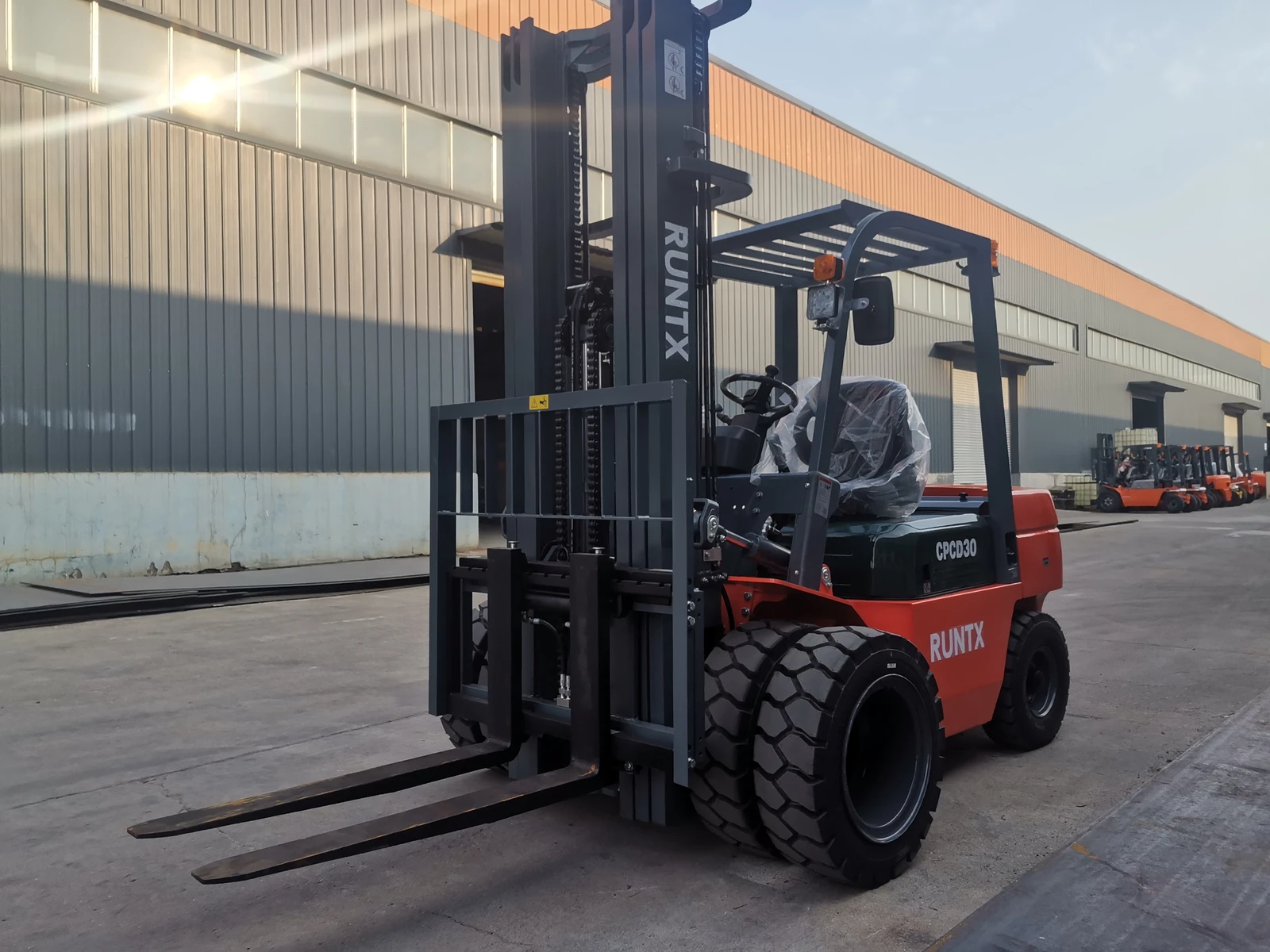
The current RUNTX CPCD30 3 Ton Diesel Forklift is published with a standard 3,000 mm lifting configuration, while mast options can be customized around the final application. RUNTX’s current product information also confirms availability of standard 2-stage, full-free 2-stage and 3-stage triplex options for suitable models.
For a contractor loading trucks in an open yard, a basic duplex mast may be the most economical solution.
2-Stage Full Free: When Height Is Limited but Extreme Reach Is Not Required
A two-stage full-free mast solves a more specific problem.
The buyer needs meaningful fork movement before the mast extends, but may not need the maximum height of a triplex mast.
That makes it especially useful for container loading, low-ceiling production areas and warehouses with restrictive doorways.
This is also why “full free” should not be confused with “high lift.”
A duplex full-free mast may provide excellent confined-space functionality while still having a lower maximum lift height than a triplex configuration.
For a business that spends much of the day loading inside trailers but only stacks pallets to moderate heights, that may actually be the better combination.
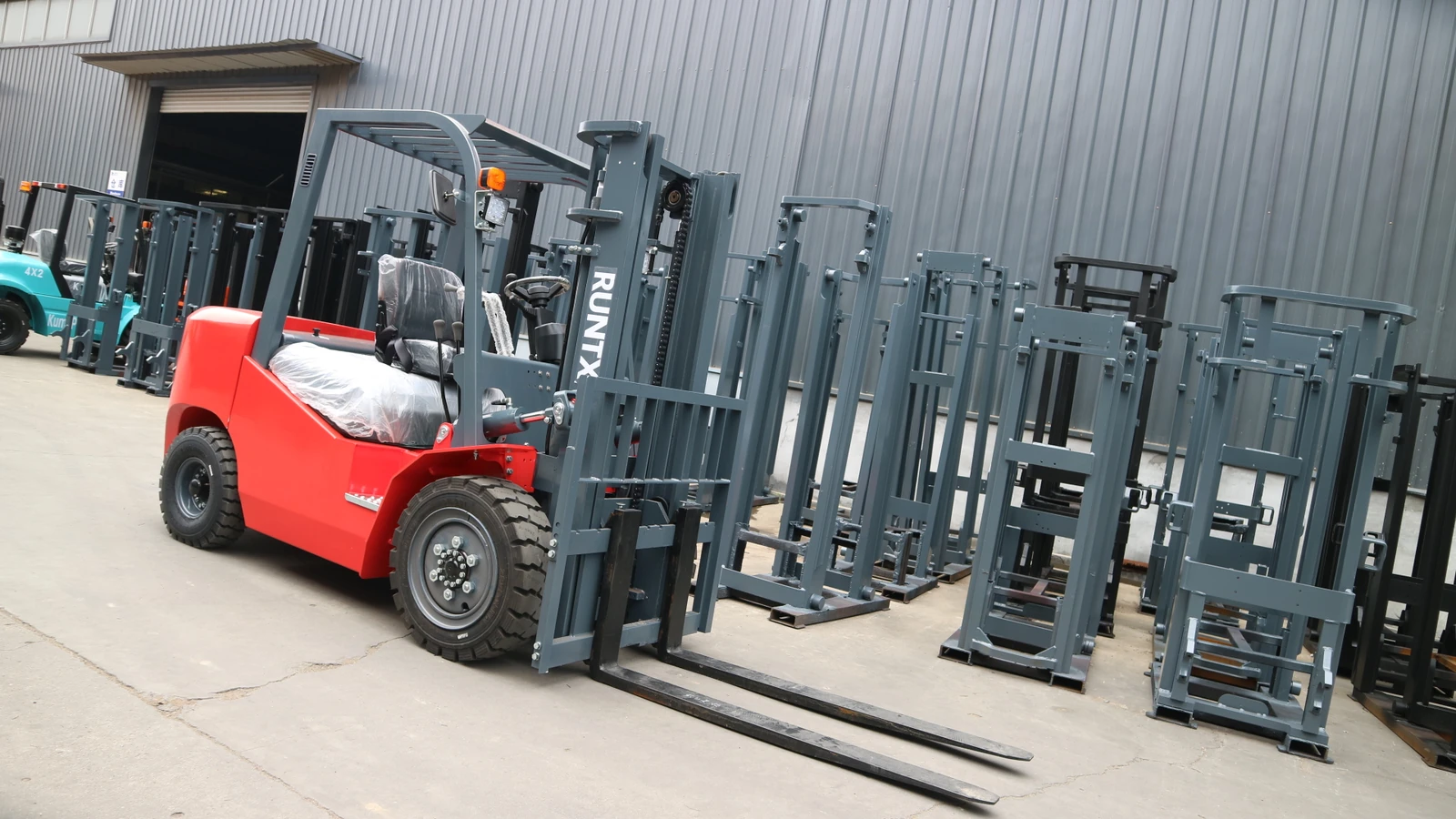
Triplex Full Free: High Rack Height Without an Extremely Tall Collapsed Mast
Triplex becomes more attractive when a forklift needs to pass through a relatively low opening and then reach significantly higher racking once inside the warehouse.
The third nested mast section allows greater extended height without requiring the collapsed mast to grow in direct proportion.
Toyota describes the three-stage mast as one of the most versatile configurations because it combines high free lift with greater maximum lift height than a two-stage mast.
Source: Toyota Material Handling, Guide to Forklift Mast Types & Heights, 2026.
RUNTX has used this type of configuration in real equipment. A CPCD30 displayed at the 139th Canton Fair was configured with a 3-stage 4,500 mm full-free mast, demonstrating a typical setup for buyers who need greater stacking height without moving to a permanently taller mast structure.
This does not mean every CPCD30 uses the same mast. It shows how the same base forklift can be configured differently depending on the customer’s site.
Duplex vs Triplex vs Full Free: Practical Comparison
| Mast Type | Main Strength | Typical Application | Main Question to Check |
|---|---|---|---|
| 2-Stage Wide View | Simple structure and good forward visibility | Standard warehouse, yard and general loading | Is the lowered mast height acceptable? |
| 2-Stage Full Free | Useful fork lift without immediate mast extension | Containers, trailers, low ceilings and low doorways | Is free lift sufficient for the confined-space task? |
| 3-Stage Full Free / Triplex | Higher maximum lift from a relatively compact collapsed package | High warehouse racking with doorway constraints | What residual capacity remains at full height? |
Lift Height and Lowered Height Must Be Checked Together
Your RUNTX mast reference table illustrates an important relationship.
As required lift height increases, the lowered height of a conventional mast generally increases as well. A triplex layout can reduce that collapsed-height penalty because the extension is divided across more nested rail sections.
That is why a 4.5-meter duplex and a 4.5-meter triplex should never be treated as interchangeable simply because both ultimately reach the same height.
The triplex may be able to pass through a doorway that the duplex cannot.
Because exact dimensions vary by truck, capacity and mast family, RUNTX confirms lowered mast height against the final forklift configuration rather than applying one mast table to every model.
How Much Lift Height Should You Actually Order?
Buying exactly the same lift height as the highest rack level can leave too little working clearance.
Toyota recommends adding at least 6 inches above the highest rack shelf when estimating required maximum mast height.
Source: Toyota Material Handling, Guide to Forklift Mast Types & Heights, 2026.
The reason is practical. The forks need to raise the pallet high enough to clear the rack beam before the operator can move the load into position.
If your highest rack position is exactly 4,500 mm, specifying exactly 4,500 mm of maximum fork height may leave insufficient clearance depending on pallet structure and operating method.
This is why rack beam height, pallet height and required clearance should all be provided when asking for a mast recommendation.
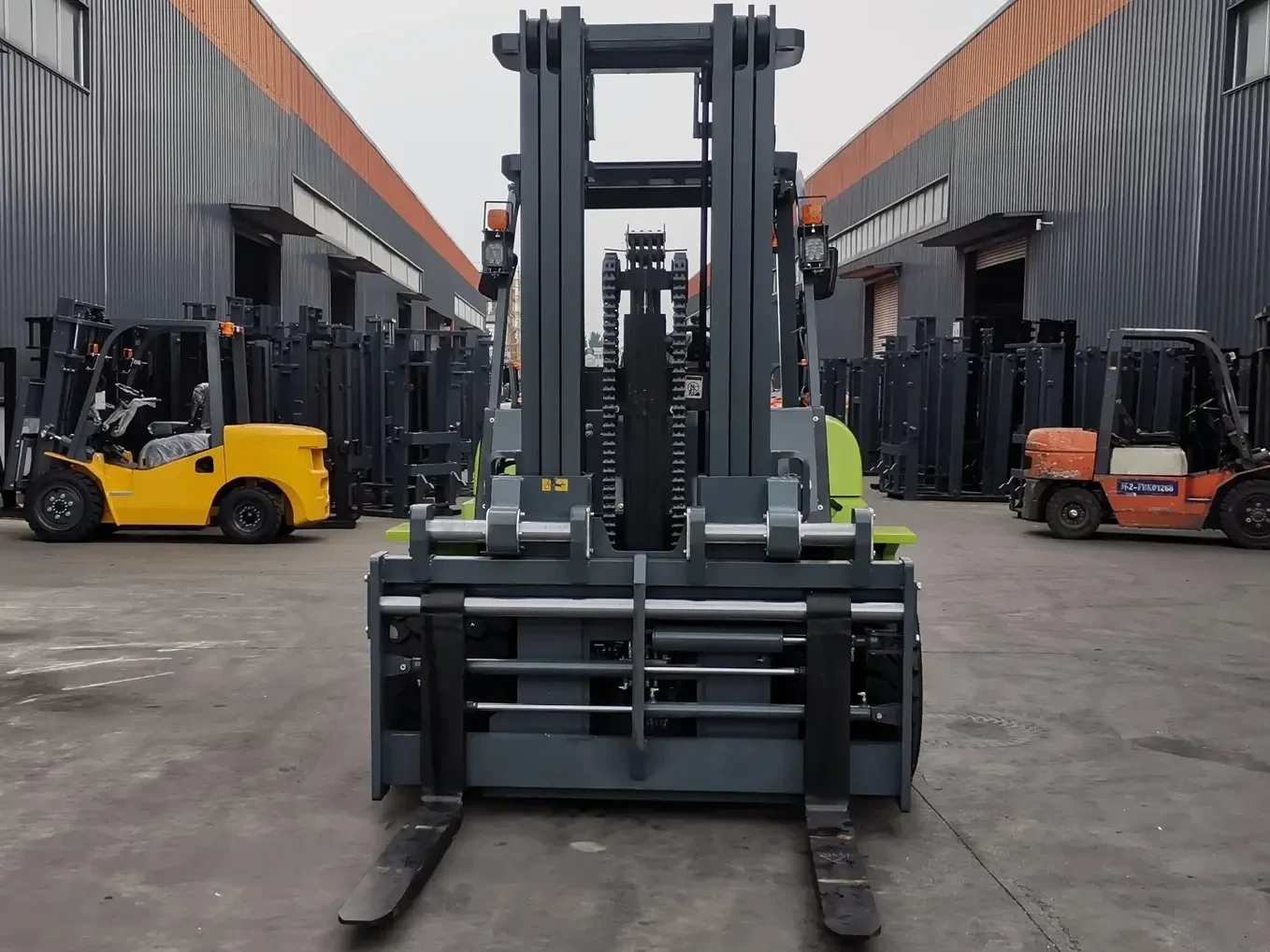
Higher Mast Does Not Mean Full Rated Capacity at Every Height
A taller mast changes more than the reach of the forklift.
As a load rises, the combined center of gravity of the forklift and load moves upward. Stability margin decreases, particularly when handling heavier loads or operating close to the truck’s capacity limit.
OSHA specifically states that forklift lifting capacity decreases as the load is raised and recommends reducing loads when high tiering with the mast fully extended.
Source: OSHA Powered Industrial Trucks – Mast and Carriage / Load Handling.
That means a buyer asking for a 5- or 6-meter mast should also ask for the applicable load chart or residual-capacity information.
A forklift rated for 3,000 kg at a standard condition does not automatically mean it can safely carry the same 3,000 kg at every mast height.
Attachments Can Change the Final Capacity Again
Mast selection does not happen in isolation.
A sideshifter, fork positioner or clamp adds weight to the front of the forklift and can change the load center.
OSHA provides a real nameplate example where a forklift rated at 5,000 lb with standard forks is rated at 4,500 lb with a sideshifter—a 10% reduction for that particular combination.
Source: OSHA Powered Industrial Trucks – Nameplate and Attachment Guidance.
That figure should not be applied universally, but it demonstrates why a high mast plus attachment package needs to be checked as a complete configuration.
Need the Forklift to Enter a Container or Low Doorway?
Send RUNTX the doorway or container clearance, highest required lift point, load weight and attachment requirement. We can compare a standard duplex, duplex full-free and triplex full-free mast before production.
A Common Container-Loading Scenario
One of the most frequent mast questions RUNTX receives comes from customers who need the forklift to enter a shipping container.
They may initially request a standard 3-meter mast because the required lifting height seems modest.
But once container clearance is considered, a full-free mast may become the more appropriate choice.
The machine needs to enter the container with the mast lowered, then lift the pallet enough to clear the floor, another pallet or the loading position without immediately extending into the roof.
In that situation, free lift may matter more than maximum lift height.
This is a good example of why the most expensive mast is not automatically the best mast. The correct option is the one that matches the confined-space geometry.
When Triplex Is Worth Paying For
A triplex full-free mast starts making more sense when the same forklift must solve two conflicting requirements:
pass through a relatively low opening and then reach high warehouse racking.
For example, a warehouse may have a restricted doorway but 4.5- or 5-meter storage positions once the truck is inside.
A standard duplex sized for the required rack height may have too much collapsed height. A triplex divides the extension across three stages, making it easier to achieve both requirements.
For distributors and rental companies, triplex can also make one machine useful to a wider range of customers—but only if the additional mast cost and capacity implications make sense for the local market.
Frequently Asked Questions
What is the difference between duplex and triplex forklift masts?
A duplex mast has two mast stages, while a triplex has three. The third stage allows a triplex mast to achieve greater maximum lift height while often retaining a relatively compact lowered height.
What does full free lift mean?
Full free lift allows the forks to rise a meaningful distance before the mast rails begin extending upward. This is particularly useful in containers, trailers and low-ceiling buildings.
Which mast is best for container loading?
A full-free mast is often the better choice when the forklift must lift while remaining inside the height limit of a shipping container or trailer. Exact mast lowered height and free lift must still be confirmed for the selected model.
Is triplex always better than duplex?
No. If the application needs only a standard lift height and has no serious overhead restriction, a simpler duplex mast may provide better value. Triplex becomes more useful when high stacking and compact lowered height are both required.
Does a taller forklift mast reduce capacity?
Residual capacity can decrease at greater lift heights. The final load chart should therefore be checked when selecting higher mast configurations, particularly for loads near the rated capacity.
What information should I send when ordering a mast?
Provide maximum load weight, highest rack or stacking height, lowest doorway or ceiling clearance, load dimensions and any attachment requirements.
Choose the Mast Around the Building, Not Just the Rack
The easiest mistake in mast selection is to look only upward.
A buyer sees a 4.5-meter rack and orders a 4.5-meter mast.
The more complete approach is to look both upward and downward:
How high must the forks reach? How low must the mast remain to enter the working area? How much free lift is required before the mast begins extending? And how much capacity remains at the final lift height?
For ordinary handling, a two-stage wide-view mast may be all you need.
For container work, a two-stage full-free mast may be much more useful.
For high racking behind a low doorway, triplex full free is often the configuration worth considering.
The best mast is not the one with the most stages.
It is the one that fits the building and the load at the same time.
Not Sure Which Mast Your Forklift Needs?
Send RUNTX your load weight, rack height, lowest doorway or container clearance and attachment requirement. We can prepare a factory-direct forklift configuration with the appropriate duplex, full-free or triplex mast.