How embodied AI and autonomous decision-making are reshaping the future of industrial logistics.
The landscape of industrial manufacturing and warehouse logistics is undergoing a profound transformation. For decades, the materials handling industry has relied on traditional, operator-driven machinery. Today, we are witnessing the dawn of a new era defined by artificial intelligence, machine learning, and advanced robotics. A notable example of this industrial shift is Hangcha, a prominent Chinese materials handling equipment manufacturer. Recently, the company hosted its AI Day, signaling a strategic pivot in its corporate direction—an evolution exploring the integration of cutting-edge robotics into traditional forklift manufacturing.
Exploring LogiMind: The Embodied AI Concept
The centerpiece of this recent industry showcase was the introduction of LogiMind. Presented as an embodied AI foundation model, it is purpose-built for the complex environment of industrial vehicles. By integrating artificial intelligence into the operational framework of material handling equipment, technologies like LogiMind aim to bridge the gap between digital cognitive processing and physical mechanical execution. The platform is designed to offer enhanced spatial awareness, operational adaptability, and task execution capabilities within demanding warehouse environments.
The Technological Architecture Behind Autonomous Logistics
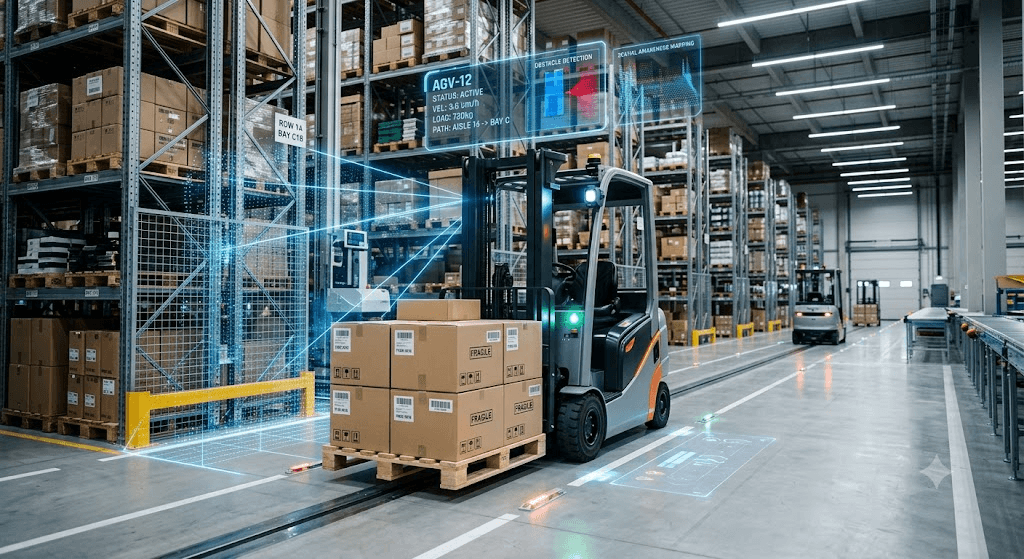
To bring these AI concepts to life, a comprehensive technological architecture is typically required. Robust autonomous systems rely on a combination of next-generation sensors and hybrid computing networks. Key technical elements highlighted in this industry trend include:
- 3D LiDAR Technology: Builds precise, real-time dynamic maps of the operating environment.
- Multi-Camera Vision: Provides deep visual recognition and object detection capabilities to identify obstacles and targets.
- Cloud-Edge Collaborative AI Engine: Processes critical data locally on the “edge” for rapid decision-making, while communicating with the “cloud” for broader fleet management.
Breaking the 2% Adoption Barrier
Despite the rapid advancements in robotics, the adoption of fully autonomous material handling equipment remains relatively low. According to industry analysis, autonomous forklifts currently account for only about 2% of all forklifts actively used in the Chinese domestic market. This figure indicates a fundamental operational barrier: until now, market solutions have often lacked the flexibility needed to justify the immense capital expenditure required to transition away from human operators.
The Limitations of Traditional AGVs vs. Autonomous Adaptability
Traditional Automated Guided Vehicles (AGVs) have been the industry standard for automation, but they often suffer from inflexibility. AGVs rely heavily on fixed routes, forcing facilities to physically adapt their layouts. Because traditional AGVs lack advanced cognitive processing, they struggle with unexpected situations—often simply stopping and waiting for human intervention.
The integration of embodied AI represents a shift in this paradigm. The new approach aims for a scenario where the machine adapts to the site, reducing the need for drastic warehouse modifications.
As Wenfei Wang, CTO at the Intelligent Logistics Research Institute, noted during the presentation: “A traditional AGV follows the exact path you tell it to take. An autonomous forklift understands what you ask it to do and determines how to complete it on its own.”
Balancing the Future with Today’s Practical Needs
While initiatives by companies like Hangcha highlight a highly intelligent global strategic vision, fully autonomous systems require significant capital investment and facility readiness. As leaders push the boundaries of artificial intelligence, warehouse managers must stay informed on how these technologies evolve.
However, for many modern supply chains, the immediate necessity remains robust, highly reliable, and cost-effective traditional equipment that can deliver guaranteed performance without the complexities of full automation.
Disclaimer: Hangcha and LogiMind are trademarks of Hangcha Group. RUNTX Machinery is an independent material handling equipment provider and is not affiliated with, endorsed by, sponsored by, or connected to Hangcha Group. The information in this article is provided for industry analysis and educational purposes only.
Ready to Optimize Your Material Handling Today?
At RUNTX Machinery, we focus on delivering practical, high-performance lifting solutions that fit your operational reality right now. Whether you are scaling up your warehouse or looking for dependable heavy-duty equipment, our team is here to help you find the most efficient fit.