An in-depth engineering analysis for procurement managers and site supervisors on selecting the optimal material handling equipment.
In the high-stakes world of industrial manufacturing, construction, and global logistics, deploying the wrong material handling equipment is more than a minor inconvenience—it is a critical operational liability. One of the most common and costly engineering miscalculations site supervisors make is deploying standard warehouse forklifts in demanding outdoor environments. When a machine designed for polished concrete meets mud, gravel, or steep inclines, the results are inevitable: compromised chassis integrity, shattered drive axles, severe safety hazards, and catastrophic operational downtime.
The materials handling industry strictly categorizes equipment based on operational intent. Understanding the mechanical DNA, structural limitations, and environmental thresholds of Standard Forklifts (Class IV and V) versus Rough Terrain Forklifts (Class VII) is fundamental to optimizing your fleet’s Total Cost of Ownership (TCO) and ensuring workplace safety. This comprehensive guide breaks down the engineering differences, helping global distributors and procurement managers make data-backed purchasing decisions.
The Mechanical DNA: Defining the Structural Differences
To the untrained eye, a forklift is simply a lifting device. However, from an engineering standpoint, standard and rough terrain forklifts share very little in common beyond the basic mast and carriage assembly. Their chassis architecture, ground clearance, and power-to-weight ratios are engineered for entirely different physics.
Standard Forklifts (Class IV & V): The Masters of the Concrete Jungle
Standard counterbalanced forklifts are the backbone of indoor warehousing, cross-docking facilities, and paved lumber yards. Designed for maximum maneuverability in tight spaces, they feature a compact wheelbase, low center of gravity, and minimal ground clearance (often less than 5 inches).
These machines utilize either cushion tires (Class IV) for smooth indoor concrete or standard pneumatic tires (Class V) for dry, flat asphalt. The suspension system is virtually non-existent, meaning any uneven surface transmits shock directly through the chassis to the mast, risking load instability and structural fatigue over time. They are highly efficient, but their operational envelope is strictly limited to improved, flat surfaces.
Rough Terrain Forklifts (Class VII): Engineered for the Unforgiving
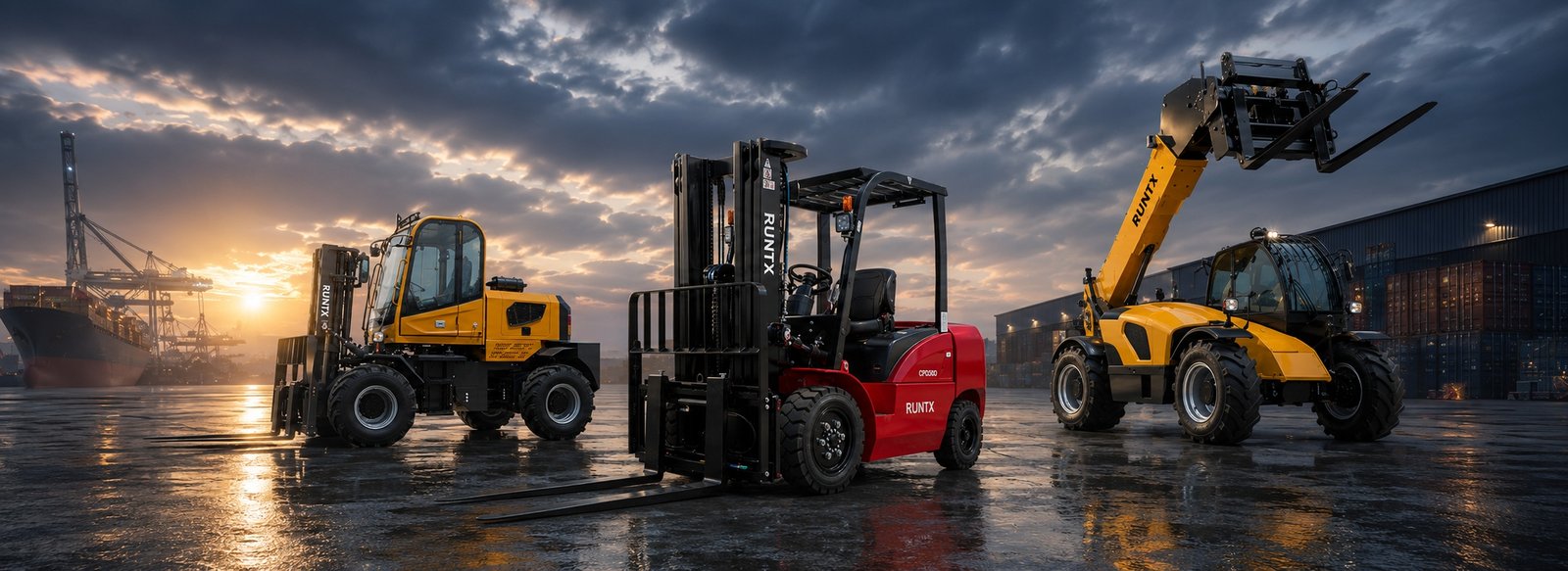
Rough terrain forklifts (RTFs) are a completely different beast, engineered from the ground up for unimproved surfaces—mud, snow, loose gravel, and steep grades. The chassis is significantly wider and longer to stabilize heavy, dynamic loads on uneven topography. They boast ground clearances of 12 to 15 inches or more, protecting critical drivetrain components from debris and water ingress.
More importantly, Class VII forklifts feature deep-tread, heavy-duty pneumatic flotation tires designed for maximum traction and shock absorption. The steering geometry often includes articulating axles or four-wheel drive (4WD) systems with differential locks, ensuring that if one wheel slips in the mud, power is immediately transferred to the wheels with grip.
Data-Driven Compliance: Safety and Ergonomics on the Job Site
Workplace safety regulatory bodies draw a hard line between these equipment classes. Deploying a standard forklift on rough terrain is not just inefficient; it is a severe compliance violation. According to the Occupational Safety and Health Administration (OSHA) Standard 1910.178, standard powered industrial trucks are generally restricted to grades of less than 10%, and pushing them beyond their intended operating surface drastically increases the risk of lateral tip-overs.
Furthermore, operator fatigue is a critical factor in heavy equipment operation. Driving a rigid standard forklift over rocky terrain causes severe physical strain. By utilizing the proper shock-absorbing pneumatic tires and engineered suspension systems found in heavy-duty rough terrain models, companies can significantly reduce Whole-Body Vibration (WBV). According to the ISO 2631-1 standard for mechanical vibration and shock, properly specified off-road equipment with ergonomic cabin isolation can reduce WBV exposure by up to 40% compared to standard rigid-axle trucks operating on the same uneven surfaces, drastically reducing operator fatigue and long-term spinal injuries.
Engine Performance and Emissions Standards
When operating outdoors in harsh conditions, torque is king. Rough terrain forklifts require high-torque engines to push through resistance (mud/snow) while simultaneously lifting heavy loads. This necessitates larger, more powerful internal combustion engines.
As a leading source factory in China, RUNTX Machinery understands that global distributors require equipment that not only performs but also complies with stringent international environmental regulations. Modern rough terrain forklifts are equipped with advanced diesel engines that meet EPA Tier 4 Final and EU Stage V emission standards. According to the Environmental Protection Agency (EPA), these advanced non-road diesel engines reduce particulate matter (PM) and nitrogen oxides (NOx) emissions by over 90% compared to older Tier 3 engines. This is achieved through advanced common-rail fuel injection, Diesel Oxidation Catalysts (DOC), and Diesel Particulate Filters (DPF), ensuring maximum power output with minimal environmental footprint.
When Should You Invest in Rough Terrain Capabilities?
The capital expenditure (CAPEX) for a Class VII rough terrain forklift is generally higher than a standard Class V machine. However, the ROI is rapidly realized if your operations involve any of the following scenarios:
- Construction Sites & Mining: Moving palletized bricks, steel beams, or heavy piping across unpaved, muddy, or deeply rutted construction sites.
- Agriculture & Forestry: Transporting feed, fertilizer, or timber over soft soil where a standard forklift would immediately sink and get stuck.
- Sloped Environments: Operating on grades exceeding 10-15%. Rough terrain models have specialized braking systems and lower gear ratios specifically designed for steep inclines.
- Extreme Weather: Facilities that operate year-round outdoors in regions with heavy snowfall or frequent torrential rains.
The RUNTX Advantage: OEM/ODM Manufacturing Excellence
Choosing the right forklift configuration requires partnering with a manufacturer that understands the nuances of industrial engineering. At RUNTX Machinery, we don’t just assemble equipment; we engineer solutions. As a premier manufacturer providing OEM and ODM customized material handling equipment, we offer unparalleled flexibility for global distributors.
Our quality control (QC) protocols are uncompromising. Before any rough terrain or heavy-duty forklift leaves our facility, it undergoes rigorous, real-world testing. We do not rely on theoretical calculations; we conduct physical, rigorous uphill stability and braking tests to ensure the mast, chassis, and hydraulic systems perform flawlessly under severe gradient stress. Whether you need a specific mast height, customized attachments, or a bespoke chassis color to match your corporate fleet, RUNTX provides factory-direct pricing without sacrificing engineering integrity.
Comparison Table: Standard vs. Rough Terrain Forklifts
| Engineering Feature | Standard Forklift (Class IV/V) | Rough Terrain Forklift (Class VII) |
|---|---|---|
| Operating Surface | Smooth concrete, paved asphalt | Mud, gravel, dirt, snow, uneven terrain |
| Ground Clearance | Low (approx. 4-6 inches) | High (12-15+ inches) |
| Tire Type | Cushion or Standard Pneumatic | Deep-tread, Flotation Pneumatic |
| Drive System | Typically 2WD | 2WD with Diff-Lock or 4WD |
| Gradeability | Low to Moderate (Under 10%) | High (Up to 30% or more) |
| Primary Application | Warehousing, cross-docking, clean yards | Construction, agriculture, mining, lumber |
Frequently Asked Questions (FAQ)
1. Can I use a rough terrain forklift indoors?
While technically possible, it is not recommended for continuous indoor use. Rough terrain forklifts are physically larger, requiring a much wider turning radius, which makes navigating narrow warehouse aisles nearly impossible. Additionally, if powered by a large diesel engine, indoor emissions can pose severe air quality hazards unless equipped with specific exhaust scrubbers and adequate warehouse ventilation.
2. Does RUNTX provide custom mast sizes for rough terrain models?
Yes. As a source manufacturer with strong OEM/ODM capabilities, RUNTX Machinery can customize mast configurations—including 2-stage, 3-stage full free lift, and specific lifting heights—tailored precisely to your operational requirements.
3. How do I maintain the advanced diesel engine in a rough terrain forklift?
Maintenance involves standard fluid checks, but pays special attention to the air filtration system. Because these machines operate in highly dusty environments, inspecting and cleaning the dual-element air filters daily is crucial. Additionally, ensure you are using the correct ultra-low sulfur diesel (ULSD) to maintain the efficiency of the Tier 4 Final emission control systems.
Making the right choice between standard and rough terrain equipment fundamentally dictates your operational efficiency, safety record, and long-term maintenance costs. Do not let the wrong equipment stall your growth.
Require a Heavy-Duty Solution Built for Your Environment?
As a trusted OEM/ODM manufacturer, RUNTX Machinery delivers robust, field-tested forklifts designed to conquer the toughest terrain. Connect with our engineering team today to receive detailed technical specifications, wholesale pricing, or discuss a customized fleet solution.