A conventional counterbalance forklift can move long materials, but once steel sections, timber packs or pipes become several meters long, the load itself—not the truck—often becomes the biggest maneuvering problem.
A five-meter steel section may weigh less than the rated capacity of a forklift and still be awkward to move.
The problem is not always weight.
It is geometry.
Put a long bundle across the forks of a conventional counterbalance forklift and the load now extends several meters to the left and right of the truck. Every doorway, rack aisle and turning area has to accommodate that width.
A side loader changes the geometry completely.
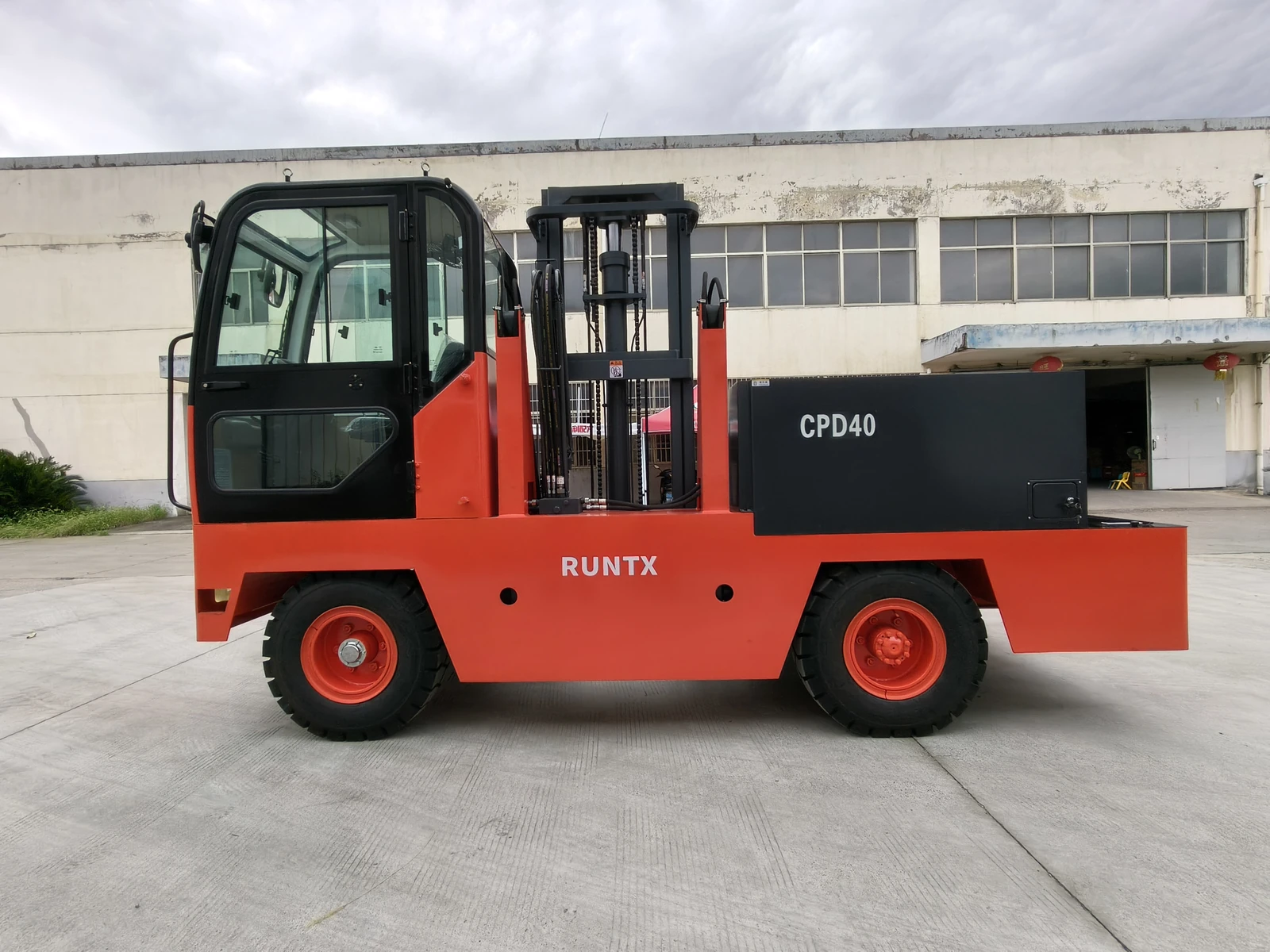
Instead of carrying the material across the direction of travel, it carries the load parallel to the truck. The forks approach the material from the side, lift it onto or alongside the truck deck, and the machine travels with the long product aligned with its direction of movement.
For steel service centers, timber yards, pipe distributors and manufacturers handling long profiles, that difference can matter more than a small difference in rated lifting capacity.
What Is a Side Loader Forklift?
A side loader is a specialized forklift designed to pick up and carry loads from the side of the truck rather than directly in front of it.
This layout is particularly useful for long products such as:
timber packs, steel bars, structural profiles, tubes, pipes, sheet bundles and other materials that are long relative to their width.
HSE’s guidance for steel and metal-stock handling specifically recommends using the appropriate truck for the job and identifies side loader trucks for long product. The same guidance notes that side loaders are widely used for loading and unloading cantilever racks and long-product stillages.
Source: UK Health and Safety Executive, HSG246 – Safety in the Storage and Handling of Steel and Other Metal Stock.
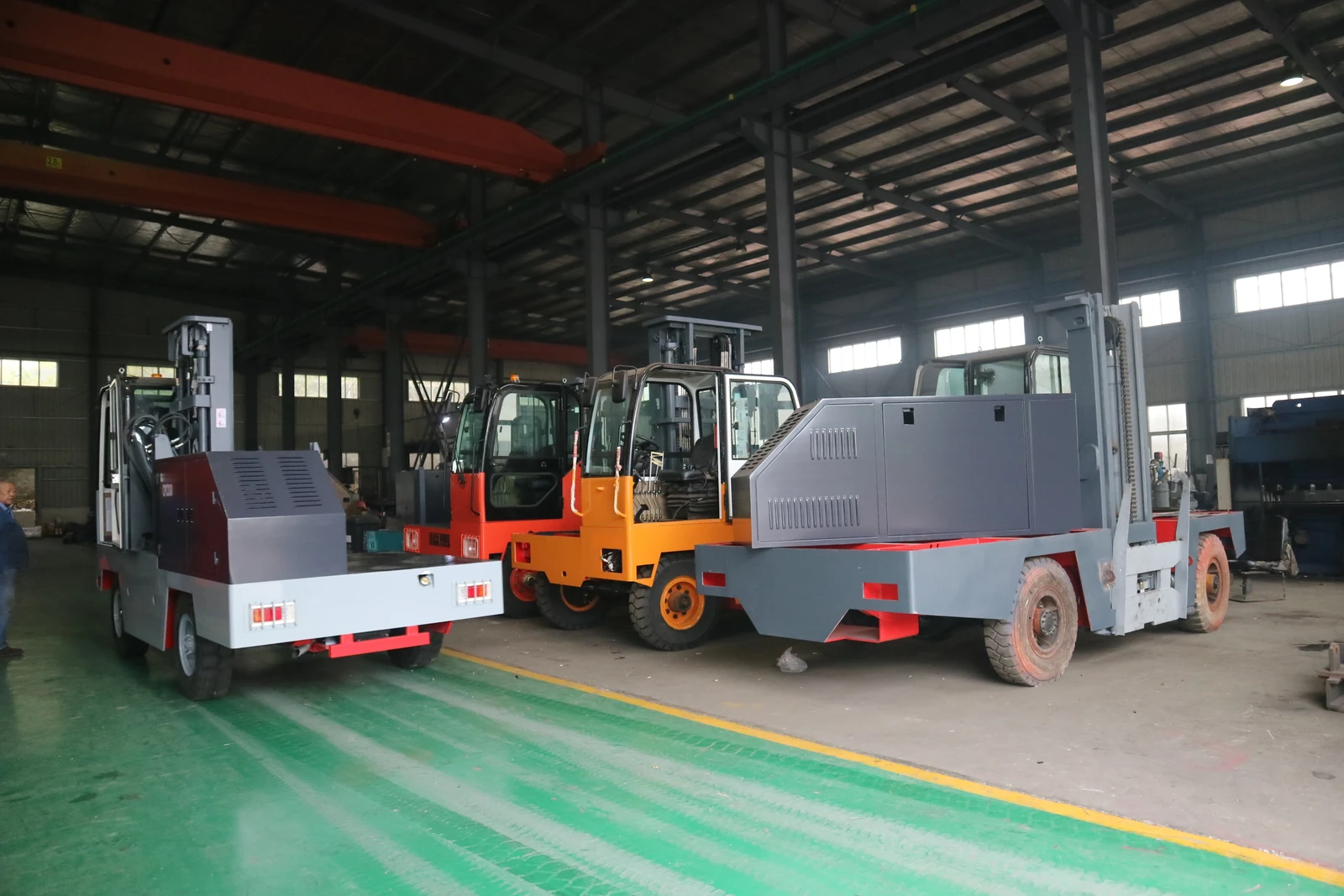
RUNTX currently offers side-loader solutions across approximately 3–12 ton capacities, including diesel and electric configurations for different indoor and outdoor long-load applications.
Why Long Loads Are Difficult for a Conventional Forklift
A normal counterbalance forklift is designed around front loading.
The forks project from the front of the machine, and the truck approaches a pallet, lifts it and reverses away.
For ordinary pallets, this layout is extremely versatile.
For a six-meter timber pack, it becomes a different problem.
When that timber is carried across the forks, the forklift may only be 1.2 or 1.5 meters wide, but the combined moving envelope is now six meters or more.
That affects:
turning space, doorway clearance, aisle width, visibility around the ends of the load and the ability to position material into long racks.
Sumitomo NACCO makes the same distinction in its side-loader guidance: when long objects are carried on a conventional forklift, aisle width generally needs to accommodate the length of the object, whereas a side loader carries the material along the side of the vehicle.
Source: Sumitomo NACCO Forklift, Side Loader Workability Guidance.
The Load Center Problem Gets Worse With Long Materials
Long-load handling is not only an aisle-space issue.
It can also change the effective load center.
OSHA explains that forklift capacity applies only at the load center shown on the data plate. When a large rectangular load is placed lengthwise on the forks, the center of gravity moves farther forward, increasing the load moment and reducing allowable lifting capacity.
One OSHA example shows a forklift capable of lifting 4,000 lb at a 24-inch load center but only about 2,666 lb at a 36-inch load center.
That is roughly a 33% reduction in allowable load simply because the center of gravity moved farther away from the truck.
Source: U.S. Occupational Safety and Health Administration (OSHA), Powered Industrial Trucks – Load Composition.
This matters when customers try to solve a long-load problem by simply fitting longer forks to a conventional truck.
Longer forks may physically support the material, but they do not automatically preserve the rated capacity.
A 60-Inch Load Can Change Capacity More Than Buyers Expect
OSHA provides another useful example.
A forklift rated for 4,500 lb at a 24-inch load center is shown handling a 60-inch-long load positioned lengthwise.
The effective load center becomes 30 inches.
To stay within the same allowable load moment, capacity has to fall from 4,500 lb to approximately:
4,500 × 24 ÷ 30 = 3,600 lb
That represents a 20% reduction.
Source: OSHA Powered Industrial Trucks – Load Composition. Field calculations are estimates; the manufacturer’s approved load chart should be used for final capacity.
This is why a buyer handling long steel or machinery components should provide both weight and dimensions when requesting a forklift recommendation.
Side Loader vs Conventional Forklift: Practical Comparison
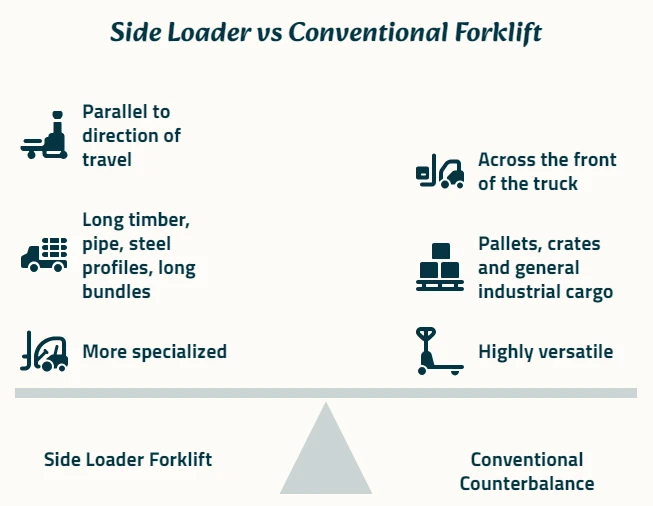
| Factor | Side Loader Forklift | Conventional Counterbalance |
|---|---|---|
| Load Direction | Parallel to direction of travel | Across the front of the truck |
| Best Load Type | Long timber, pipe, steel profiles, long bundles | Pallets, crates and general industrial cargo |
| Aisle Requirement With Long Loads | Can keep long load aligned with the aisle | Load length may determine required clearance |
| General Pallet Work | More specialized | Highly versatile |
| Cantilever Rack Work | Well suited | Possible, but space may become limiting |
| Best Buyer | Long-material specialist | Mixed general material handling |
How Much Long Material Can a Side Loader Handle?
The answer depends on the exact machine, but the application range can be substantial.
Raymond’s current side-loader guidance describes applications involving long materials approximately 8 to 26 ft in length, depending on configuration.
That is roughly 2.4 to 7.9 meters.
Source: Raymond Corporation, Side Loader Forklifts. Load length capability is model- and application-dependent and should not be treated as a universal specification.
This range gives some context for why ordinary pallet-forklift thinking can break down in timber and steel operations.
A seven-meter load carried across the front of a conventional forklift creates a very different traffic envelope from the same load carried lengthwise on a side loader.
Steel, Timber and Pipes Each Create Different Problems
Steel Profiles and Structural Sections
Steel is often both long and dense.
That means the machine must handle not only the load length but also a significant load moment.
A side loader is particularly useful where steel sections are stored on cantilever racks because the truck can travel down the aisle with the material aligned to the storage direction and approach the rack laterally.
Timber Packs
Timber may be lighter than steel per unit length, but long packs can still become difficult to maneuver through gates and storage rows.
The side-loader deck can also help support the material during travel instead of relying entirely on a long overhanging load across the forks.
Pipes and Tubes
Pipe bundles create another challenge because round material can shift if it is not properly secured.
Load stability, fork spacing and bundle restraint therefore become as important as rated tonnage.
HSE’s metal-stock guidance emphasizes using suitable equipment, controlling long stock properly and selecting side loaders where appropriate rather than making a conventional truck perform a task it was not designed around.
Long-Load Selection Rule:
If the load regularly extends several meters beyond the truck and aisle width or turning space becomes the main operating constraint, compare a side loader before simply ordering a larger conventional forklift with longer forks.
When a Conventional Forklift Is Still the Better Choice
A side loader is not automatically the better machine.
If most of the work involves standard pallets and only an occasional long load, a counterbalance forklift may remain more economical and flexible.
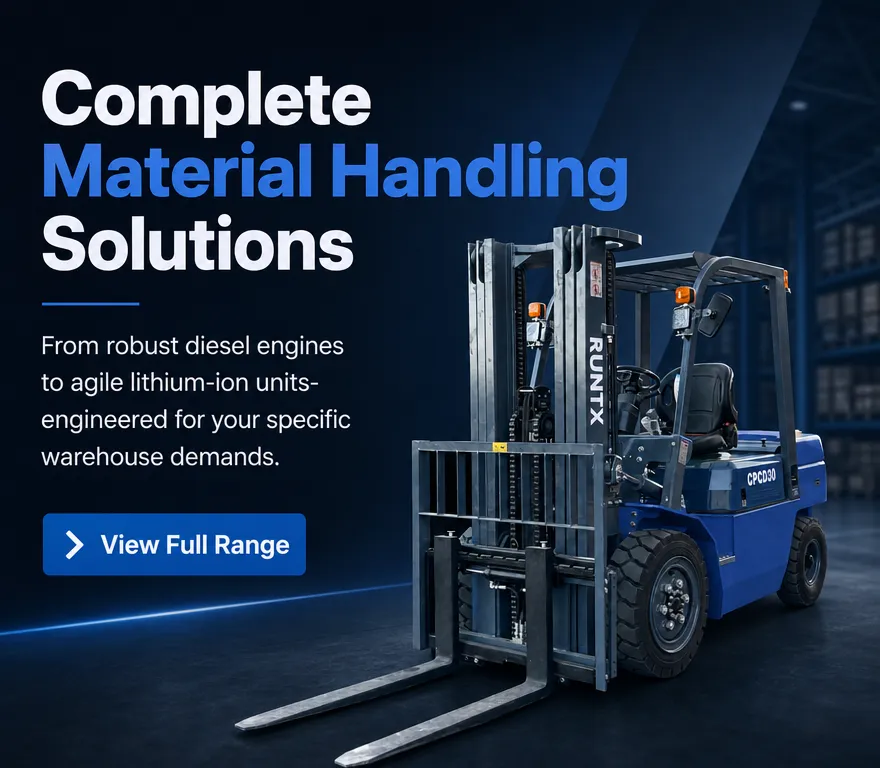
The RUNTX CPCD30 3 Ton Diesel Forklift, for example, is designed around general industrial handling with a 500 mm load center and conventional front-loading geometry.
A larger conventional forklift may also be appropriate in an open yard where there is enough room to turn and the long materials are handled only over short distances.
The key question is frequency.
If the awkward long-load maneuver happens twice a month, specialization may be difficult to justify.
If it happens fifty times every shift, the machine should probably be designed around that load.
When a Side Loader Starts to Pay for Itself
The business case usually appears when space and repeated maneuvering become expensive.
Every time an operator carrying a long load has to stop, reverse, reposition and wait for a wider traffic area, the handling process consumes additional time and interrupts nearby traffic.
A side loader does not eliminate every maneuver, but its load orientation is fundamentally better suited to long-product travel.
Baumann’s side-loader guidance describes deck widths starting around 1.95 meters for narrower applications and extending to approximately 2.5 meters or more for wider configurations. The key idea is that the long load travels along the machine rather than becoming an extremely wide moving object.
Source: Baumann Side Loader Sales Guide. Dimensions are manufacturer examples, not RUNTX specifications.
For a timber merchant or steel distributor, saving aisle width may be more valuable than saving a small amount on the initial forklift purchase.
RUNTX Side Loader Options for Long-Load Operations
RUNTX’s current side-loader range is positioned around long and bulky material handling, with approximately 3–12 ton capacity options.
Diesel configurations are suited to demanding outdoor timber yards, steel logistics and industrial sites, while electric side-loader solutions can be considered for indoor facilities where local emissions and operating noise are more important.
RUNTX also offers specialized four-way configurations where required, allowing the machine to travel in more than one direction for tighter material positioning.
Buyers can review the broader RUNTX Side Loader & Material Handling Range or send the engineering team the exact long-load dimensions for a model recommendation.
For suitable projects, RUNTX supports 1 Unit MOQ as well as small-batch, distributor and OEM/ODM orders. Custom requirements can include power type, forks, mast configuration, body color, branding and other application-specific details.
Handling Steel, Timber or Pipes?
Send RUNTX the maximum load weight, total load length, load width, storage method, aisle width and required lift height. We can compare a side loader with a conventional counterbalance forklift before you commit to the equipment.
Frequently Asked Questions
What is a side loader forklift used for?
A side loader is primarily used for long materials such as timber, steel profiles, tubes, pipes and long industrial bundles. It carries the material parallel to the truck’s direction of travel instead of across the front.
Is a side loader better for timber?
It often is when timber packs are long and must travel through storage aisles or be placed onto cantilever racks. A conventional forklift can still work in open yards with sufficient maneuvering space.
Can a normal forklift carry long steel?
Yes, but the actual capacity, load center, fork length and traffic space need to be checked. Long steel carried across the forks can significantly increase the required clearance and may change the effective load center.
Why is a side loader easier to use in narrow aisles with long loads?
Because the load travels lengthwise along the truck rather than perpendicular to it. The aisle does not need to accommodate the full long-load span in the same way as a conventional forklift carrying the material across its forks.
Does a longer load reduce forklift capacity?
It can. If the longer load moves the center of gravity farther away from the fork face, the effective load center increases and allowable lifting capacity decreases. Always check the manufacturer’s approved load chart.
Should I buy a side loader or a conventional forklift?
Choose a conventional forklift when most work involves pallets and mixed general cargo. Consider a side loader when long steel, timber, pipes or profiles are a regular part of the operation and maneuvering space is a recurring problem.
The Best Forklift Is the One Designed Around the Load
A side loader and a conventional counterbalance forklift solve different problems.
The counterbalance forklift remains one of the most versatile machines in material handling. For pallets, crates, truck loading and mixed warehouse work, it is difficult to beat.
But long materials change the geometry of the job.
Once a steel beam, timber pack or pipe bundle becomes the widest object moving through the facility, the normal front-loading layout can start working against the operator.
A side loader solves that problem by turning the load through 90 degrees relative to a conventional forklift and carrying it along the direction of travel.
That is why the decision should not begin with:
“Which forklift is better?”
It should begin with:
“How long is the material, and where does it need to travel?”
Need a Forklift for Long Steel, Timber or Pipes?
Send RUNTX your load weight, total length, storage layout, aisle width and working environment. We can compare side-loader and conventional forklift configurations and prepare a factory-direct proposal for a single machine or fleet.