How much can a large diesel forklift really lift? Explore heavy-duty forklift capacity, load centers, attachments, stability, operating space and the factors that determine whether a high-capacity truck is right for your business.
Moving a three-ton pallet is one thing. Moving steel coils, machinery, stone blocks, industrial molds or oversized cargo weighing 15, 20 or even 30+ tons is a completely different engineering problem.
For contractors, equipment rental companies, manufacturers and smaller industrial businesses, the challenge is not simply finding the largest diesel forklift available. A machine that is too small creates safety and productivity problems, while an oversized forklift can leave you paying for extra fuel, transport space and capital that your operation does not actually need.
The real question is:
This guide explains what changes when you move from a conventional 5–6 ton forklift into the world of heavy-duty diesel forklifts, and what smaller buyers should check before making a high-value equipment investment.
.webp)
1. What Counts as a Large Diesel Forklift?
There is no single universal definition, but in practical industrial purchasing, forklifts above the common 2–5 ton class are generally treated as increasingly specialized machines. Once capacities enter the 10–16 ton range and beyond, chassis size, mast structure, counterweight, axle loading, hydraulic capacity, cooling and braking systems become significantly more important.
A 6 ton diesel forklift, for example, may still be suitable for general industrial yards, building-material operations and logistics work. A 16 ton heavy-duty diesel forklift moves into applications such as steel handling, machinery manufacturing, ports, mining support and heavy industrial logistics.
At still higher capacities, such as 20 ton and 50 ton heavy-duty forklifts, machine selection becomes much more application-specific.
2. Rated Capacity Is Only the Beginning
The number written on the side of a forklift does not mean that the truck can safely lift that weight under every possible condition.
Rated capacity is tied to a specified load center, mast configuration and lift condition. When the load becomes longer, an attachment moves the load farther forward, or the required lift height increases, the residual capacity can change.
OSHA gives a useful real-world example: a forklift rated for 5,000 lb at a 24-inch load center is shown with a sideshifter attachment at a rated capacity of 4,500 lb. That is a 10% reduction in that specific configuration.
Source: U.S. Occupational Safety and Health Administration (OSHA), Powered Industrial Trucks – Nameplate and Attachment Guidance.
3. Why Heavy-Duty Forklifts Need More Than a Bigger Counterweight
Increasing forklift capacity requires the entire machine to manage higher forces. The mast, carriage, forks, chassis, steering axle, drive axle, tires, hydraulic cylinders and counterweight all work together.
Reinforced structural components
Heavy cargo creates substantial bending and torsional forces. This is why large industrial forklifts use more substantial frame and mast structures rather than simply adding weight at the rear.
Higher-capacity hydraulics
A heavy load requires hydraulic components capable of generating controlled lifting force without making operation unnecessarily abrupt. For the owner, smooth hydraulic control matters because it helps the operator position expensive machinery, steel or fabricated components more accurately.
Cooling and drivetrain durability
Heavy-duty work often involves repeated loaded travel, low-speed maneuvering and continuous hydraulic demand. Adequate engine and transmission cooling therefore becomes particularly important in hot ports, steel yards, mines and construction-material facilities.
For a small business with only one heavy forklift, this matters even more: when your only machine is down, there may be no backup truck available.
.webp)
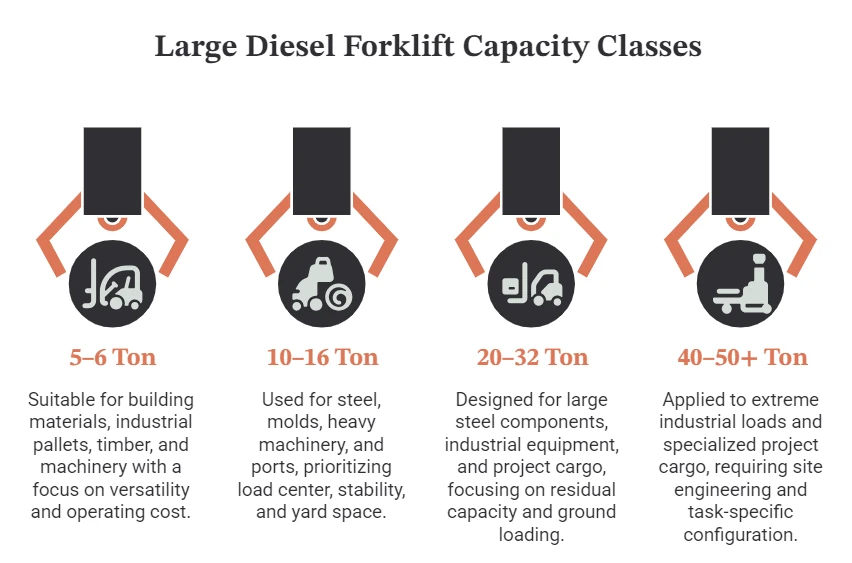
4. Large Diesel Forklift Comparison: What Changes as Capacity Increases?
| Capacity Class | Typical Applications | Main Buying Concern | Best Fit |
|---|---|---|---|
| 5–6 Ton | Building materials, industrial pallets, timber, machinery | Versatility and operating cost | Small factories, contractors, rental fleets |
| 10–16 Ton | Steel, molds, heavy machinery, ports | Load center, stability and yard space | Heavy manufacturing and logistics |
| 20–32 Ton | Large steel components, industrial equipment, project cargo | Residual capacity and ground loading | Ports, fabrication plants, energy projects |
| 40–50+ Ton | Extreme industrial loads and specialized project cargo | Site engineering, transport and task-specific configuration | Specialized heavy industry |
The lesson is straightforward: bigger is not automatically better. A 20 ton truck operating at low utilization can be a poorer investment than a correctly specified 16 ton machine working productively every day.
5. Turning Radius and Yard Space Become Major Cost Factors
Large forklifts need room. As counterweight size, wheelbase and overall dimensions increase, maneuverability changes significantly.
This is easy to underestimate when buying from a brochure. Before ordering, measure gate widths, aisle widths, loading areas, turning zones and trailer access points.
A high-capacity forklift that requires repeated three-point maneuvering may reduce productivity even though it has more than enough lifting capacity.
For rental companies and contractors, transport should also be considered. Machine width, operating weight and overall height affect how easily the forklift can be moved between jobsites and what transport equipment may be required.
6. Heavy Lifting Makes Safety Engineering More Important, Not Less
The consequences of a mistake increase as the load becomes heavier.
The UK Health and Safety Executive reports that lift trucks are involved in approximately one-quarter of workplace transport accidents. HSE separately reports that vehicle overturns account for nearly one-fifth of workplace transport deaths.
Source: UK Health and Safety Executive (HSE), Managing Lift Trucks and Workplace Transport Overturning Guidance.
Recent U.S. data reinforces the point. OSHA reported that 84 workers were killed in incidents involving forklifts and other powered industrial trucks in 2024.
Source: U.S. Occupational Safety and Health Administration, National Forklift Safety Day Remarks, June 2026; underlying data from the U.S. Bureau of Labor Statistics.
For buyers, safety should therefore be treated as an operating-cost issue as well as a compliance issue. Proper braking, operator visibility, seat restraints, tires, capacity plates and attachment matching all deserve attention.
BLS data also shows the potential downtime impact: forklift-related cases resulting in days away from work had a median of 13 days away from work in 2017, compared with eight days across all cases.
Source: U.S. Bureau of Labor Statistics, Occupational Injuries, Illnesses, and Fatalities Involving Forklifts.
7. When Does a Large Diesel Forklift Make Financial Sense?
A heavy-duty forklift should earn its keep by eliminating inefficient handling steps, reducing dependence on outsourced lifting or allowing your business to accept work that your current equipment cannot perform.
For a smaller company, calculate the investment around actual working hours rather than maximum theoretical capacity.
- How many heavy lifts will the machine perform per week?
- Are you currently renting heavy equipment for these jobs?
- Can one forklift replace repeated crane or subcontracted handling for certain tasks?
- Will the machine create new rental or project opportunities?
- How much revenue is lost when your existing forklift cannot handle a load?
If heavy lifts are occasional, buying the largest possible machine may not generate an acceptable return. If they occur every day, however, owning a correctly specified heavy-duty forklift can remove a major operational bottleneck.
Not Sure Whether You Need 16, 20 or 30+ Tons?
Send RUNTX your load weight, dimensions, required lift height, attachment and working environment. Our team can help identify a suitable heavy-duty configuration before you pay for capacity you do not need.
8. Why Factory-Direct Sourcing Can Help Smaller Heavy-Equipment Buyers
Large forklifts are often highly configuration-sensitive. This makes direct communication with the manufacturer particularly valuable.
As a source manufacturer, RUNTX can discuss mast configuration, forks, attachments, tires, engine and emission requirements, paint and OEM/private-label options according to the customer’s application.
For smaller contractors, factories and independent buyers, procurement flexibility is equally important. RUNTX supports 1 Unit MOQ for suitable orders, allowing a customer to request factory-direct pricing without committing to a large fleet purchase.
Dealers and rental companies purchasing several machines can instead request small-batch wholesale terms and OEM/ODM support.
International buyers can also receive assistance with export documentation and shipping coordination—particularly useful for first-time importers concerned about container loading, port handling, customs paperwork and destination logistics.
.webp)
Frequently Asked Questions
What is considered a heavy-duty forklift?
In commercial use, the term normally refers to forklifts built for loads significantly heavier than standard warehouse trucks. Machines in the 10 ton, 16 ton, 20 ton and higher capacity classes are commonly used for steel, machinery, ports, mining and other heavy-industrial applications.
Can a 16 ton forklift always lift 16 tons?
No. Rated capacity applies under specified conditions. Actual permissible capacity can change with load center, lift height, fork length and attachments. Always request capacity information for the final configuration.
Is diesel still suitable for large forklifts?
Diesel remains widely used for heavy outdoor material handling because it provides strong continuous power and practical refueling for demanding duty cycles. Local emission rules and indoor-use restrictions should still be checked before purchasing.
Should I buy a larger forklift than I currently need?
A modest reserve can be useful, but excessive oversizing increases acquisition cost and may increase machine dimensions and transport requirements. Select capacity using your heaviest regular load and its actual load center rather than buying the largest model available.
Can I order only one heavy-duty RUNTX forklift?
Yes. RUNTX supports single-unit purchasing for suitable configurations, while distributors and rental fleets can request small-batch wholesale pricing.
Final Verdict: Extreme Lifting Is Really About Correct Engineering
The capability of a large diesel forklift is not defined by one impressive capacity number.
A dependable heavy-lift solution combines the correct rated capacity with the right load center, residual capacity, mast, forks, attachment, chassis stability, tires and operating environment.
For small contractors and independent equipment owners, that disciplined approach matters because there is less room for an expensive purchasing mistake. Buy enough capacity for the job—but make sure every extra ton serves a real business purpose.
Need a Heavy-Duty Forklift for Your Actual Load?
Buying one machine? Get single-unit factory-direct pricing. Building a rental or distribution fleet? Ask for small-batch wholesale terms. Send us your load weight, dimensions, lift height, attachment requirements and destination, and we can help you compare suitable configurations.
“`